
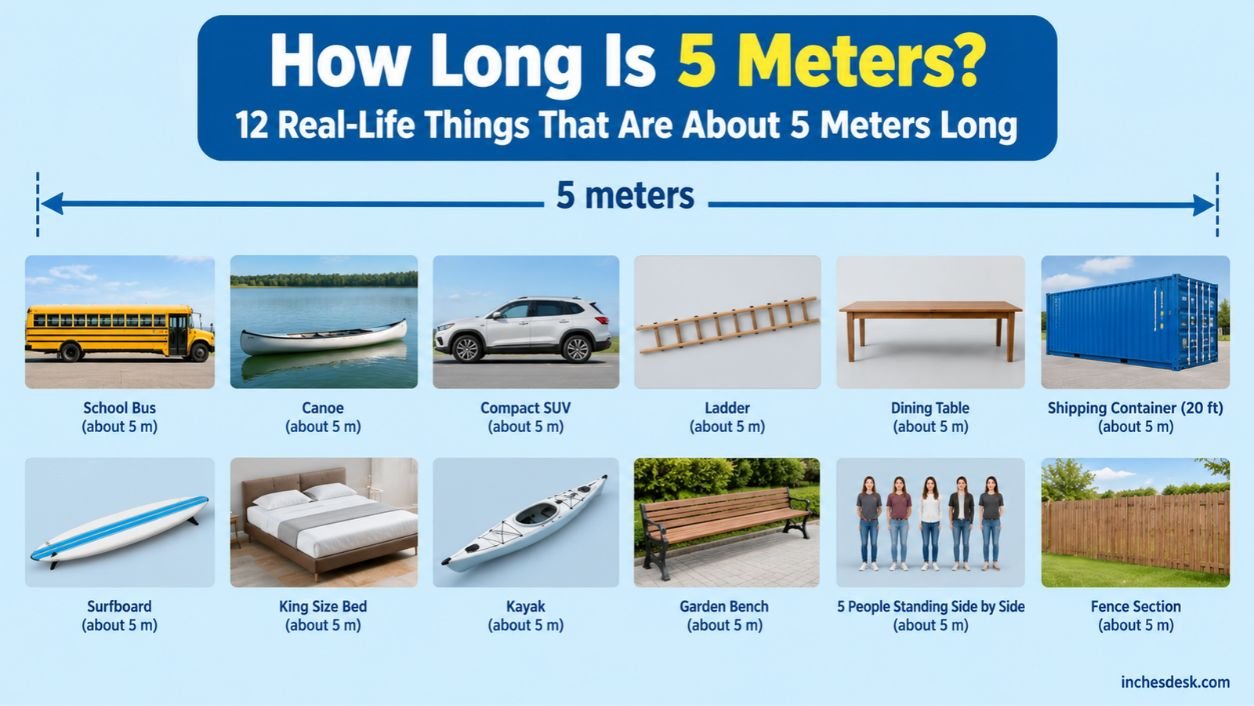
Five meters is a length of 500 centimeters, approximately 16.4 feet or 196.85 inches. It is long enough to span a large vehicle, cover a significant portion of a room, or match the length of certain large animals. Understanding how long 5 meters is becomes easier when you compare it with familiar objects, buildings, sports equipment, and everyday spaces.
Whether you are measuring a room, planning a DIY project, checking product dimensions, or trying to visualize a distance without a measuring tape, real-life comparisons can help you develop a better sense of this measurement. In this guide, you will learn the exact conversions for 5 meters, compare it with human height, and explore 12 examples that help make this length easier to picture.
How Long Is 5 Meters?
5 meters is exactly 500 centimeters, approximately 16 feet 4.85 inches, or 5.47 yards. It is a little longer than a typical full-size pickup truck’s overall length range midpoint and considerably taller than an average adult if you imagine the distance vertically. This measurement is useful for estimating room dimensions, vehicle lengths, outdoor spaces, and other large objects.
A useful way to visualize 5 meters is to picture a straight line stretching across a medium-sized room or along the length of a large vehicle. You could also imagine five 1-meter-long segments placed end to end.
For a practical example, if you are arranging furniture in a room that measures 5 meters across, that distance equals 500 cm. Knowing this conversion helps you compare furniture dimensions, estimate available floor space, and determine whether a large item will fit.
Keep in mind that 5 meters is a precise measurement, while real-world comparisons are estimates. The dimensions of vehicles, animals, ladders, and other objects vary by model, species, age, and design.
5 Meters in Feet, Inches, CM and Yards
To convert 5 meters into another unit, multiply the meter value by the appropriate conversion factor. For feet, multiply by approximately 3.28084; for inches, multiply by approximately 39.3701; and for centimeters, multiply by 100. These calculations provide an accurate way to compare metric measurements with the imperial units commonly used for construction, shopping, and everyday measuring.
The following table shows how 5 meters converts into several commonly used units.
| Measurement Unit | Equivalent of 5 Meters |
|---|---|
| Meters | 5 m |
| Kilometers | 0.005 km |
| Centimeters | 500 cm |
| Millimeters | 5,000 mm |
| Micrometers | 5,000,000 µm |
| Feet | 16.4042 ft |
| Feet and inches | 16 ft 4.85 in |
| Inches | 196.8504 in |
| Yards | 5.4681 yd |
| Miles | 0.00311 mi |
How to Calculate 5 Meters in Different Units
You can calculate these conversions yourself using the following formulas.
1. Meters to feet
Multiply the number of meters by 3.28084.
5 × 3.28084 = 16.4042 feet
Therefore, 5 meters is approximately 16.4 feet.
2. Meters to inches
Multiply the number of meters by 39.3701.
5 × 39.3701 = 196.8505 inches
Therefore, 5 meters is approximately 196.85 inches.
3. Meters to centimeters
Multiply the number of meters by 100.
5 × 100 = 500 centimeters
Therefore, 5 meters equals exactly 500 centimeters.
4. Meters to millimeters
Multiply the number of meters by 1,000.
5 × 1,000 = 5,000 millimeters
Therefore, 5 meters equals exactly 5,000 millimeters.
5. Meters to yards
Multiply the number of meters by approximately 1.09361.
5 × 1.09361 = 5.46805 yards
Therefore, 5 meters is approximately 5.47 yards.
Why These Conversions Are Useful
Knowing these conversions can make everyday measuring tasks easier. If a product listing gives a length of 5 meters, converting it to feet or inches helps you understand how much space it will occupy. This is especially useful when buying cables, ropes, pipes, curtains, or other materials sold in metric measurements.
For construction and home improvement, centimeters and millimeters are useful when you need more precise dimensions. For example, 500 cm may be convenient when planning a room layout, while 5,000 mm can be useful when working with technical drawings or metric building materials.
For quick mental estimates, remember that 5 meters is about 16.4 feet or 197 inches. These rounded figures are easy to remember and are generally sufficient for visual comparisons. However, use the exact conversion when accuracy matters, particularly when cutting materials, installing fixtures, or checking whether an item will fit into a specific space.
How Big Is 5 Meters Compared to a Human?
Five meters is much longer than an average adult is tall. An adult measuring 1.7 meters (about 5 feet 7 inches) would need to stand nearly three times their height to match a 5-meter distance. This comparison makes it easier to visualize the measurement, whether you imagine it vertically from the ground or horizontally across a room.
For a clearer comparison, consider these approximate adult heights:
| Human Height | Height in Meters | How It Compares to 5 Meters |
|---|---|---|
| Short adult | 1.5 m | 5 meters is about 3.3 times taller |
| Average-height adult | 1.7 m | 5 meters is about 2.9 times taller |
| Tall adult | 1.9 m | 5 meters is about 2.6 times taller |
| Very tall adult | 2.0 m | 5 meters is 2.5 times taller |
Imagine three adults, each approximately 1.67 meters tall, standing one on top of another. Their combined height would be almost exactly 5 meters. Although this is only a mental visualization, it provides a useful reference for understanding how substantial this length is.
You can also compare 5 meters with a person lying down. An adult who is around 1.7 meters tall would occupy roughly one-third of the distance. You would need almost three such body lengths placed end to end to cover 5 meters.
Visualizing 5 Meters in a Room
In a home or workplace, a 5-meter distance can span much of a living room, garage, or open office. If you mark a starting point on the floor and walk toward a point 5 meters away, you will cover a distance equivalent to nearly three average adult heights.
Remember that height and length describe different directions, but the measurement remains the same. A 5-meter-tall structure and a 5-meter-long object have the same measured dimension, even though one extends vertically and the other horizontally.
This human-height comparison is particularly useful when estimating spaces before moving furniture, arranging equipment, or planning a small DIY project. It gives you a practical starting point, but use a measuring tape or laser distance meter whenever precise dimensions are required.
12 Common Things That Are About 5 Meters Long
1. Saltwater Crocodile (Adult Male)

Adult male saltwater crocodiles are among the largest living reptiles, and exceptionally large individuals can reach around 5 meters in length or more. Their long bodies, powerful tails, and broad heads make them useful examples of how substantial a 5-meter measurement can be.
A 5-meter crocodile measures approximately 16 feet 5 inches from the tip of its snout to the end of its tail. That is longer than many family cars and enough to stretch across a large section of a living room.
However, not every adult male saltwater crocodile reaches this size. Many are shorter, so 5 meters is best understood as a large individual’s approximate length rather than the standard size of every adult male.
2. Tiger Shark
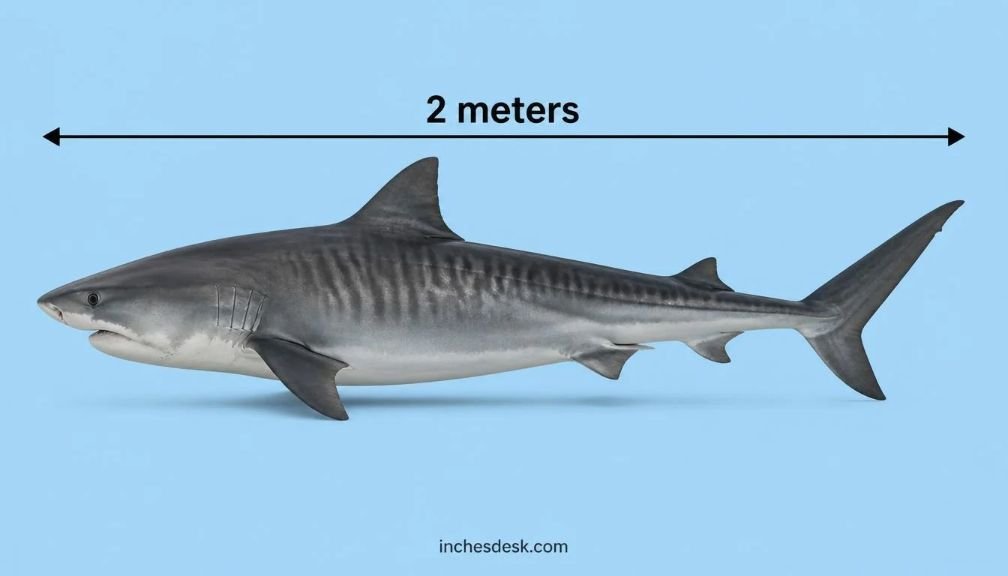
A large tiger shark can provide another real-life comparison for 5 meters. Tiger sharks are powerful marine predators with broad bodies, long tails, and distinctive dark markings that often become less noticeable as they mature.
Large tiger sharks can approach 5 meters in length, although many individuals measure less. Their length is generally measured from the snout to the end of the tail, making the full body a useful reference for understanding this distance.
Imagine a large tiger shark laid out in a straight line. Its nose-to-tail length could span roughly 500 centimeters, giving you a sense of the space required to accommodate a very large marine animal.
Because shark size varies with age, sex, and individual growth, 5 meters should be treated as an approximate comparison rather than the typical length of every tiger shark.
3. Female Orca
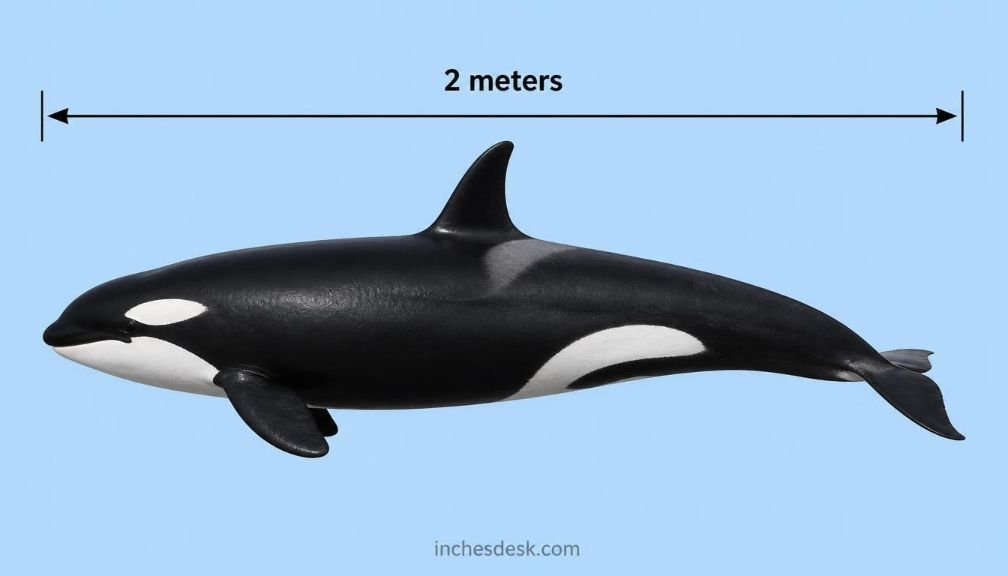
A female orca, also known as a killer whale, can be another helpful example of a large animal measuring around 5 meters. Orcas have streamlined bodies, prominent dorsal fins, and powerful tails that help them travel efficiently through the water.
Female orcas commonly grow longer than 5 meters, with adult lengths varying by population and individual. A length of 5 meters therefore represents a useful comparison for a younger or smaller individual rather than a universal adult female size.
At 5 meters, an orca would measure approximately 16.4 feet from the front of its head to the end of its tail. This is longer than many vehicles and considerably longer than a typical adult human is tall.
The comparison also highlights why measuring a large animal requires a clear definition of its overall length. The usual measurement runs from the front of the body to the tail tip, not simply the length of its head or torso.
4. Reticulated Python
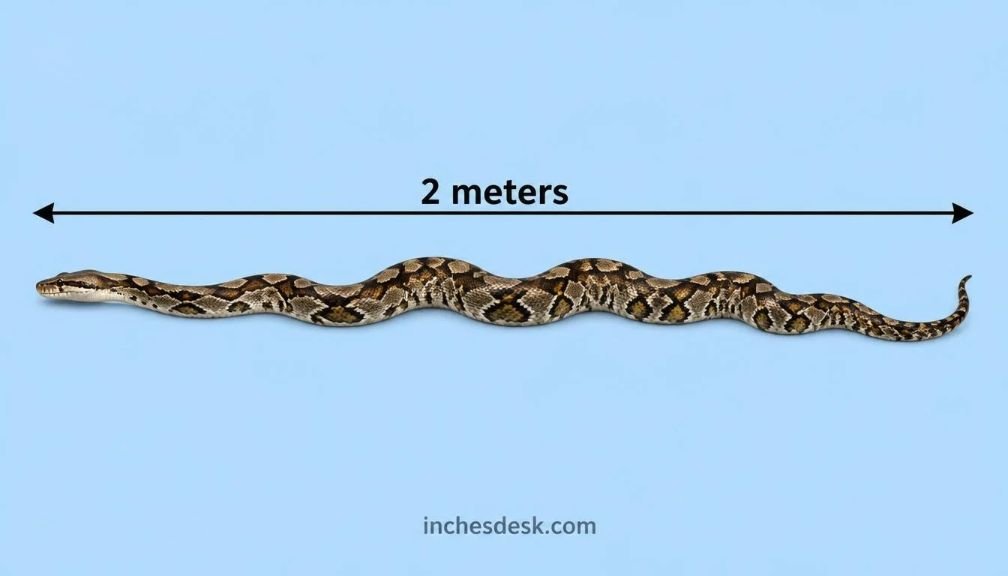
The reticulated python is one of the world’s longest snake species. Its long, narrow body can stretch across several meters, making it an interesting example for visualizing a 5-meter distance.
A reticulated python measuring 5 meters is approximately 16 feet 5 inches long. If stretched out in a straight line, its body would cover the same distance as five 1-meter segments placed end to end.
Some reticulated pythons grow longer than 5 meters, while others remain considerably shorter. Their size depends on factors such as age, sex, health, and available food.
Unlike a vehicle or rigid pole, a snake’s body bends and curves. If a 5-meter python coils up, it may occupy a relatively small area even though its body is 5 meters long. This is a useful reminder that an object’s length does not necessarily indicate how much floor space it occupies.
5. Full-Size Pickup Truck
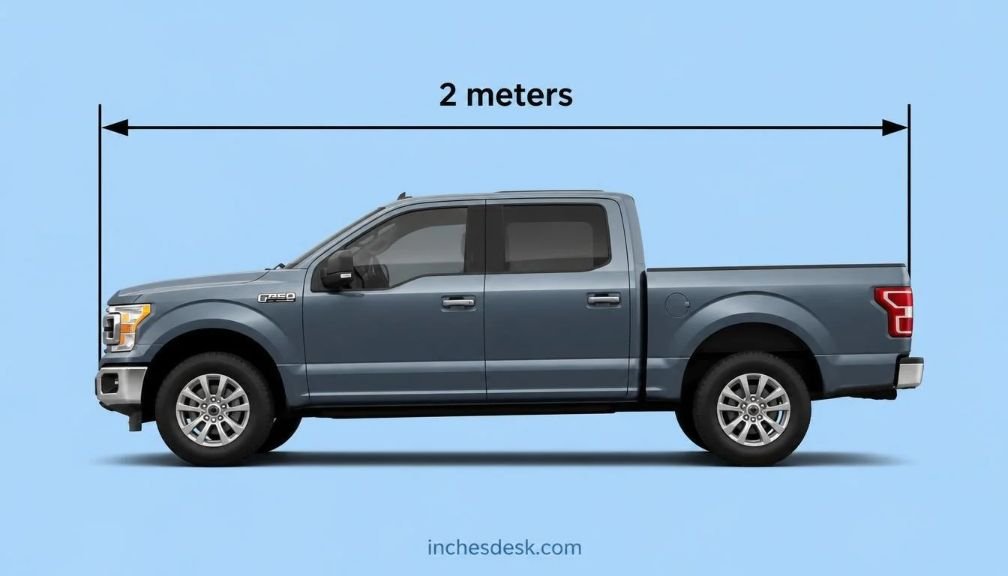
A full-size pickup truck is one of the most practical everyday comparisons for 5 meters. Many full-size pickups measure roughly 5 to 6.5 meters long, depending on the manufacturer, cab configuration, bed length, and model year.
A pickup measuring exactly 5 meters would be approximately 196.85 inches long, measured from the front bumper to the rear bumper. This makes it a useful reference when estimating parking spaces, garage dimensions, or the amount of room required to turn or maneuver a vehicle.
For example, imagine parking a large pickup inside a garage that measures 5 meters from front to back. A truck that is also 5 meters long would use virtually the entire available length, leaving no practical clearance for the bumpers, doors, or walking space.
Not every pickup is 5 meters long. Before purchasing a vehicle or planning a garage, check the manufacturer’s published overall-length specification rather than relying on this general comparison.
6. Travel Caravan (Compact)
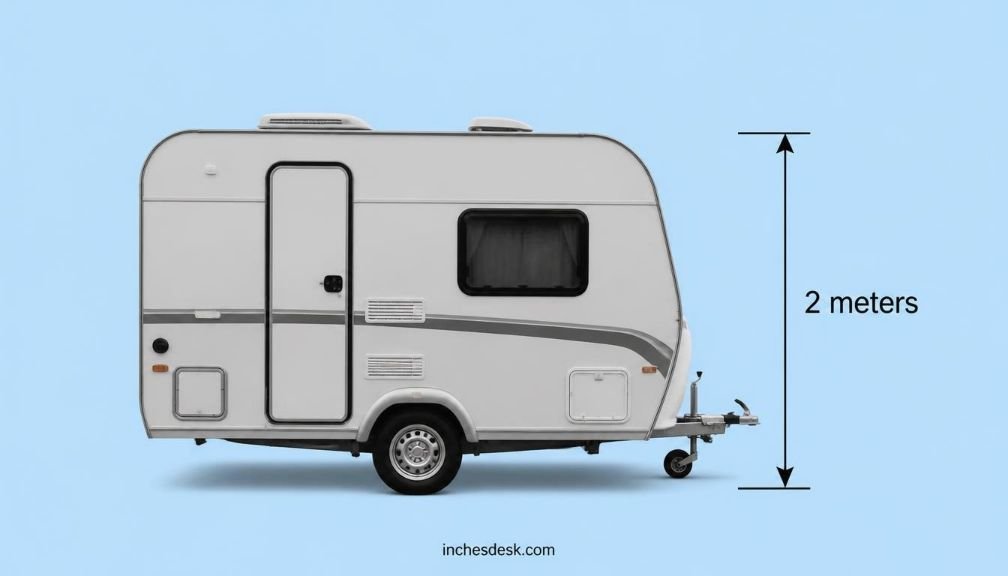
A compact travel caravan can help you picture a length close to 5 meters, particularly when comparing camping equipment or planning storage space. Caravan dimensions vary considerably, and some compact models have overall lengths near this measurement.
A caravan with an overall length of 5 meters would extend approximately 16 feet 5 inches from one end to the other. Depending on the manufacturer, the stated length may include the drawbar or hitch, so it is important to check which measurement is being used.
This comparison is useful when planning a campsite, driveway, storage area, or towing arrangement. A caravan that measures 5 meters long may need additional space for its towing vehicle and room to maneuver.
Keep in mind that the living compartment may be shorter than the overall caravan length. Always distinguish between the body length and the total length when checking specifications.
7. Pole Vault Pole

A pole vault pole is a long piece of sports equipment used by athletes to propel themselves over a high bar. These poles are made from flexible materials, commonly fiberglass or carbon-fiber composites, and bend under the athlete’s weight during a jump.
A pole measuring 5 meters is exactly 500 centimeters long, making it a straightforward example of this measurement. Pole vault poles come in different lengths and stiffness ratings to suit an athlete’s body weight, strength, and technique.
A 5-meter pole is not necessarily the right size for every vaulter. Athletes use equipment selected for their individual needs, and the length of the pole does not determine the height they can clear on its own.
Unlike a rigid measuring rod, a pole vault pole bends significantly during use. Its length remains the same even when its shape changes, illustrating the difference between an object’s measured length and the space it occupies while being used.
8. Extension Ladder (Fully Extended)
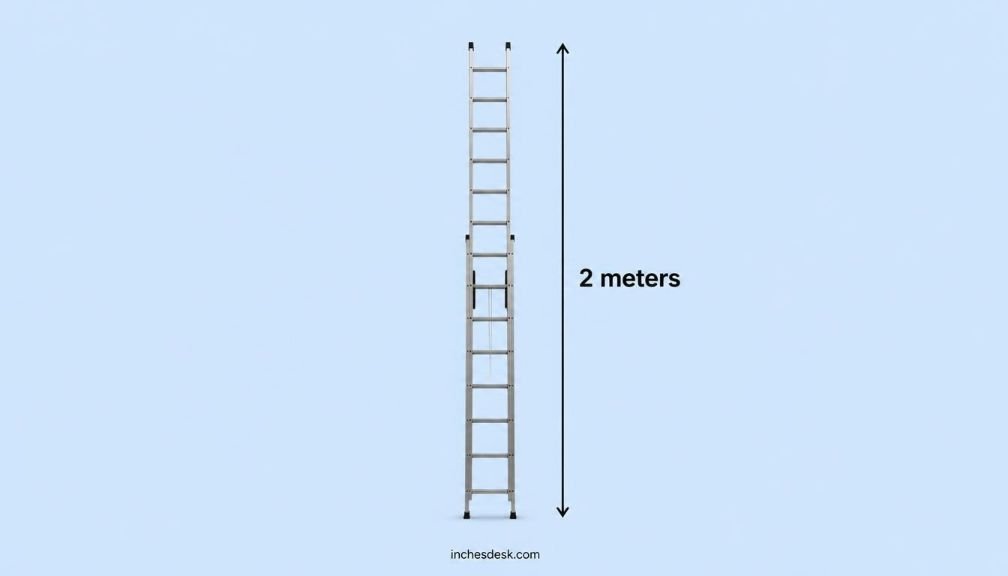
An extension ladder can provide a helpful comparison for 5 meters, particularly for home maintenance and construction work. Some extension ladders can reach approximately this length or extend considerably farther, depending on their design and model.
A ladder with a total extended length of 5 meters measures 16.4 feet along its rails. However, this does not mean it can safely reach a vertical height of 5 meters when positioned for use. The ladder must lean against a support at an appropriate angle, and its working reach depends on the ladder’s setup and the user’s height.
For example, a ladder advertised with a maximum extended length of 5 meters may have a lower safe working height because part of the ladder remains below the point where it rests against a wall.
When buying or using an extension ladder, check its maximum extension, overlap requirements, load rating, and manufacturer’s safety instructions. Never extend a ladder beyond its designated limit simply to reach a particular height.
9. 5-Meter Diving Platform
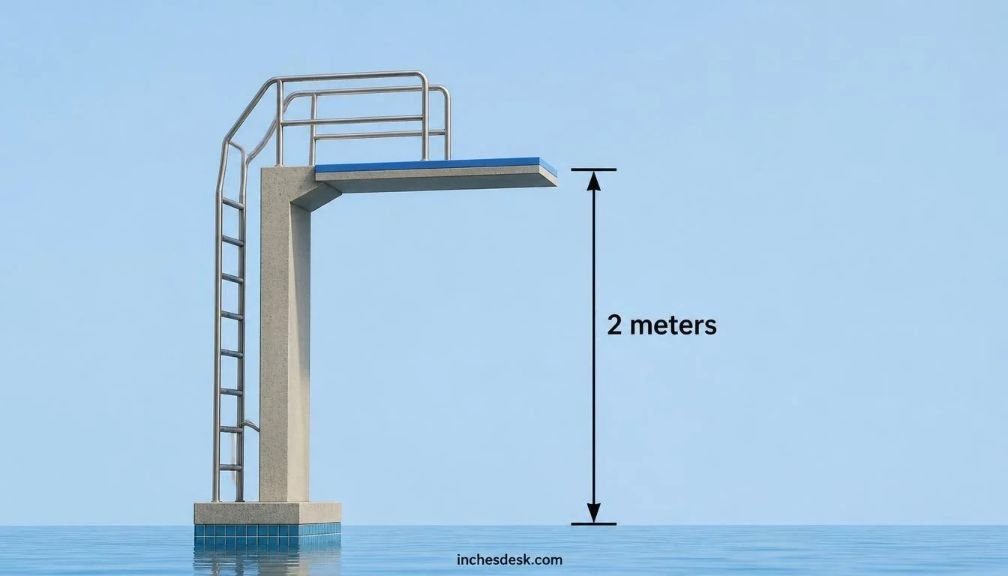
A diving platform offers a familiar sports-related way to imagine a vertical measurement of 5 meters. A platform positioned 5 meters above the water would stand approximately 16 feet 5 inches above the water surface.
This height is useful for visualizing the distance between a raised platform and the ground or water below it. Compared with an adult who stands 1.7 meters tall, a 5-meter platform is almost three times that person’s height.
However, platform heights vary by facility and competition type. A 5-meter platform is not the standard platform height for every form of competitive diving; common recognized platform heights include 5 meters, 7.5 meters, and 10 meters in relevant diving settings.
This example also demonstrates how orientation affects perception. Five meters measured vertically can feel more dramatic than the same distance measured horizontally along a floor because the height creates a more obvious sense of elevation.
10. Two-Storey House Wall Height
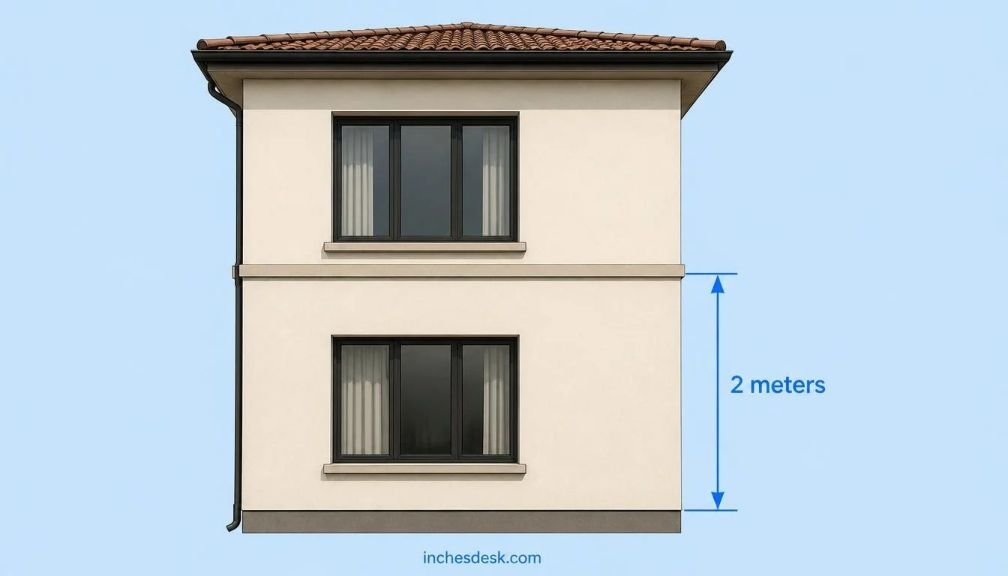
The wall height of a two-storey house can help you visualize 5 meters vertically, although the exact dimensions depend on the building design. Two storeys together may reach around this height when measured from the ground floor to the upper floor or across selected wall sections, but the total exterior height can be greater.
A 5-meter vertical distance equals 500 centimeters or approximately 16 feet 5 inches. This is a substantial height for a residential space and can help when estimating exterior wall dimensions, planning scaffolding, or visualizing a building elevation.
It is important to distinguish between wall height, floor-to-floor height, and the total height of a house. Ceiling heights, floor structures, roof design, and foundations all affect the final measurement.
For a practical example, if a drawing shows a wall section measuring 5 meters, converting it to approximately 16.4 feet helps you interpret the dimension if you are more familiar with imperial units. For actual building work, rely on architectural plans and measured site dimensions rather than a general comparison.
11. Macedonian Sarissa
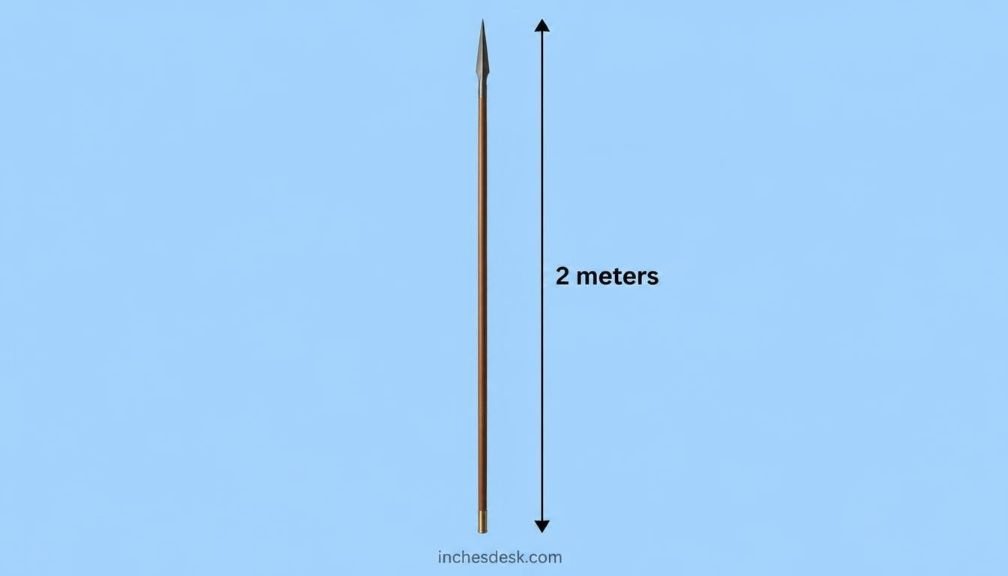
The Macedonian sarissa was a long pike used by infantry soldiers in ancient Macedonian armies. It became particularly associated with the Macedonian phalanx, whose soldiers carried long weapons designed to project beyond the front ranks.
Sarissas varied in length, and many historical descriptions place them well beyond 5 meters. A 5-meter shaft therefore provides a useful scale comparison, but it should not be treated as the exact standard length of every sarissa.
At 5 meters, a straight pike would extend approximately 16 feet 5 inches from end to end. This length would be difficult to maneuver in a confined room, illustrating why long weapons required specific formations and coordinated movement.
The sarissa is an example of how long objects can serve specialized purposes. Its length helped shape ancient battlefield tactics, just as the dimensions of modern equipment influence how it is handled and used.
12. Standard Scaffold Tube

Scaffold tubes are widely used in construction to create temporary working platforms around buildings and other structures. Common scaffold tube systems use standard tube lengths, including lengths close to 5 meters, although available sizes depend on the supplier and scaffolding system.
A scaffold tube measuring 5 meters is exactly 5,000 millimeters long. This makes it a particularly useful comparison for builders, tradespeople, and DIY enthusiasts who regularly work with metric dimensions.
For example, a 5-meter tube can span a substantial section of a scaffold structure, depending on the design and approved arrangement. The actual span, however, must follow the system’s engineering requirements and load limits rather than the tube’s length alone.
Scaffold tubes are also useful for understanding the difference between nominal and actual measurements. When purchasing materials, check the supplier’s specified length, diameter, wall thickness, and applicable standards.
5 Meters in Sports and Everyday Standards
Five meters is a useful reference measurement in sports, construction, and everyday activities. It can describe the length of equipment, the distance between two points, or the dimensions of a space. Understanding how 5 meters appears in different settings makes it easier to estimate distances and interpret measurements when working with metric units.
In sports, meters are commonly used to specify distances, heights, and equipment dimensions. A 5-meter distance is short enough to visualize across a playing area but long enough to make a noticeable difference in positioning, spacing, and movement.
Here are several examples of how 5 meters relates to sports and everyday standards.
| Application | How 5 Meters Relates |
|---|---|
| Swimming pools | A 5-meter section represents a small portion of a standard 25-meter or 50-meter pool. |
| Diving facilities | A 5-meter platform is a recognized diving height used in some facilities and competitions. |
| Athletics | A 5-meter distance can serve as a short practice interval or a spacing reference. |
| Gym and fitness areas | Five meters can provide room for short shuttle runs, movement drills, or exercise stations. |
| Construction | A 5-meter length can be used when planning material layouts, walls, and structural spacing. |
| Home improvement | Five meters can help estimate curtain lengths, cable runs, garden layouts, and room dimensions. |
| Vehicle parking | A 5-meter reference is useful when comparing the overall lengths of larger passenger vehicles and pickup trucks. |
Five Meters in Swimming and Diving
Swimming pools provide a convenient way to understand this measurement. A standard 25-meter pool is five times as long as a 5-meter distance, while a 50-meter pool is ten times as long. If you imagine dividing a 25-meter pool into five equal sections, each section would measure 5 meters.
Diving offers another clear comparison. A platform positioned 5 meters above the water provides a vertical reference for this length. It is different from measuring 5 meters across the floor because the distance rises upward rather than extending horizontally.
Five Meters in Construction and DIY Projects
For builders and DIY enthusiasts, 5 meters is a practical metric dimension. It may represent the length of a material, the width of an outdoor area, or the distance between two marked points. Converting the measurement into millimeters gives 5,000 mm, which can be useful when reading technical drawings or preparing cutting lists.
For example, someone planning a garden walkway that is 5 meters long can mark out a 500-centimeter section before laying paving stones. A person installing a cable run can use the same conversion to estimate the required cable length, while allowing extra material for routing, bends, and connections.
The key is to distinguish between a nominal measurement and the amount of material actually required. A straight 5-meter distance does not necessarily mean a 5-meter cable or pipe will be sufficient once bends, fittings, overlaps, and installation requirements are considered.
Five Meters in Everyday Planning
You can also use 5 meters as a reference when arranging furniture, planning a garage, measuring a backyard, or estimating the length of a room. For instance, if a room measures 5 meters across, that width is approximately 16.4 feet.
This conversion is particularly useful when comparing products sold in different measurement systems. A metric product listing may give dimensions in meters or centimeters, while an American product listing may use feet and inches. Knowing the equivalent values helps you compare them accurately.
Remember that 5 meters is a fixed unit of length, but its practical meaning depends on the context. Five meters of rope, a 5-meter vertical platform height, and a 5-meter-wide room share the same measurement even though they serve different purposes.
How to Measure 5 Meters Without a Tape
You can estimate 5 meters without a measuring tape by using familiar measurements, counting steps, or marking repeated lengths. The most reliable approach is to combine a known reference, such as a 1-meter object, with a little practical checking. These methods work well for rough estimates, although a proper measuring tool is preferable when accuracy is essential.
1. Use Five 1-Meter Lengths
The simplest method is to identify an object or marked distance that measures exactly 1 meter and repeat it five times.
Since 1 meter equals 100 centimeters, the calculation is straightforward:
- First segment: 1 meter
- Second segment: 2 meters in total
- Third segment: 3 meters in total
- Fourth segment: 4 meters in total
- Fifth segment: 5 meters in total
If you have a meter-long stick, a known 1-meter section of flooring, or another verified reference, you can use it to mark five consecutive segments. Make sure each new segment begins where the previous one ends to avoid gaps or overlaps.
This approach is more dependable than estimating the entire distance by eye because each section provides a clear reference point.
2. Count Your Walking Steps
Walking is a convenient way to estimate 5 meters when you are outdoors or measuring an open room. However, step length varies according to height, walking speed, and personal gait, so the result is only an approximation.
For example, if your average step length is 0.7 meters, the calculation is:
5 meters ÷ 0.7 meters per step = approximately 7.1 steps.
You would therefore need about 7 average steps to cover 5 meters.
| Average Step Length | Approximate Steps for 5 Meters |
|---|---|
| 0.5 m | 10 steps |
| 0.6 m | 8.3 steps |
| 0.7 m | 7.1 steps |
| 0.75 m | 6.7 steps |
| 0.8 m | 6.25 steps |
To improve your estimate, walk a known distance first and count your normal steps. If you can verify a 5-meter stretch once, you can use that experience as a reference for similar distances later.
Remember that a walking step is not the same as a pace in every measuring convention. For this method, count each individual step consistently.
3. Use a Known Object as a Reference
Certain everyday objects have relatively predictable dimensions, making them useful for estimating a longer distance. For instance, five 1-meter-long sections placed end to end create a total length of 5 meters.
Other objects can help you visualize the distance, but they may not be precise enough for direct measurement. A full-size pickup truck, for example, may be close to 5 meters long, but the actual length depends on the model. Similarly, a door, sofa, or table can vary significantly in size.
For the best results, use an object with a published or verified dimension. If you know that a particular item measures 2 meters, placing two full lengths alongside one another and adding another 1-meter section gives you 5 meters.
4. Use Floor Tiles or Flooring Sections
Floor tiles can help you estimate 5 meters if you know the dimensions of each tile. Count the tiles along a straight line and multiply their number by the length of one tile.
For example, if each tile measures 50 centimeters along the direction you are measuring, then:
- 1 tile = 0.5 meters
- 2 tiles = 1 meter
- 10 tiles = 5 meters
Therefore, 10 tiles measuring 50 centimeters each cover 5 meters, provided the tiles are laid edge to edge without gaps.
If the tiles are not square, use the dimension that runs along your intended measuring direction. Also account for grout gaps if you need a closer estimate.
5. Mark the Distance With String or Rope
A piece of string or rope can help you transfer an estimated distance from one location to another. If you have a verified 5-meter length of cord, stretch it between two points to mark the distance.
If you do not know the cord’s length, first establish a reference using a ruler or another measured object. Mark the cord at the required intervals, then stretch it along the area you want to measure.
Keep the cord straight and taut, without pulling it so hard that it stretches. This method is particularly useful when laying out garden beds, arranging outdoor furniture, or marking a work area.
6. Use Your Smartphone for a Rough Estimate
Some smartphones include augmented-reality measuring tools that use the camera to estimate distances and dimensions. Depending on the device, software, lighting, and surface conditions, these tools may help you estimate a 5-meter stretch without carrying a separate measuring tape.
For a more dependable result, follow the app’s instructions carefully and check the measurement from another position if possible. Camera-based measurements can be less reliable over longer distances or in spaces with poor lighting and limited visual references.
Best practical tip: If the measurement affects cutting materials, installing fixtures, construction, or safety, do not rely on steps or visual estimates alone. Use a measuring tape, laser distance meter, or another suitable measuring instrument to confirm the exact 5-meter distance.
Real-Life Uses of 5-Meter Measurements
A 5-meter measurement is useful in home improvement, construction, gardening, vehicle planning, and many other everyday situations. Because 5 meters equals 500 centimeters, 5,000 millimeters, or approximately 16.4 feet, it provides a convenient reference when measuring larger objects and spaces. Understanding this length can help you estimate material requirements, plan layouts, and compare product dimensions before making a purchase.
Here are several practical situations where knowing the length of 5 meters can be helpful.
1. Measuring Rooms and Living Spaces
Five meters is a useful reference when checking the dimensions of a living room, bedroom, garage, or office. For example, a room measuring 5 meters from one wall to another has a width of approximately 16 feet 5 inches.
This information can help you plan furniture arrangements, estimate flooring requirements, or determine whether a large sofa will fit comfortably. If you are comparing a room’s dimensions with furniture measurements listed in inches, converting the room length to approximately 197 inches makes the comparison easier.
Remember that room dimensions should be measured between the relevant finished surfaces. Built-in cabinets, doorways, radiators, and other obstructions can reduce the usable space.
2. Planning Garden Layouts and Outdoor Spaces
In gardening, 5 meters can serve as a convenient length for a garden bed, pathway, fence section, or outdoor seating area. A 5-meter garden path, for example, covers 500 centimeters from its starting point to its endpoint.
If you are laying paving stones, establishing a boundary, or positioning outdoor furniture, marking the distance before beginning work helps maintain a consistent layout.
For a rectangular garden area measuring 5 meters long and 2 meters wide, the surface area would be:
5 m × 2 m = 10 square meters.
This calculation is useful when estimating the quantity of turf, paving, or other materials required to cover a measured area. Allow for cutting waste, spacing, and the manufacturer’s installation recommendations when purchasing materials.
3. Buying Rope, Cables, and Extension Materials
Many products, including ropes, electrical cables, garden hoses, and decorative lighting, are sold in lengths measured in meters. Knowing what 5 meters looks like helps you decide whether a particular product will reach between two points.
A 5-meter cable is approximately 16.4 feet long, which may be sufficient for connecting equipment across a room or along a short route. However, the required length depends on where the cable runs, whether it needs to go around furniture, and how much slack is needed at each end.
Before purchasing, measure the complete route rather than only the straight-line distance. A cable running around a doorway or behind a desk may require more than 5 meters even when the endpoints are less than 5 meters apart.
For electrical installations, choose cables and extension products suitable for the intended load and environment. Never use a length estimate as a substitute for checking electrical safety requirements.
4. Checking Vehicle and Garage Dimensions
A distance of 5 meters is a helpful reference when evaluating vehicle lengths and available garage space. Some full-size pickup trucks approach or exceed this length, although vehicle dimensions differ significantly by model and configuration.
If your garage measures 5 meters internally, a vehicle of the same overall length would leave virtually no room at either end. You would need additional clearance to park comfortably, walk around the vehicle, and operate the garage door safely.
When comparing vehicles, check the manufacturer’s overall-length specification and measure the usable garage space. Also account for storage shelves, workbenches, bicycles, and other items that may reduce the available parking area.
5. Planning Construction and Renovation Work
Builders and tradespeople regularly work with dimensions expressed in meters, centimeters, and millimeters. Five meters can represent a wall section, a material length, a pipe run, or a distance between marked points on a construction site.
For technical drawings, converting the length to 5,000 mm can make it easier to compare the dimension with other measurements shown in millimeters.
For example, if a plan calls for a straight 5-meter section of suitable material, a tradesperson can use this conversion when preparing a cutting list. The final quantity should still account for joints, overlaps, trimming, and the specifications of the construction system.
Never assume that a material can safely span 5 meters without intermediate support. Structural capacity depends on factors such as material type, cross-section, loading, and installation method.
6. Estimating Sports and Exercise Distances
Five meters is a useful short-distance reference for fitness activities, movement drills, and recreational games. You can mark two points 5 meters apart to create a short shuttle-run course or practice controlled movements across a defined space.
For example, marking a start line and a turnaround point 5 meters away allows you to repeat the same movement over a consistent distance. This can make practice sessions easier to organize and compare.
However, the required distance depends on the activity. A 5-meter interval should not be confused with official competition distances or equipment standards unless the relevant sporting rules specifically use that measurement.
7. Measuring Furniture and Household Items
Large household items can be compared with a 5-meter reference when planning deliveries, rearranging furniture, or organizing storage. Although most individual pieces of furniture are shorter than 5 meters, several items placed in a line may occupy this much space.
For example, if you are planning a row of furniture along a wall that is 5 meters long, measure each item’s width and include the gaps needed for access and movement. Adding the widths together will show how much of the wall the arrangement uses.
This method is especially helpful when buying several cabinets, shelving units, or desks. Always check the product’s actual dimensions instead of assuming that items of the same general type have identical sizes.
8. Estimating Material Quantities
A 5-meter reference can simplify the first stage of estimating how much material a project requires. Rope, trim, edging, piping, and similar products may be sold in fixed lengths or rolls.
Suppose you need to cover a straight edge that measures 5 meters. A product supplied in a single 5-meter length may match the measured distance, but it leaves no allowance for mistakes, cuts, or joints. Depending on the project, purchasing extra material may be sensible.
For surface-covering projects, remember that length alone does not determine the total amount required. You must also consider width, depth, thickness, and the shape of the area.
Overall, understanding 5 meters is useful because it connects a precise metric measurement with familiar spaces and practical tasks. Whether you are measuring a garden, checking a garage, planning a cable route, or preparing materials for a renovation, a clear sense of this length can help you make better estimates before starting work.
5 Meters vs 5 Yards vs 5 Feet (Easy Comparison)
Five meters is longer than both 5 yards and 5 feet. Specifically, 5 meters equals approximately 16.4 feet, while 5 yards equals 15 feet and 5 feet equals only 1.52 meters. Although these measurements may sound similar, the difference between them is significant when measuring rooms, buying materials, or estimating distances.
The following table compares the three lengths.
| Measurement | Equivalent in Meters | Equivalent in Feet | Equivalent in Inches |
|---|---|---|---|
| 5 meters | 5 m | 16.40 ft | 196.85 in |
| 5 yards | 4.572 m | 15 ft | 180 in |
| 5 feet | 1.524 m | 5 ft | 60 in |
5 Meters vs 5 Yards
Five meters is longer than 5 yards by approximately 0.428 meters, or 42.8 centimeters. Since 1 yard equals exactly 3 feet, 5 yards equals 15 feet. By comparison, 5 meters is approximately 16 feet 4.85 inches.
The difference is about 16.85 inches, which is enough to matter when measuring a piece of furniture, calculating a material requirement, or marking a distance on the ground.
For example, if you need a 5-meter length of rope but purchase a 5-yard length instead, you will receive approximately 42.8 centimeters less rope than required.
5 Meters vs 5 Feet
Five meters is much longer than 5 feet. The former equals approximately 16.4 feet, while the latter measures only 1.524 meters.
The difference between them is approximately 3.476 meters, or 11.4 feet. In practical terms, a 5-meter length is more than three times as long as 5 feet.
This distinction is especially important when reading product descriptions or construction plans. Confusing meters with feet can result in substantial measurement errors, particularly when cutting materials or planning a space.
An Easy Way to Remember the Difference
Use these simple reference points:
- 5 meters: About 16.4 feet, roughly the length of a large vehicle.
- 5 yards: Exactly 15 feet, slightly shorter than 5 meters.
- 5 feet: A much shorter distance of 60 inches.
When comparing metric and imperial measurements, remember that a meter is longer than a yard, and a yard is equal to 3 feet. These relationships make it easier to estimate lengths without performing a full calculation every time.
For exact work, use the appropriate conversion factor and retain sufficient decimal places until the final result. Round only when you know the level of precision required for your project.
FAQs
How many feet is 5 meters?
5 meters equals approximately 16.4 feet, or 16 feet and 4.85 inches. To convert meters to feet, multiply the meter value by 3.28084. For example, multiplying 5 by 3.28084 gives 16.4042 feet. This conversion is useful when comparing room dimensions, vehicle lengths, construction materials, or other measurements given in metric units.
How many steps is 5 meters?
It generally takes about 6 to 10 walking steps to cover 5 meters, depending on your stride length. Someone with an average step length of 0.7 meters would need approximately 7 steps to cover the distance. Because step lengths vary with height, walking style, and speed, this method provides an estimate rather than an exact measurement.
To improve accuracy, walk a known distance while counting your steps and use your average step length to calculate how many steps you need. For construction, furniture placement, or other tasks requiring precise measurements, confirm the distance with a measuring tape or laser distance meter.
Is 5 meters bigger than 5 yards?
Yes, 5 meters is longer than 5 yards by approximately 42.8 centimeters (16.85 inches). Five meters equals about 16.4 feet, whereas 5 yards equals exactly 15 feet. Although the measurements sound similar, the difference can matter when buying rope, fabric, flooring materials, or other products sold by length.
To compare the two measurements, convert them into the same unit. Five meters equals 500 centimeters, while 5 yards equals 457.2 centimeters. Subtracting the two values gives a difference of 42.8 centimeters.
What can I use at home to estimate 5 meters?
You can estimate 5 meters at home using a known 1-meter object, floor tiles of a verified size, a measured piece of string, or your walking steps. Five consecutive 1-meter sections equal exactly 5 meters, while ten tiles measuring 50 centimeters each also cover 5 meters when placed edge to edge.
For a quick estimate, you can count approximately seven steps if your average step length is around 70 centimeters. However, everyday objects such as sofas and tables vary in size, so they are less reliable unless you know their actual dimensions. If the measurement affects construction, cutting materials, or furniture fitting, use a proper measuring tool to verify the result.
Conclusion
Five meters is a practical measurement to understand because it appears in vehicle dimensions, construction projects, sports facilities, outdoor layouts, and everyday measuring tasks. It equals 500 centimeters, 5,000 millimeters, approximately 16.4 feet, or 196.85 inches. These conversions make it easier to compare metric measurements with familiar imperial units.
You can visualize 5 meters by imagining five 1-meter sections placed end to end, a large vehicle approaching that length, or a short distance marked across a room or garden. Comparisons with people, animals, ladders, and sports equipment provide additional ways to picture the measurement, although their actual dimensions vary.
When estimating distances without a measuring tape, walking steps, floor tiles, and known object dimensions can provide useful starting points. For accurate construction, shopping, or installation measurements, always verify the length with an appropriate measuring tool. Understanding both the numerical conversion and the real-life scale of 5 meters helps you make more confident decisions when planning spaces and working with measurements.
