

How Long Is 100 Feet?
100 feet is exactly 1,200 inches or 30.48 meters long. It is slightly longer than the length of a standard basketball court and about one-third the length of a football field, excluding the end zones. This distance is large enough to span a typical residential yard or accommodate several large vehicles arranged end to end.
The basic conversion formula is straightforward: multiply feet by 12 to get inches, multiply feet by 0.3048 to get meters, or divide feet by 3 to get yards.
| Measurement unit | Equivalent of 100 feet |
| Inches | 1,200 inches |
| Yards | 33.33 yards |
| Meters | 30.48 meters |
| Centimeters | 3,048 cm |
| Millimeters | 30,480 mm |
| Kilometers | 0.03048 km |
| Miles | 0.01894 miles |
How to Calculate 100 Feet in Other Units
You can convert 100 feet into other measurement units using these simple calculations.
- Feet to inches: 100 × 12 = 1,200 inches
- Feet to yards: 100 ÷ 3 = 33.33 yards
- Feet to meters: 100 × 0.3048 = 30.48 meters
- Feet to centimeters: 30.48 × 100 = 3,048 centimeters
- Feet to millimeters: 3,048 × 10 = 30,480 millimeters
For a quick mental estimate, remember that 3 feet equal 1 yard and 1 foot equals 30.48 centimeters. These two reference points help you convert feet into familiar units without a calculator.
How Far Is 100 Feet In Steps, Walking Time And Everyday Distance?
A distance of 100 feet equals 30.48 meters and typically takes around 35–45 ordinary walking steps for an adult, depending on stride length. Walking this distance usually takes about 20–30 seconds at a comfortable pace. It is a manageable distance to cross a yard, walk along a driveway, or move between two points on a property.
Your actual step count and walking time depend on your height, walking speed, terrain, and whether you are carrying anything. Here is a practical breakdown to help you picture the distance.
How Many Steps Does It Take to Walk 100 Feet?
The number of steps needed to cover 100 feet depends on the length of each step. A person with a longer stride generally needs fewer steps than someone with a shorter stride.
| Average step length | Approximate steps for 100 feet |
| 2 feet per step | 50 steps |
| 2.5 feet per step | 40 steps |
| 2.75 feet per step | 36 steps |
| 3 feet per step | 33 steps |
For a quick estimate, 40 steps is a useful starting point for someone whose average step covers about 2.5 feet. This is only an estimate, not a fixed rule.
To estimate your own walking distance, walk naturally over a measured 10-foot stretch and count your steps. Multiply that number by 10 to estimate how many steps you would need to cover 100 feet, assuming your stride remains similar.
How Long Does It Take to Walk 100 Feet?
Walking 100 feet usually takes less than half a minute for an adult walking at a normal pace. The time increases if you walk slowly, navigate obstacles, or move over uneven ground.
| Walking pace | Approximate time for 100 feet |
| Slow walk | 30–40 seconds |
| Comfortable walk | 20–30 seconds |
| Brisk walk | 15–20 seconds |
| Light jog | 10–15 seconds |
These times are estimates rather than exact predictions. A person who pauses, walks uphill, or moves through a crowded area may take longer.
Everyday Ways to Visualize 100 Feet
If you do not have a measuring tape nearby, familiar distances can help you picture 100 feet.
- A residential yard: A long backyard may extend about 100 feet from the house to the rear boundary.
- A driveway: A long driveway measuring 100 feet would provide space for several passenger vehicles parked end to end, depending on their sizes and the gaps between them.
- A building frontage: A row of storefronts or a wide building facade may span approximately 100 feet.
- A sports field: A 100-foot distance is a little longer than the length of a regulation basketball court, which is 94 feet long in the NBA.
- A walking route: Walking about 40 steps can give you a rough sense of the distance, depending on your stride.
For practical measuring, use these examples as visual references rather than substitutes for an accurate measurement. If you are laying out a fence, installing a cable, or planning a construction project, verify the distance with a measuring tape or another suitable measuring tool.
12 Things That Are About 100 Feet Long
1. A Standard Long Garden Hose
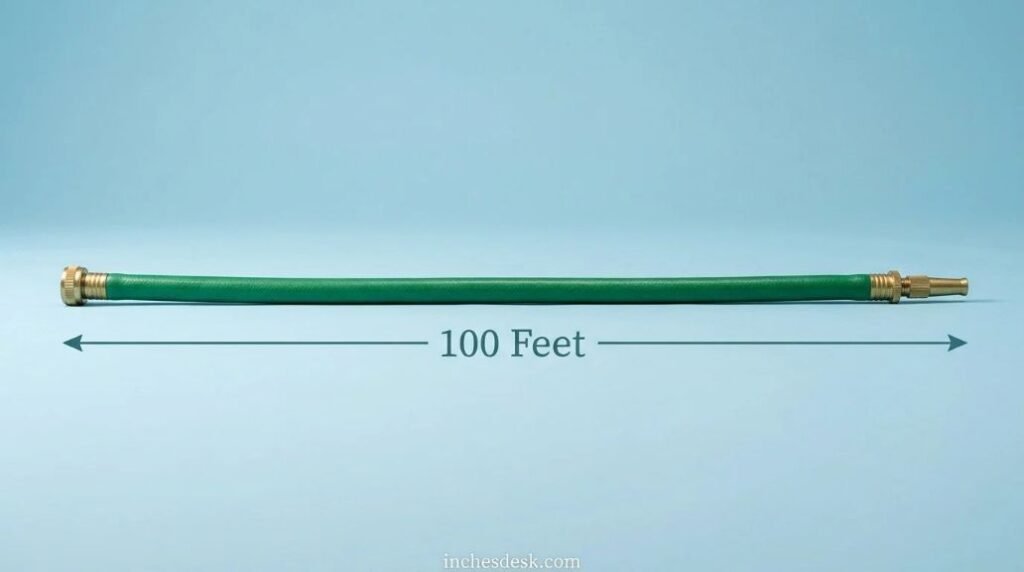
A 100-foot garden hose measures exactly 100 feet when fully extended, making it one of the most practical references for this length. It is commonly useful for watering lawns, reaching garden beds, and connecting an outdoor faucet to plants farther away from a house.
A hose of this length can cover a substantial area, although its usable reach depends on where the water source is located and how the hose is routed around obstacles. Curves and bends do not change the hose’s total length, but they can reduce how far it reaches in a straight line.
If you are buying a hose, check whether the listed length refers to the hose itself rather than its packaging or any additional accessories.
2. A 100-Foot Open-Reel Measuring Tape

A 100-foot open-reel measuring tape is designed to measure distances up to 100 feet in a single run. Unlike a short retractable tape used for furniture or indoor measurements, this tool is useful for landscaping, construction layouts, property work, and outdoor projects.
When fully extended along a straight line, the tape provides a direct reference for the entire 100-foot distance. Many long tapes use fiberglass or other durable materials suited to outdoor work.
For accurate measurements, keep the tape aligned with the intended measuring line and avoid excessive slack. A tape that bends around obstacles may show the path’s length rather than the straight-line distance between two points.
3. Embraer E175 Regional Jet (Length)

The Embraer E175 regional passenger jet is approximately 103 feet 11 inches long, depending on the aircraft specifications being referenced. That makes it slightly longer than 100 feet and an excellent aviation example for understanding this measurement.
The aircraft is designed for regional airline routes and typically carries fewer passengers than larger narrow-body or wide-body jets. Its long, slender fuselage makes the difference between 100 feet and roughly 104 feet easier to visualize when viewed from the side.
Because aircraft dimensions vary by model and configuration, use the specifications for the exact aircraft when precise measurements matter.
4. Supersaurus Dinosaur
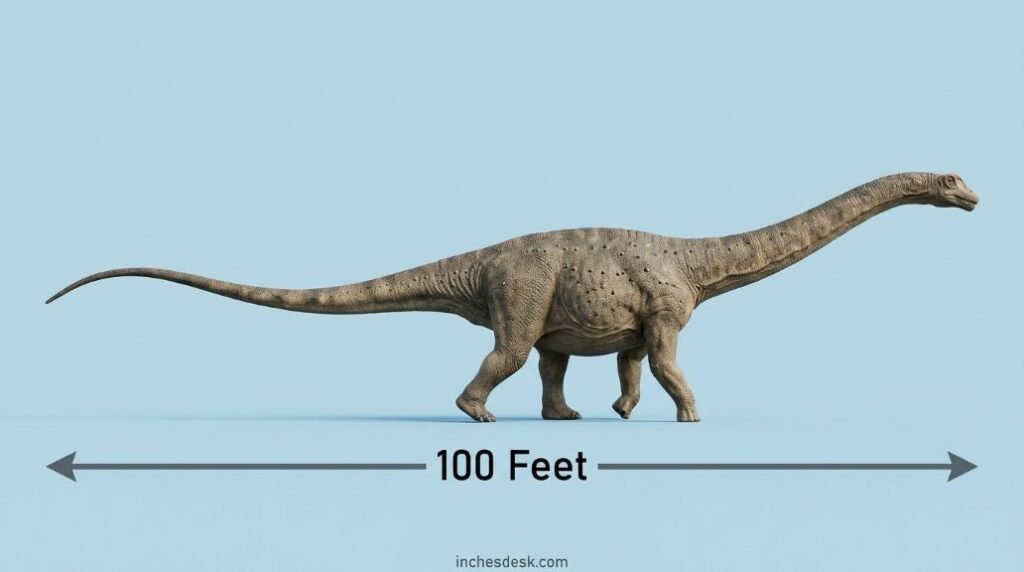
Supersaurus was an enormous long-necked sauropod dinosaur whose estimated total length may have exceeded 100 feet. Estimates vary because scientists reconstruct its size from fossil remains, and the available evidence does not provide a complete, perfectly preserved skeleton.
Its exceptionally long neck and tail contributed greatly to its overall length. Comparing Supersaurus with a 100-foot line gives a sense of the enormous scale that some long-necked dinosaurs reached.
This is an approximate natural-history comparison rather than an exact measurement. Dinosaur size estimates can change as new fossil evidence and revised scientific analyses become available.
5. A 100-Foot Superyacht
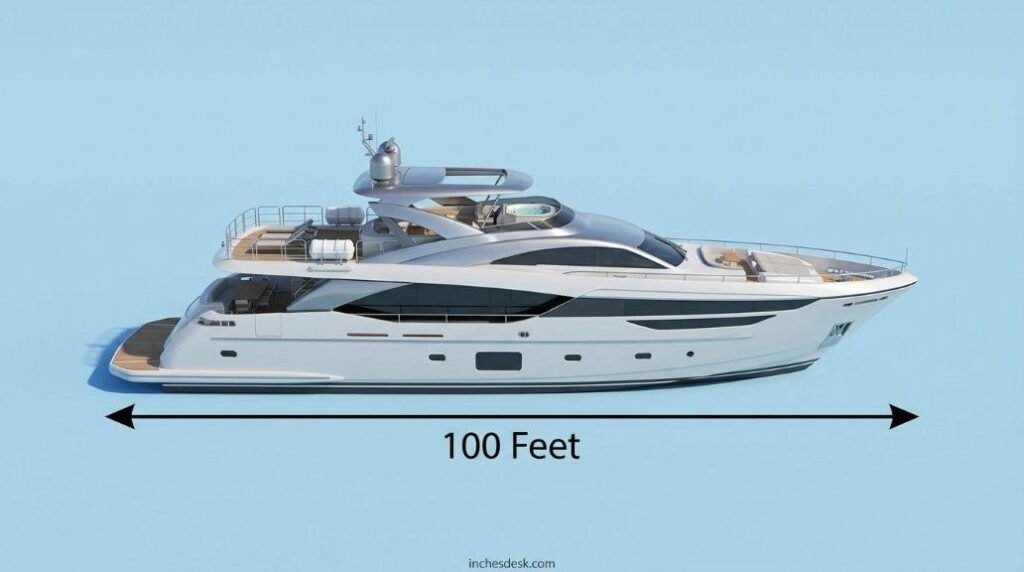
A 100-foot superyacht measures 100 feet from bow to stern, equivalent to 30.48 meters. This length places the vessel in a size range that can accommodate multiple guest cabins, spacious lounges, outdoor decks, and crew areas, depending on its design.
To visualize the length, imagine a yacht stretching across a large residential yard. Its hull may look relatively narrow compared with its length, making it a useful example of how 100 feet can extend across a considerable distance without occupying a wide area.
Read More: How Tall Is 69 Inches? Feet, CM, Height and Real-Life Examples
Yacht dimensions differ by model, and some vessels marketed as superyachts are considerably longer than 100 feet. The exact length should be checked against the manufacturer’s specifications.
6. A Light Rail Vehicle
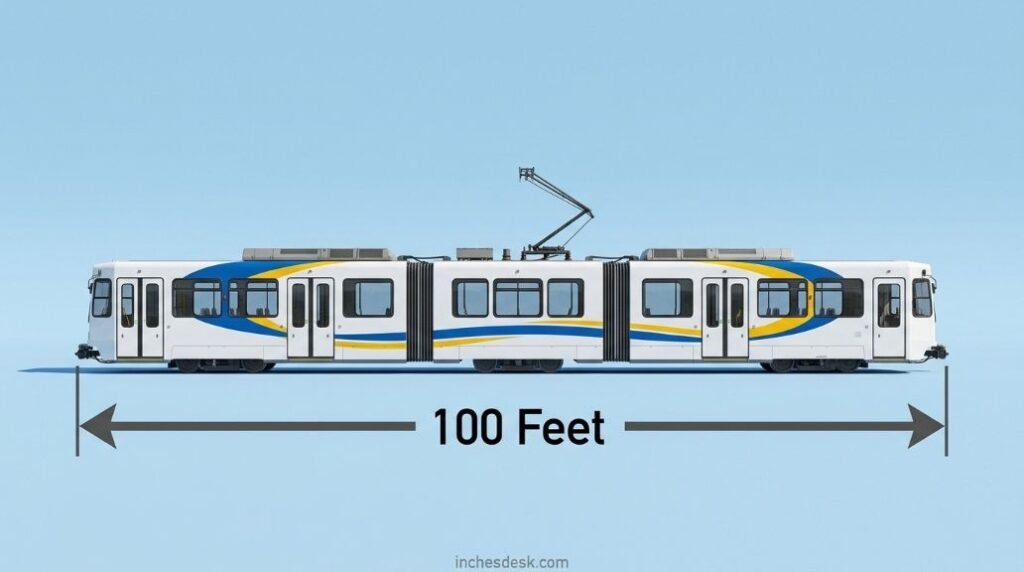
A light rail vehicle can measure approximately 100 feet long, particularly when it consists of multiple connected sections. These vehicles transport passengers along urban rail networks, often operating on dedicated tracks through city streets or along separate rights of way.
A 100-foot light rail vehicle gives you a practical transportation reference for this distance. Picture the vehicle standing beside a station platform: its length can span a substantial section of the platform and accommodate several passenger compartments.
Not every light rail vehicle reaches 100 feet. Some are shorter single-car units, while longer articulated vehicles or coupled sets can exceed this length. Always distinguish between the length of one vehicle and the combined length of an entire train.
7. Two Railroad Boxcars Coupled Together
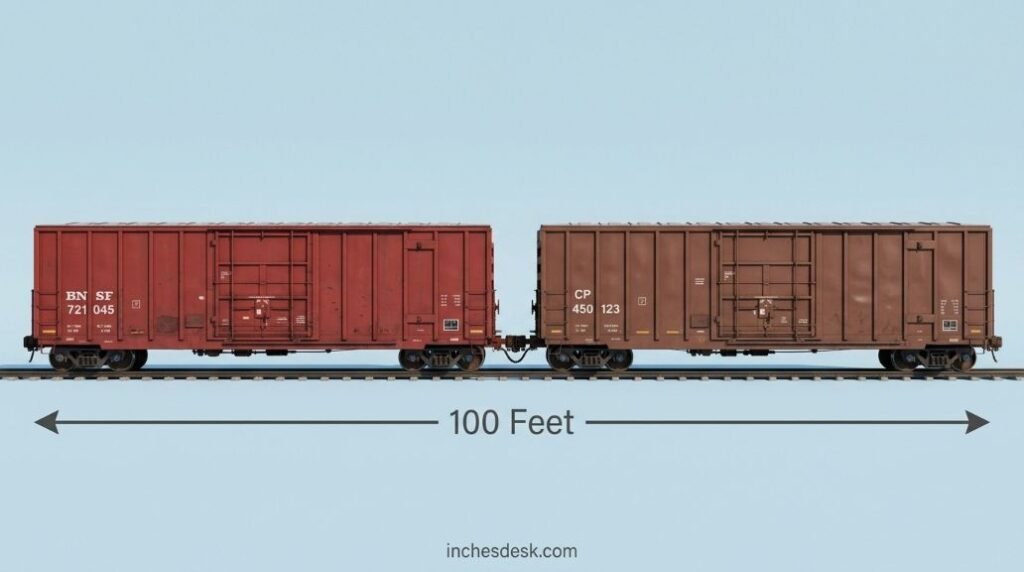
Two railroad boxcars coupled together can measure around 100 feet in combined length, depending on the dimensions of the individual cars. Many conventional freight boxcars are roughly 50 feet long, so placing two of them end to end provides a useful approximation.
This example is especially helpful around rail yards, industrial facilities, and freight terminals, where long rail vehicles make large distances easier to appreciate. The combined length includes both cars, although couplers and the spacing between them can affect the total.
Freight cars come in different lengths, including shorter and longer designs. For an exact total, add the specified lengths of both cars and account for the coupling arrangement if required.
8. A Harbor Tugboat
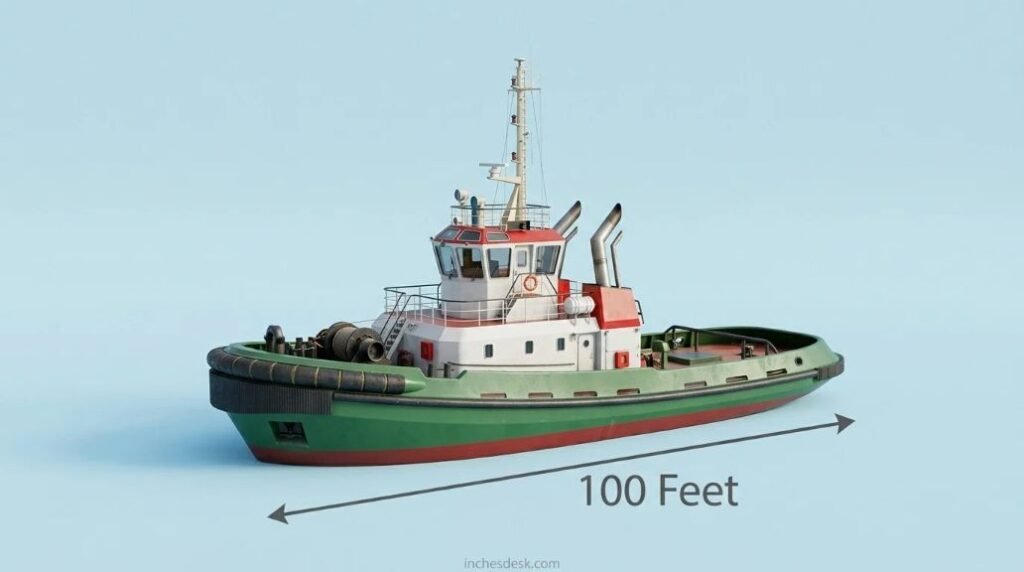
A large harbor tugboat may approach 100 feet in length, although many tugboats are substantially shorter. These powerful vessels help maneuver ships in ports, assist with docking, and move or position floating equipment.
A tugboat around this size provides an interesting comparison because its compact, sturdy hull contrasts with the much larger ships it assists. Its overall length may be similar to a 100-foot measuring line, but its broad hull, high deckhouse, and towing equipment make it appear more substantial than a simple line of the same length.
Tugboat dimensions vary according to their intended tasks, engine power, and operating environment. Smaller harbor tugs and larger ocean-going tugboats can differ considerably in size.
9. A Mobile Crane Boom (Extended)

The extended boom of a mobile crane can reach 100 feet or more, depending on the crane model and its configuration. The boom is the long, extendable structure that supports the lifting line and allows the crane to handle loads at different distances.
Imagine a crane positioned on a construction site with its boom stretched horizontally across a work area. A 100-foot boom can span the length of a large building frontage or much of a residential property.
However, boom length is not the same as safe lifting reach. The crane’s operating radius, boom angle, load weight, stabilizers, and manufacturer load chart determine what it can safely lift. A fully extended boom may also reach far beyond 100 feet on larger cranes.
10. A Cell Tower Monopole
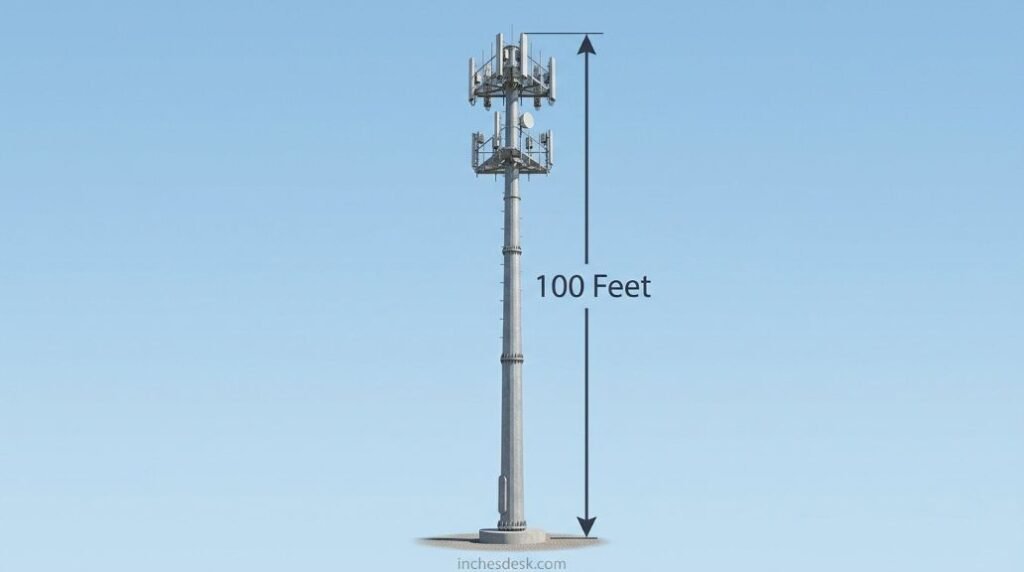
A cell tower monopole can stand approximately 100 feet tall, providing a useful vertical comparison for understanding this measurement. A monopole is a single, tall support structure that carries antennas and other telecommunications equipment.
Unlike a 100-foot road or hose, a tower extends upward rather than horizontally. Looking at one from the ground helps illustrate how much vertical space 100 feet occupies.
Tower heights vary with coverage requirements, terrain, local regulations, and the equipment installed. Also, a tower’s total height may include antennas or other structures above the main pole, so the exact measurement depends on what is being counted.
11. An Eastern White Pine
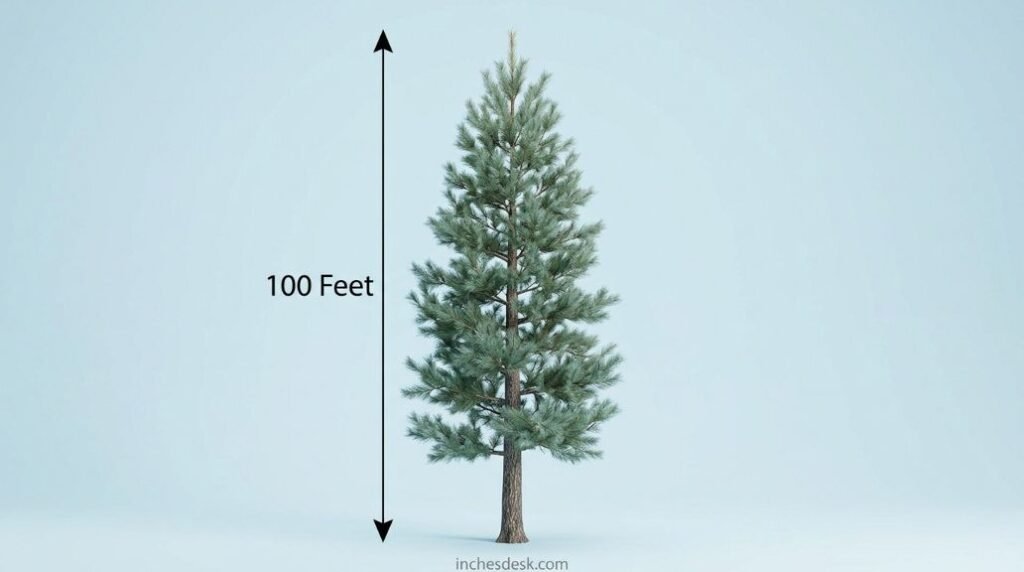
An eastern white pine can grow to around 100 feet tall or taller under suitable conditions. This large North American evergreen is known for its straight trunk, soft needle clusters, and broad, irregular crown as it matures.
A tree of this height provides a memorable natural reference for 100 feet. If you imagine laying the same distance along the ground, it would extend roughly as far as the tree reaches from its base to its highest point.
Not every eastern white pine reaches this height. Growth depends on age, soil conditions, climate, available sunlight, and competition from nearby trees. A mature tree’s height should therefore be treated as an estimate unless it has been measured.
12. A 30-Meter Sprint Segment
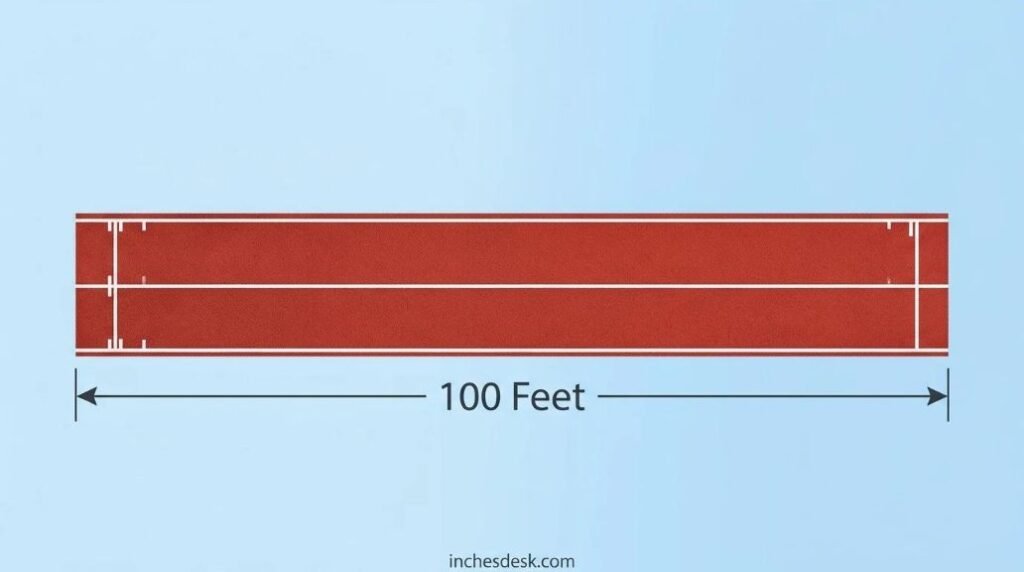
A 30-meter sprint segment measures approximately 98.43 feet, making it very close to 100 feet. The difference is about 1.57 feet, or 19 inches.
This comparison is useful for students, coaches, and athletes who work with metric track measurements. A 30-meter section of a running track gives you an easy visual reference for a distance that is almost exactly 100 feet long.
| Distance | Equivalent |
| 30 meters | 98.43 feet |
| 100 feet | 30.48 meters |
| Difference | 1.57 feet, or about 0.48 meters |
Although a 30-meter segment is a convenient estimate, it should not be treated as exactly 100 feet when setting up a measured training drill or marking a competition area. Use the correct unit and verify the endpoints if accuracy matters.
How To Measure Or Estimate 100 Feet Without A Tape Measure
You can estimate 100 feet without a tape measure by counting your steps, using familiar objects as reference points, or measuring a shorter distance and repeating it. Since 100 feet equals 30.48 meters, you can also use a meter-based reference if one is available. These methods work well for rough estimates, but construction and property projects require more accurate measurements.
1. Count Your Walking Steps
Counting steps is one of the easiest ways to estimate a 100-foot distance across a yard, driveway, or open space.
For an adult whose average step covers approximately 2.5 feet, 100 feet requires about 40 steps.
Follow these steps:
- Walk naturally across a short, known distance, such as 10 feet.
- Count how many steps you take to cover that distance.
- Use the result to estimate the number of steps needed to cover 100 feet.
- Walk the estimated number of steps along your intended route.
For example, if you take four steps to cover 10 feet, you would need approximately 40 similar steps to cover 100 feet.
Accuracy tip: Your stride may change when you walk uphill, cross uneven ground, or carry equipment. Use step counting only for a rough estimate.
2. Use a 30-Meter Reference
Because 100 feet equals 30.48 meters, a measured 30-meter stretch is almost the same length. The difference is only about 1.57 feet.
If you have access to a marked sports area, a measuring wheel, or a meter-based measuring tool, use 30 meters as your starting reference. Add another 0.48 meters to reach exactly 100 feet.
This approach is especially useful for sports practice, landscaping, and outdoor planning where metric measurements are common.
3. Estimate the Distance Using a Car
A typical passenger car is roughly 14–16 feet long, although vehicle sizes vary. If you picture six cars parked end to end, their combined length would be approximately 84–96 feet.
Seven cars of similar size would usually extend beyond 100 feet.
This method helps visualize the distance, but it is not suitable for marking an exact boundary. Vehicle lengths differ, and the gaps between parked cars affect the total distance.
4. Use a Long Rope or Garden Hose
If you have a rope, garden hose, or cable with a known length, use it to mark the distance. A hose labeled 100 feet can provide a direct reference when stretched along a straight path.
For shorter lengths, measure a section and repeat it. For example, five consecutive 20-foot sections add up to 100 feet.
Keep each section aligned with the same measuring line. Overlapping sections or leaving gaps between them can make the final measurement inaccurate.
5. Use a Smartphone Measuring Tool
Some smartphones offer built-in measuring applications or support augmented-reality measurement tools. Depending on the device and conditions, these apps may estimate distances between points.
To estimate 100 feet:
- Open a suitable measuring app.
- Follow its instructions to establish the starting point.
- Mark the endpoint and check the displayed distance.
- Repeat the measurement if the result seems inconsistent.
Smartphone measurements can be affected by camera calibration, lighting, surface conditions, and the app’s capabilities. For a long distance such as 100 feet, a dedicated measuring tool is generally more dependable.
Which Method Is Best?
| Method | Best use | Accuracy |
| Counting steps | Quick outdoor estimates | Low to moderate |
| 30-meter reference | Sports and open spaces | Good if the reference is measured |
| Car-length comparison | Visualizing distance | Low |
| Rope or measured hose | Gardens and property layouts | Good if the length is known |
| Smartphone measuring app | Quick preliminary measurements | Varies by device and conditions |
| 100-foot measuring tape | Construction and precise layouts | High when used correctly |
For everyday visualization, counting steps or comparing the distance with familiar objects is usually sufficient. For fence installation, construction layouts, or property measurements, use a suitable measuring tape, measuring wheel, or other reliable measuring instrument.
100 Feet Vs Other Lengths
100 feet equals 33.33 yards, 30.48 meters, and 1,200 inches. Comparing it with shorter and longer distances makes it easier to understand when planning a garden, measuring a property, or estimating the length of equipment.
The table below shows how 100 feet compares with common measurements and helps you identify the difference between each distance.
| Length | Equivalent in feet | Difference from 100 feet |
| 10 feet | 10 ft | 90 feet shorter |
| 20 feet | 20 ft | 80 feet shorter |
| 25 feet | 25 ft | 75 feet shorter |
| 50 feet | 50 ft | 50 feet shorter |
| 75 feet | 75 ft | 25 feet shorter |
| 100 feet | 100 ft | Reference length |
| 125 feet | 125 ft | 25 feet longer |
| 150 feet | 150 ft | 50 feet longer |
| 200 feet | 200 ft | 100 feet longer |
| 300 feet | 300 ft | 200 feet longer |
100 Feet Compared With Common Metric Measurements
Metric measurements are especially useful when working with construction plans, international product specifications, and sports facilities.
| Measurement | Length in feet | How it compares with 100 feet |
| 5 meters | 16.40 ft | Much shorter |
| 10 meters | 32.81 ft | About one-third as long |
| 20 meters | 65.62 ft | About two-thirds as long |
| 30 meters | 98.43 ft | Almost the same length |
| 30.48 meters | 100 ft | Exactly equivalent |
| 40 meters | 131.23 ft | Longer |
| 50 meters | 164.04 ft | About 64 feet longer |
100 Feet Compared With Familiar Objects
Everyday reference points can make the distance easier to visualize without calculating every measurement.
- A 50-foot garden hose: Two 50-foot hoses placed end to end span 100 feet, provided their full lengths are usable.
- A 100-foot measuring tape: A direct reference for marking a straight distance.
- A 30-meter sprint segment: At 98.43 feet, it is only about 19 inches shorter than 100 feet.
- An NBA basketball court: Its 94-foot length is 6 feet shorter than 100 feet.
- A 100-foot yacht: Its bow-to-stern length matches the reference distance, making it useful for visualizing a large vessel.
The best comparison depends on what you are measuring. Use familiar objects to estimate the scale, but rely on exact conversions and proper measuring equipment when accuracy is important.
Faqs
How Long Is 100 Feet In Meters?
100 feet equals exactly 30.48 meters. To convert feet into meters, multiply the number of feet by 0.3048.
How Many Steps Is 100 Feet?
Walking 100 feet typically takes around 35–45 steps for an adult, although the exact number depends on stride length. Someone with shorter steps may need 50 or more, while a person with a longer stride may cover the distance in fewer steps.
Is 100 Feet The Same As 100 Yards?
No, 100 feet is not the same as 100 yards. Since one yard equals 3 feet, 100 yards is three times as long as 100 feet.
How Long Does It Take To Walk 100 Feet?
Walking 100 feet generally takes around 20–30 seconds at a comfortable pace. A brisk walker may cover the distance in approximately 15–20 seconds, while a slower pace or uneven terrain can increase the time.
Is 100 Feet Enough For A Zipline Or A Garden Fence?
Yes, 100 feet can be enough for a short garden fence or a recreational zipline, but the requirements differ significantly. A 100-foot fence can cover a substantial boundary, while a zipline needs careful planning to ensure adequate clearance, suitable slope, and safe braking.
