
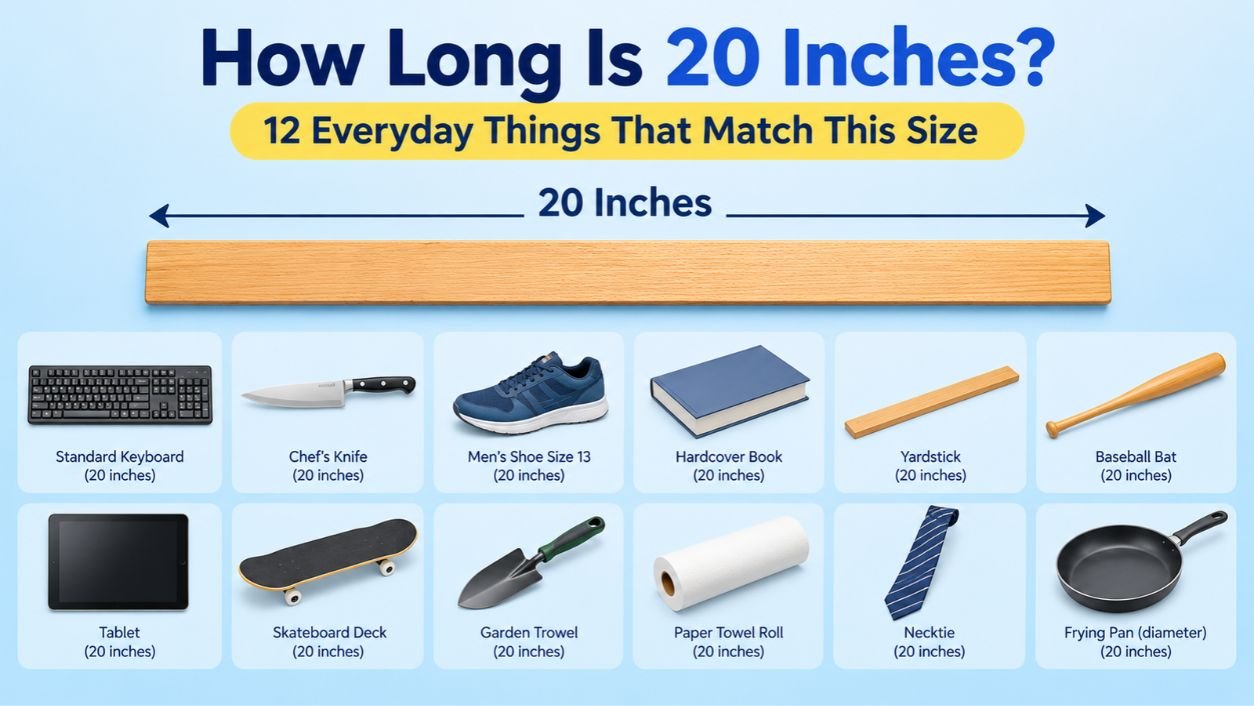
How Long Is 20 Inches?
20 inches is exactly 1 foot 8 inches (1.667 feet) or 50.8 centimeters long. It is slightly longer than a standard 12-inch ruler by 8 inches. This measurement is useful for understanding the size of tools, kitchen equipment, framed artwork, and other everyday objects.
An inch is a unit of length commonly used in the United States, while centimeters and millimeters are part of the metric system. Converting between these units helps you understand product specifications, follow project plans, and compare measurements listed in different systems.
20 Inches Conversion Table
Here are the most useful conversions for 20 inches:
| Unit | Equivalent |
| Inches | 20 inches |
| Feet | 1.667 feet |
| Feet and inches | 1 foot 8 inches |
| Centimeters | 50.8 cm |
| Millimeters | 508 mm |
| Meters | 0.508 m |
| Yards | 0.556 yards |
These values are based on standard length conversions, so you can use them for school assignments, shopping, and most everyday measuring tasks.
How to Convert 20 Inches Into Other Units

To convert 20 inches into another unit, multiply or divide by the appropriate conversion factor.
1. Inches to centimeters
One inch equals exactly 2.54 centimeters.
- Start with 20 inches.
- Multiply 20 by 2.54.
- The result is 50.8 centimeters.
Formula: 20 × 2.54 = 50.8 cm
2. Inches to feet
One foot contains 12 inches. Divide 20 by 12 to convert inches into feet.
- Start with 20 inches.
- Divide 20 by 12.
- The result is approximately 1.667 feet.
Formula: 20 ÷ 12 = 1.667 feet
You can also express this measurement as 1 foot 8 inches, which is often easier to visualize.
3. Inches to millimeters
One inch equals 25.4 millimeters.
- Start with 20 inches.
- Multiply 20 by 25.4.
- The result is 508 millimeters.
Formula: 20 × 25.4 = 508 mm
4. Inches to meters
One inch equals 0.0254 meters.
- Multiply 20 by 0.0254.
- The result is 0.508 meters.
Formula: 20 × 0.0254 = 0.508 m
What Does 20 Inches Look Like in Real Life?
A length of 20 inches is about the distance from your elbow to the tips of your fingers for some adults, although individual arm lengths vary. It is also a practical size for several tools, kitchen accessories, and recreational equipment.
Use these comparisons as visual references rather than exact measurements. The dimensions of manufactured products can vary by model.
For example, a product advertised as a 20-inch car wheel rim refers to its nominal rim diameter, not its width or circumference. Similarly, a 20-inch handsaw generally describes the blade length, while a 20-inch pizza refers to its diameter. Understanding which dimension a measurement describes is essential when comparing products.
12 Things That Are About 20 Inches Long
1. Car Wheel Rim (20-Inch)
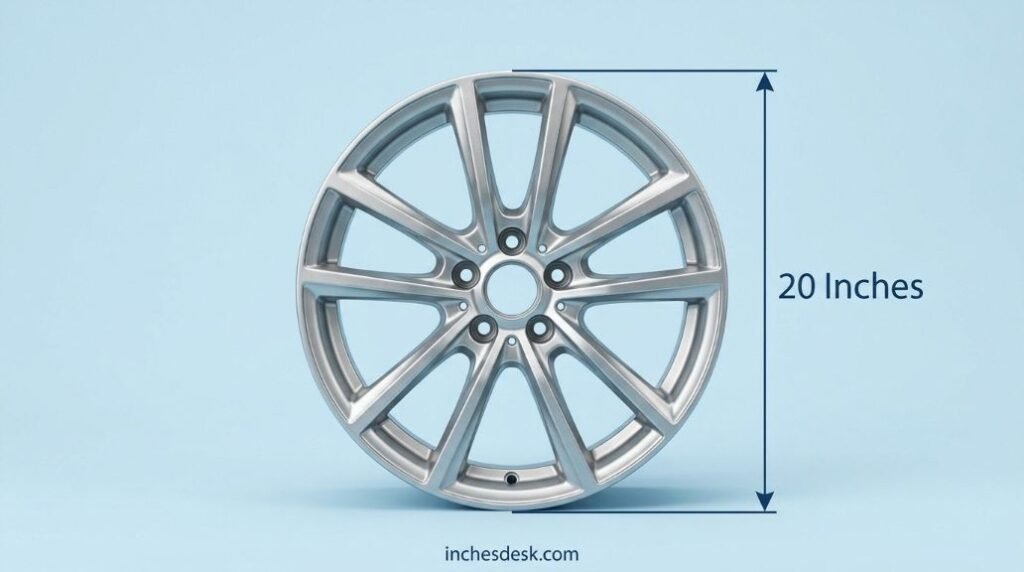
A 20-inch car wheel rim is a useful example of this measurement. The 20-inch designation refers to the nominal diameter of the rim where the tire mounts, rather than the wheel’s overall outside diameter with the tire installed.
A 20-inch rim is commonly found on larger sedans, SUVs, and performance vehicles. Its actual appearance depends on the wheel design, spoke pattern, and tire size. If you are comparing a wheel rim with a straight 20-inch object, remember that the rim’s diameter is measured across its center, not along its curved edge.
2. 20×20 HVAC Air Filter
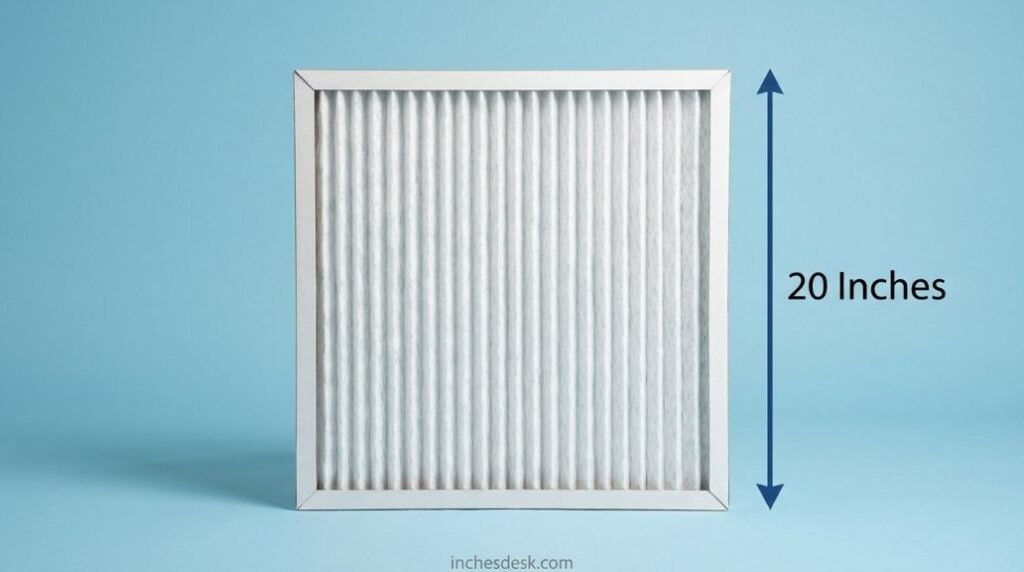
A 20 × 20-inch HVAC air filter measures 20 inches across and 20 inches in the other direction, giving it a square shape. It is used in compatible heating, ventilation, and air-conditioning systems to capture airborne particles such as dust and other household debris.
This filter provides a convenient way to picture 20 inches because either side is designed around that nominal dimension. However, the actual dimensions can differ slightly from the printed size. Before buying a replacement, check the filter slot and the manufacturer’s listed actual measurements.
3. 20-Inch Handsaw
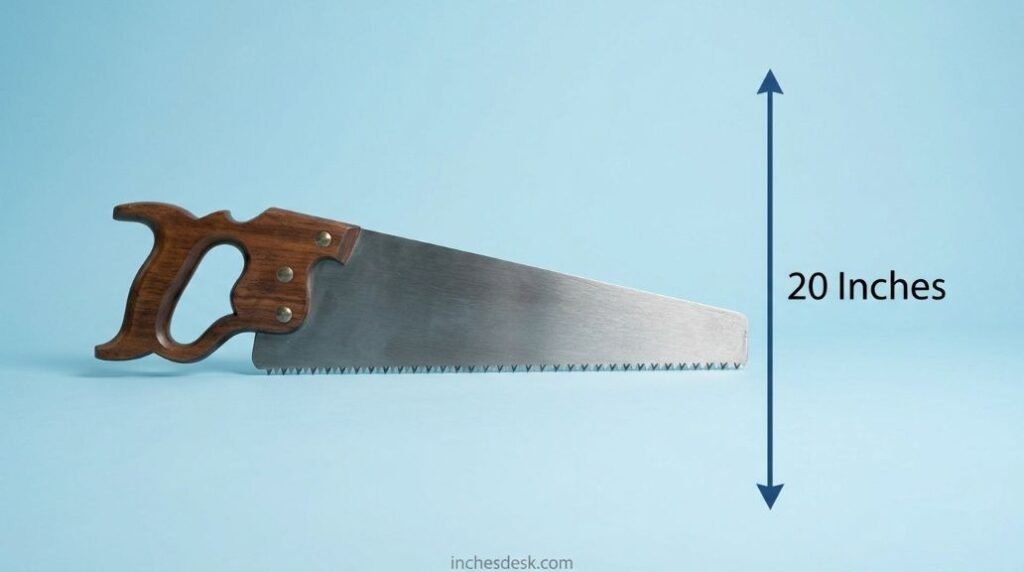
A 20-inch handsaw gives you a straight-line reference for understanding this length. Depending on the product, the advertised measurement may refer to the blade rather than the entire tool, including its handle.
Handsaws are used for cutting wood during carpentry, home repairs, and DIY projects. A blade measuring 20 inches is long enough to provide a clear visual comparison with other tools and household objects. If you need a saw for a particular task, consider the blade type, tooth pattern, and material being cut, not just its length.
4. 20-Inch Toolbox
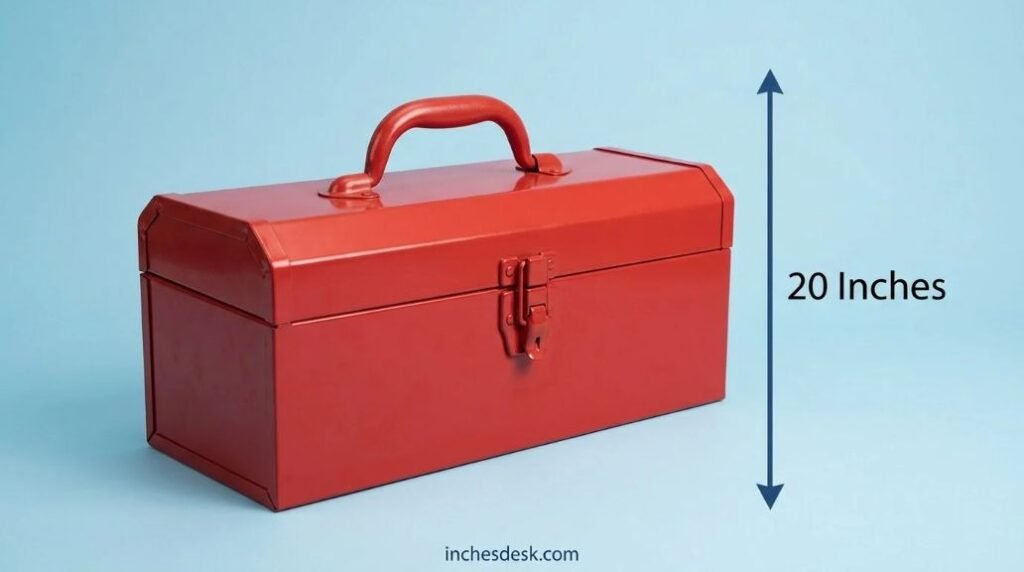
A 20-inch toolbox can help you imagine how much space a medium-sized storage container occupies. Its advertised length is generally measured across the longest side, although the width and height depend on the design.
This size may suit homeowners, hobbyists, and tradespeople who need to carry frequently used hand tools. Some models include multiple compartments, removable trays, or a carrying handle. Keep in mind that a toolbox measuring 20 inches long is not necessarily 20 inches wide or tall, so check all three dimensions before deciding whether it will fit on a shelf or inside a vehicle.
5. Compact Kitchen Range
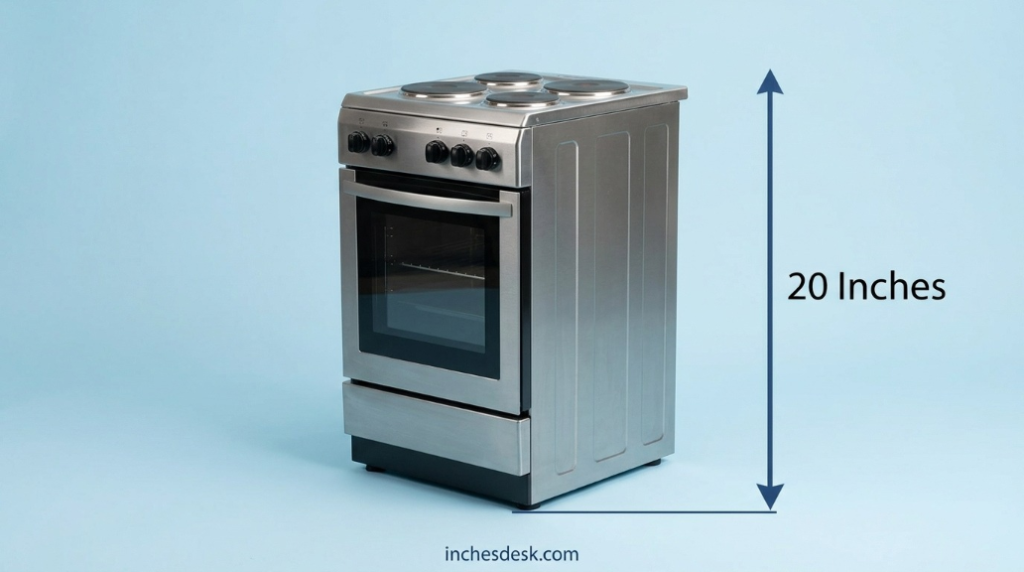
A compact kitchen range can provide another reference for a measurement of approximately 20 inches, particularly when comparing the appliance’s width. Some narrow ranges are designed for smaller kitchens, apartments, and spaces where a full-size cooking appliance would be difficult to install.
Unlike a 20-inch handsaw, this comparison describes width rather than length. Appliance dimensions also vary by manufacturer, and a nominal 20-inch range may have slightly different exterior measurements. If you are replacing an existing stove, measure the available opening, nearby cabinets, and required installation clearances before purchasing.
6. 20-Inch Paella Pan

A 20-inch paella pan has a nominal diameter of 20 inches, equivalent to 50.8 centimeters across. Paella pans are wide and relatively shallow, allowing rice and other ingredients to spread across a broad cooking surface.
This makes the pan a useful example of a 20-inch circular object. When placed on a suitable cooking surface, it occupies considerably more horizontal space than a small everyday frying pan. The handles may extend beyond the stated diameter, so the pan’s total outside width can be greater than 20 inches.
Before choosing one, check whether the listed diameter refers to the upper rim, cooking base, or another measurement. That distinction affects how the pan fits on a burner and how much storage space it requires.
7. 20-Inch Party Pizza
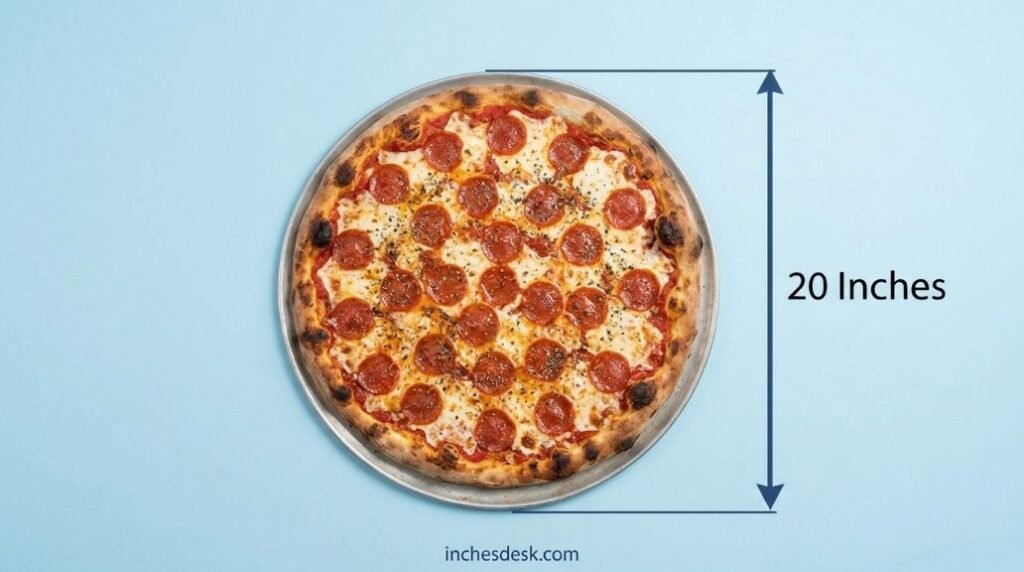
A 20-inch party pizza measures 20 inches across from one outer edge to the opposite edge through its center. That is equivalent to 50.8 centimeters in diameter, making it a particularly easy object to visualize.
A pizza of this size covers a large circular area. Its total area, using the nominal diameter, is approximately 314 square inches:
- Diameter: 20 inches
- Radius: 20 ÷ 2 = 10 inches
- Area: π × 10² ≈ 314.16 square inches
The actual pizza may be slightly smaller or larger depending on the restaurant and how the dough is prepared. Also, a 20-inch pizza is not 20 inches long in a straight-line sense; the measurement describes its diameter.
8. 20×24 Poster Frame

A 20 × 24-inch poster frame has nominal dimensions of 20 inches by 24 inches. Its shorter side provides a reference for the target length, while the longer side measures 4 inches more.
Frames of this size are used for posters, prints, photography, and decorative artwork. They are also helpful for visualizing how 20 inches compares with a rectangular object rather than a straight tool or circular item.
The listed dimensions usually refer to the artwork size the frame is intended to hold. The frame’s exterior dimensions may be larger because of the surrounding border. If you are hanging artwork, check both the opening size and the outside dimensions before selecting a location.
9. 20-Inch Zipper
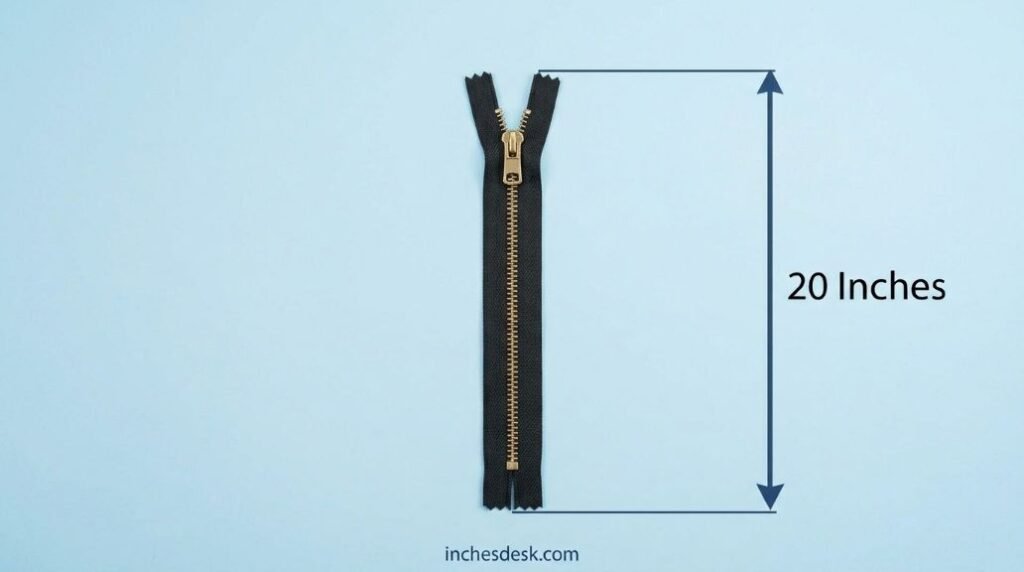
A 20-inch zipper is another practical example of this length. It may be used in jackets, bags, cushions, covers, and other sewn products, depending on its design and construction.
Zipper sizing commonly refers to the length of the closed or usable zipper chain, although conventions can differ between zipper types and manufacturers. The fabric tape or surrounding garment may extend beyond the stated length.
For sewing projects, measure the opening that needs to be closed and check the zipper manufacturer’s sizing guidance. A zipper that is too short can make an opening difficult to use, while one that is too long may require alterations.
10. 20-Inch Ride Cymbal
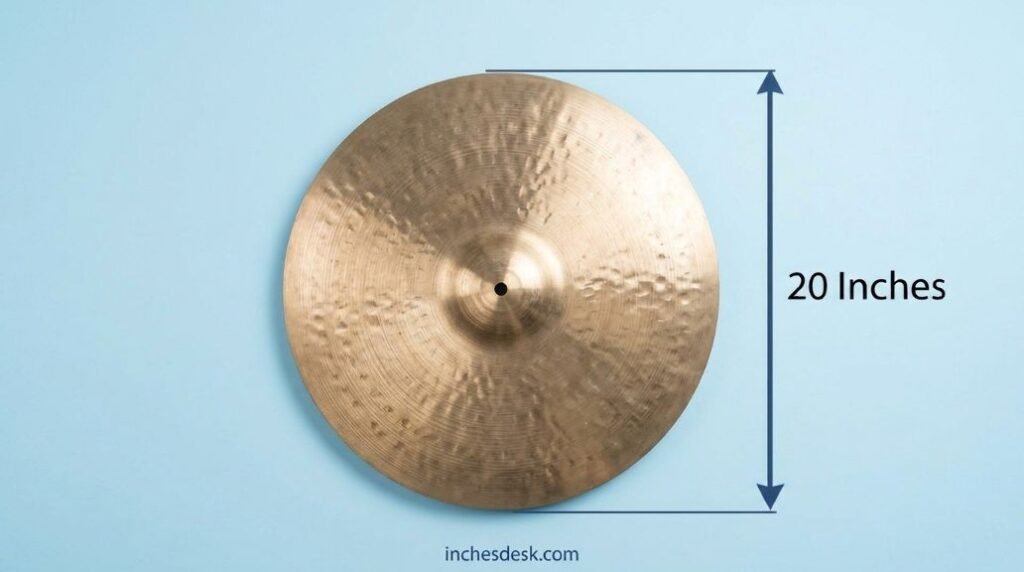
A 20-inch ride cymbal has a nominal diameter of 20 inches, or 50.8 centimeters. Ride cymbals are commonly used in drum kits to maintain a steady rhythmic pattern and produce a sustained metallic sound.
Because the cymbal is circular and relatively thin, its diameter is the most useful measurement for comparison. Its curved profile and bell in the center give it a different shape from a flat sheet or circular pan, but the distance across its widest part remains the relevant reference.
If you are buying a cymbal, diameter alone does not determine its sound. Thickness, alloy, manufacturing method, and profile also influence its tonal characteristics.
11. 20-Inch Bass (Kick) Drum
A 20-inch bass drum, also called a kick drum, is another circular object that helps demonstrate this measurement. The advertised size typically refers to the drum’s diameter, not the length of its shell from front to back.
Bass drums are used in drum kits to produce low-frequency rhythmic sounds. A 20-inch model can be a useful option for musicians seeking a drum that balances a substantial sound with a more compact setup than many larger kick drums.
The shell depth varies between models, so two 20-inch bass drums may have the same diameter but occupy different amounts of space. Check both diameter and depth when planning a drum kit or transport case.
12. 20-Inch Plyo Box Height
A 20-inch plyo box height provides a vertical example of this measurement. Plyometric boxes are used for exercises such as step-ups, jump training, and other strength and conditioning movements.
A box set to 20 inches stands 1 foot 8 inches high. Depending on the product, this measurement may describe one of several available sides of a multi-height box rather than the overall height in every orientation.
Read More: How Tall Is 69 Inches? Feet, CM, Height and Real-Life Examples
Plyo boxes are made from materials such as foam, wood, or covered composite structures. If you are selecting one for exercise, consider stability, surface grip, the intended movement, and your current fitness level. The height should suit the exercise and your ability, rather than being chosen by measurement alone.
How To Measure Or Visualize 20 Inches Without A Ruler
You can estimate 20 inches without a ruler by combining familiar measurements, using an object with known dimensions, or measuring with a standard sheet of paper. These methods are useful for quick household checks, although a tape measure or ruler is more reliable when precise dimensions matter.
Use a Standard 8.5 × 11-Inch Sheet of Paper
A standard US letter-size sheet measures 8.5 inches wide and 11 inches long. Its longer side gives you a simple reference for estimating 20 inches.
- Place the paper along the length you want to estimate.
- Imagine two 11-inch lengths placed end to end.
- The combined length is 22 inches, which is 2 inches longer than 20 inches.
This method gives you a reasonably close visual estimate. It works best when you need to judge whether an object is around 20 inches long rather than verify an exact measurement.
Use a 12-Inch Ruler
A standard 12-inch ruler makes the calculation straightforward.
- Start with a known length of 12 inches.
- Add another 8 inches.
- The total is 20 inches, or 1 foot 8 inches.
If you only have a ruler without a measuring tape, measure the object in sections and mark each completed length carefully. Avoid leaving gaps or overlapping the ruler when repositioning it, since small errors can accumulate.
Compare It With Your Forearm
Your forearm can serve as a quick reference, but it is not a standardized measuring tool. The distance from your elbow to your fingertips differs from person to person, so do not assume that your forearm measures exactly 20 inches.
To use this method, compare the object with your forearm and then check the estimate against a known item, such as a sheet of paper or a ruler. This approach is suitable for rough visualization when shopping or organizing a space, but it is not appropriate for precise cutting, fitting, or installation.
Use a Measuring Tape or String
A measuring tape is the best choice when you need a dependable 20-inch measurement. Extend it to the 20-inch mark, keep it straight, and align the starting point with one edge of the object.
If a tape measure is unavailable, a piece of string can help:
- Lay the string along a ruler or tape measure and mark a 20-inch section.
- Keep the marked section straight and place it along the object.
- Check that the string follows the correct dimension, rather than a curved edge or diagonal.
- Repeat the measurement if the result will affect a purchase, installation, or DIY cut.
String can stretch or bend, so use a rigid measuring tool whenever accuracy is essential.
20 Inches Vs Real-World Sizes People Often Confuse
Twenty inches can be difficult to visualize because different products use the same number to describe different dimensions. A 20-inch pizza is measured across its diameter, a 20-inch handsaw usually refers to its blade length, and a compact kitchen range may be described by its width. Understanding these differences helps you compare sizes accurately and avoid mistakes when shopping or measuring.
Here are several common measurements that people confuse with 20 inches.
20 Inches vs. 2 Feet
Twenty inches is shorter than 2 feet. Since 1 foot equals 12 inches, 2 feet equals 24 inches. The difference between these lengths is 4 inches.
| Measurement | Equivalent in Inches |
| 20 inches | 20 inches |
| 1 foot 8 inches | 20 inches |
| 2 feet | 24 inches |
| Difference | 4 inches |
For example, if you need a 20-inch shelf but purchase one that is 2 feet long, it will be 4 inches longer than your intended measurement. This difference can matter when fitting a shelf into a narrow cabinet or placing equipment in a limited space.
20 Inches vs. 18 Inches
Twenty inches is 2 inches longer than 18 inches. Although the difference may seem small, it can affect how an object fits inside a drawer, storage container, or designated installation area.
| Measurement | Length in Centimeters |
| 18 inches | 45.72 cm |
| 20 inches | 50.8 cm |
| Difference | 5.08 cm |
If you are choosing between an 18-inch and a 20-inch tool, check the available working space before buying. The extra 2 inches may provide additional reach, but it could also make the tool harder to store.
20 Inches vs. 50 Centimeters
Twenty inches is slightly longer than 50 centimeters. Using the exact conversion factor of 1 inch = 2.54 centimeters, 20 inches equals 50.8 centimeters, making it 0.8 centimeters longer than 50 centimeters.
| Measurement | Equivalent |
| 20 inches | 50.8 cm |
| 50 centimeters | 19.69 inches |
| Difference | 0.8 cm, or about 0.31 inches |
This distinction is useful when comparing products sold in countries that use different measurement systems. A product listed as 50 cm is close to 20 inches, but the two measurements are not identical.
20 Inches vs. a Standard 12-Inch Ruler
A standard ruler is typically 12 inches long, so 20 inches is 8 inches longer. You would need one full 12-inch ruler plus another 8 inches to measure the complete distance.
| Object or Measurement | Length |
| Standard ruler | 12 inches |
| Additional length needed | 8 inches |
| Total | 20 inches |
20 Inches vs. a 20-Inch Television
A 20-inch television does not generally measure 20 inches wide. Television sizes are measured diagonally across the screen, from one corner to the opposite corner.
For a typical widescreen television with a 16:9 aspect ratio, a 20-inch screen has an approximate width of 17.4 inches and a height of 9.8 inches, excluding the bezel and stand.
| Screen Measurement | Approximate Size |
| Diagonal | 20 inches |
| Width | 17.4 inches |
| Height | 9.8 inches |
This is an important distinction when planning a desk setup or selecting a television for a small room. The overall dimensions will be larger than the screen measurements once you include the frame, stand, or mounting hardware.
FAQs
How Many Cm Is 20 Inches?
20 inches equals 50.8 centimeters. To convert inches to centimeters, multiply the number of inches by 2.54.
How Many Feet Is 20 Inches?
20 inches equals 1.667 feet, or 1 foot 8 inches. To convert inches into decimal feet, divide the number of inches by 12..
What Is 20 Inches in Mm?
20 inches equals 508 millimeters (mm). Since 1 inch is exactly 25.4 millimeters, multiply 20 by 25.4 to get the result.
Is 20 Inches Bigger Than a Standard Ruler?
Yes, 20 inches is 8 inches longer than a standard 12-inch ruler. A 20-inch length is equivalent to one full ruler length plus an additional 8 inches.
How Wide Is a 20-Inch TV?
A typical 20-inch widescreen TV has a screen width of approximately 17.4 inches and a screen height of about 9.8 inches. The 20-inch specification refers to the diagonal measurement, not the horizontal width.
What Age Is a 20-Inch Bike For?
A 20-inch bicycle is commonly suitable for children around 5 to 8 years old, although the right size depends more on the child’s height, inseam, and riding ability than on age alone.
