
How Tall Is 48 Inches?
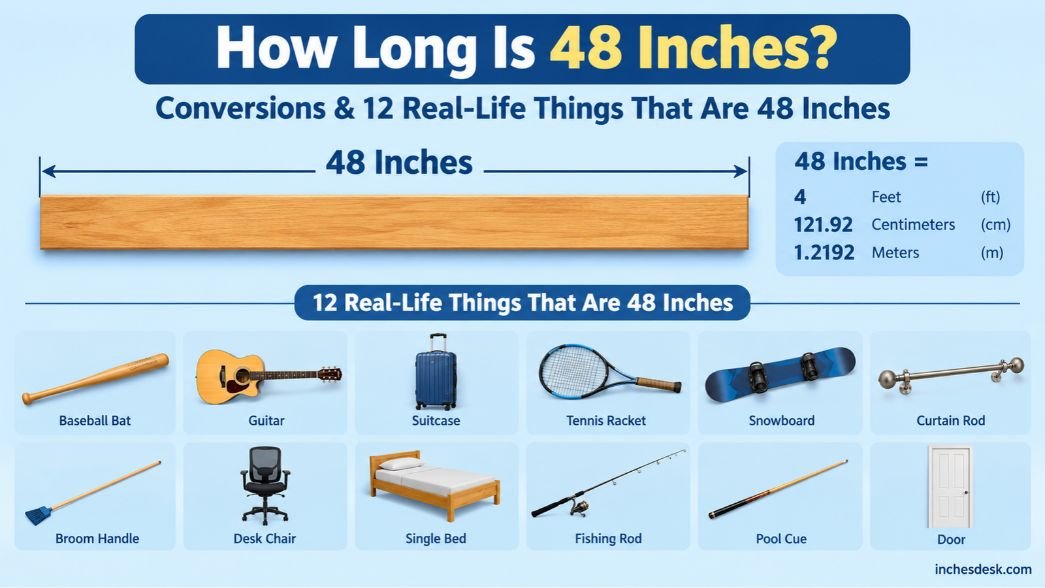
48 inches is exactly 4 feet, 121.92 centimeters, or 1.2192 meters. It is a common measurement used in home improvement, furniture sizing, lighting, and everyday objects. To picture this length, imagine a 4-foot shop light, a standard 4-foot level, or the shorter side of a typical 4 × 8-foot plywood sheet.
The easiest way to understand 48 inches is to divide it into four equal sections of 12 inches each. Since every foot contains 12 inches, four feet add up to 48 inches.
Here are the essential measurements for quick reference:
| Unit | Equivalent of 48 Inches |
| Inches | 48 inches |
| Feet | 4 feet |
| Centimeters | 121.92 cm |
| Meters | 1.2192 m |
| Millimeters | 1,219.2 mm |
| Yards | 1⅓ yards |
A length of 48 inches is especially useful when choosing furniture, planning storage, installing lighting, or measuring building materials. For example, a 48-inch shelf can fit a four-foot-wide space, while a four-foot level helps builders check whether surfaces are straight.
48 Inches Converted to Other Units
Converting 48 inches into other units is straightforward once you know the basic conversion factors. For feet, divide inches by 12. For centimeters, multiply inches by 2.54. These calculations are useful when comparing product dimensions, reading construction plans, or working with metric measurements.
48 Inches to Feet
To convert inches to feet, divide the number of inches by 12 because 1 foot equals 12 inches.
Calculation:
48 ÷ 12 = 4 feet
Therefore, 48 inches equals exactly 4 feet, which can also be written as 4 ft. This conversion is useful for measuring room dimensions, furniture, boards, and other items commonly described in feet.
48 Inches to Centimeters
To convert inches to centimeters, multiply the inch measurement by 2.54 because one inch equals exactly 2.54 centimeters.
Calculation:
48 × 2.54 = 121.92 cm
Therefore, 48 inches equals 121.92 centimeters. This is helpful when comparing American product measurements with metric specifications used in many other countries.
48 Inches to Meters
One meter contains 100 centimeters. After converting 48 inches to centimeters, divide the result by 100 to obtain meters.
Calculation:
121.92 ÷ 100 = 1.2192 meters
So, 48 inches equals 1.2192 meters, or approximately 1.22 meters when rounded to two decimal places.
48 Inches to Millimeters
Millimeters are commonly used for precise measurements in engineering, manufacturing, and DIY projects. Since one inch equals 25.4 millimeters, multiply 48 by 25.4.
Calculation:
48 × 25.4 = 1,219.2 mm
Therefore, 48 inches equals 1,219.2 millimeters.
48 Inches to Yards
A yard contains 36 inches. To convert 48 inches to yards, divide 48 by 36.
Calculation:
48 ÷ 36 = 1⅓ yards
Therefore, 48 inches equals 1⅓ yards, or approximately 1.33 yards.
How Big Is 48 Inches? Easy Ways to Visualize It
48 inches is 4 feet long, making it easy to visualize using familiar household items, furniture, and tools. If you do not have a measuring tape nearby, think of a four-foot shop light, a longboard skateboard, or the shorter side of a standard 4 × 8-foot plywood sheet. These reference points can help you estimate the length when shopping, planning a DIY project, or arranging furniture.
Here are a few practical ways to picture 48 inches:
- Four 12-inch sections: Imagine four equal sections, each measuring one foot. Together, they make exactly 48 inches.
- A four-foot object: A product measuring 4 feet long gives you a direct reference for 48 inches.
- A little over one meter: Since 48 inches equals 121.92 cm, the length is about 22 cm longer than one meter.
- A four-foot furniture space: A 48-inch-wide desk, shelf, or cabinet needs a space approximately four feet across, although its actual dimensions should be checked before installation.
You can also compare 48 inches with nearby measurements. A 47-inch object is one inch shorter, while a 50-inch object is two inches longer. These differences may seem small, but they can matter when fitting furniture into a narrow space or selecting a replacement part.
12 Things That Are 48 Inches Long or Tall
Standard Plywood or Drywall Sheet Width (4×8)
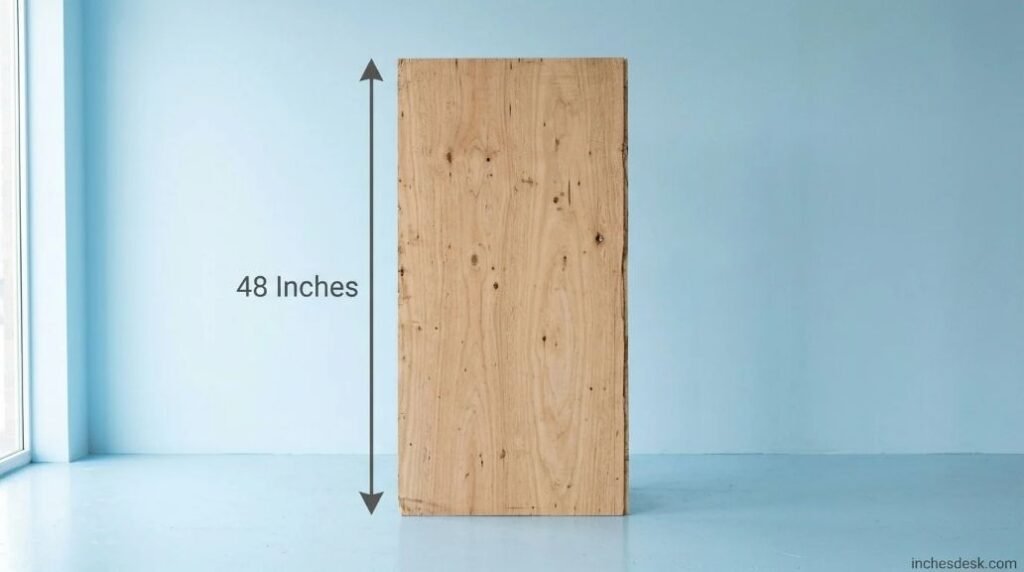
A standard 4 × 8-foot plywood or drywall sheet is one of the clearest ways to visualize 48 inches. Its nominal dimensions are 4 feet wide and 8 feet long, which means the shorter side measures 48 inches.
These sheets are commonly used for wall construction, roofing, cabinetry, flooring, and other building projects. Their four-foot width is a familiar reference for carpenters, contractors, and DIY enthusiasts.
When planning a project, remember that the nominal dimensions and actual dimensions can differ depending on the material and manufacturer. Measure the sheet itself if you need an exact fit.
Full-Size Cello Height

A full-size cello provides another useful visual reference for understanding a measurement close to four feet. Depending on its design and how the instrument is measured, a full-size cello can be around 48 inches tall or longer.
Cellos are large string instruments played while seated, with the body resting between the musician’s knees. Their long neck, fingerboard, and endpin contribute to their overall height.
If you are comparing a cello with a 48-inch measurement, distinguish between the instrument’s body height and its total height, including the endpin. These dimensions are not interchangeable, and the exact size varies by model.
4-Foot LED Shop Light

A 4-foot LED shop light is designed around a nominal length of 48 inches. These long fixtures are popular in garages, workshops, utility rooms, basements, and storage areas where broad, practical lighting is needed.
Their elongated shape makes them easy to compare with other four-foot objects. Many models are designed for ceiling mounting or suspension above workbenches, helping illuminate a wide working area.
However, the overall fixture length may vary slightly by manufacturer. Check the listed dimensions before installing one between cabinets or inside a space with limited clearance.
4-Foot Spirit Level

A four-foot spirit level is a construction and DIY tool that measures approximately 48 inches in length. It helps users check whether a surface is level horizontally or plumb vertically.
Builders and homeowners commonly use this tool when installing cabinets, aligning door frames, positioning shelves, and checking wall structures. Its long body spans a larger area than a short level, making it useful for identifying uneven surfaces across a wider distance.
For anyone trying to visualize 48 inches, this is a particularly practical example because the tool is often sold by its length. If you need a precise 48-inch reference, verify the tool’s stated overall length.
Electric Bass Guitar Length

An electric bass guitar is a useful musical reference for understanding a length near four feet. Many full-size electric bass guitars measure roughly 44 to 48 inches from end to end, depending on the body shape, headstock, and model.
Bass guitars have longer necks than many standard electric guitars because they are designed for lower-pitched strings. Their overall length makes them easy to recognize as relatively large musical instruments.
Not every bass guitar is exactly 48 inches long. If you are purchasing a gig bag, shipping an instrument, or arranging storage, compare the instrument’s actual measurements with the available space.
Roller Coaster Height Requirement

A height of 48 inches is a familiar benchmark at amusement parks, where some roller coasters and other rides use minimum rider-height requirements around four feet.
For parents and children, this provides a practical way to understand how tall 48 inches is in real life. A child who measures four feet tall may meet the height requirement for certain attractions, depending on the park and ride.
However, 48 inches is not a universal roller coaster requirement. Some rides have lower limits, while others require riders to be taller. Always check the specific attraction’s posted safety requirements and measure the child without shoes if instructed by the park.
Upright Vacuum Cleaner

Some upright vacuum cleaners reach approximately 48 inches in overall height, particularly models with tall handles and extended bodies. This makes them a helpful household comparison for a four-foot measurement.
The total height can affect where you store the appliance, whether it fits beneath a shelf, and how much vertical space you need in a utility closet. Upright vacuum cleaners also vary considerably in shape, handle design, and storage configuration.
If you are planning a storage area, measure the vacuum from the bottom of its base to the highest point of its handle. Do not assume every upright model is exactly four feet tall.
Longboard Skateboard

Longboard skateboards are longer than many conventional skateboards, but most are considerably shorter than 48 inches. Some specialized or unusually long boards may approach four feet, making them a useful near-comparison rather than a standard exact example.
Longboards are designed for activities such as cruising, carving, and downhill riding. Their deck lengths vary according to the intended riding style, and a longer deck can provide a different stance and feel.
For an accurate 48-inch reference, measure the board from one end of the deck to the other. Avoid using the wheelbase, which is the distance between the wheel assemblies, because it is much shorter than the board’s overall length.
Kids’ Bookshelf
A wide children’s bookshelf can measure 48 inches across, especially models designed to hold books, toys, and small storage bins. A four-foot width offers useful storage without requiring a full wall of shelving.
This measurement is helpful when organizing a playroom, bedroom, classroom, or reading corner. A bookshelf that is 48 inches wide can serve as a reference for planning the available wall space.
Remember that width and height are different measurements. A bookshelf may be 48 inches wide but only 30 inches tall, or it may have different proportions altogether. Check the product dimensions before buying to ensure it fits your intended location.
Baby Gate or Playpen Panel
Some baby gates, expandable safety barriers, and playpen panels are designed for openings or configurations approaching 48 inches wide. This makes them relevant examples when planning child-safe spaces at home.
A four-foot opening may occur between room dividers, at the entrance to a play area, or between selected sections of a modular barrier. However, safety gates are available in many widths, and the measurement can refer to the opening they fit rather than the gate’s own physical length.
Before purchasing a gate, measure the opening at the manufacturer’s recommended points and confirm its compatible width range. Correct installation is essential because a gate that does not fit securely may create a safety hazard.
Fluorescent Tube Fixture
Many traditional fluorescent lighting systems were designed around four-foot lamps, making them a familiar example associated with 48 inches. These fixtures have been widely used in workshops, offices, garages, classrooms, and commercial buildings.
The four-foot designation generally describes the lamp’s nominal size, not necessarily the total length of the fixture housing. End caps, sockets, and mounting components can affect the overall dimensions.
If you are replacing an existing fluorescent light with an LED alternative, check the lamp type, fixture dimensions, electrical compatibility, and installation requirements. A four-foot label alone does not guarantee that two products have identical physical measurements.
Standard Bed Rail or Wide Window Blind
A bed rail or window blind measuring 48 inches can provide another everyday reference for four feet. Wide blinds are commonly available in four-foot widths, while some bed frames use rails or support components of similar lengths.
Read More: How Long Is 14 Inches? 12 Surprising Things That Are About 14 Inches Long
These measurements are especially useful when arranging a bedroom, replacing window coverings, or checking whether a piece of furniture will fit along a wall. A 48-inch window blind, for example, may be intended for a window of a particular width, depending on whether the stated measurement refers to the blind itself or the window opening.
Always distinguish between the product’s overall dimensions and its intended fitting size. For window blinds, check whether the manufacturer specifies inside-mount or outside-mount measurements. For bed rails, confirm the frame design and attachment points before ordering replacements.
48 Inches in Everyday Life: Where This Measurement Matters
A measurement of 48 inches (4 feet) is useful in home improvement, furniture planning, construction, shopping, and everyday measuring tasks. Knowing this length helps you estimate whether an object will fit into a room, compare product dimensions, and plan projects without repeatedly converting between inches and feet.
Here are several situations where 48 inches is especially relevant.
1. Home improvement and construction
Four feet is a common nominal dimension for building materials, including plywood and drywall sheets. Knowing that 48 inches equals 4 feet helps when planning wall layouts, estimating material placement, and measuring the width of panels. However, always check the manufacturer’s actual dimensions before cutting or installing materials.
2. Furniture and storage planning
A 48-inch-wide desk, bookshelf, cabinet, or tabletop occupies four feet of horizontal space. This measurement can help you determine whether furniture will fit against a wall or between two existing objects. Leave additional clearance for drawers, doors, cables, and comfortable movement where necessary.
3. Lighting installation
Four-foot LED shop lights and fluorescent lighting systems are common examples of products associated with a 48-inch nominal length. If you are replacing a fixture, measure the available ceiling space and check the new product’s complete dimensions before purchasing it.
4. Shopping for household products
Product listings often display dimensions in inches, especially when describing televisions, furniture, window blinds, and storage equipment. Converting 48 inches to 4 feet makes the measurement easier to understand when comparing products or planning delivery and installation.
5. Children’s height and recreation
Four feet is also a useful height reference for children. Some amusement park rides use a 48-inch minimum height, although the requirement varies by attraction. When measuring a child, use a flat floor and a vertical wall, and follow the specific ride’s posted rules rather than relying on an estimate.
6. DIY projects and woodworking
For woodworking, shelving, and home repairs, a 48-inch reference can simplify layout calculations. You can mark four feet directly on a workpiece, divide the length into equal sections, or convert the measurement into millimeters when following metric plans.
For example, dividing a 48-inch board into four equal pieces gives you four sections measuring 12 inches each. Dividing it into three equal pieces gives you sections measuring 16 inches each.
How to Measure 48 Inches Without a Tape Measure
You can estimate 48 inches without a tape measure by using a known four-foot object, combining smaller measurements, or marking a reference length. For projects that require accuracy, use a ruler, a verified object dimension, or another measuring tool rather than relying on visual estimates alone.
Here are four practical methods.
Method 1: Use a Known Four-Foot Object
Look for an object with a verified length of 48 inches, such as a four-foot spirit level or a four-foot lighting fixture. Place it alongside the area you want to measure, provided it is safe and practical to do so.
If the object is exactly 48 inches long, it gives you a direct reference for the target measurement. Check its specifications first because a product described as four feet long may have slightly different physical dimensions.
Method 2: Combine Smaller Measurements
If you have a 12-inch ruler, use it to build up the total length in four sections.
Follow these steps:
- Mark the starting point on the surface.
- Measure and mark 12 inches from that point.
- Continue measuring another 12 inches from the previous mark.
- Repeat until you have four equal sections.
The calculation is:
12 + 12 + 12 + 12 = 48 inches
This method works well for DIY layouts, school projects, and marking material before cutting. Keep the ruler aligned with the previous mark, and avoid leaving gaps or overlapping sections.
Method 3: Convert from Metric Measurements
If you have a metric ruler or measuring stick, you can use centimeters to estimate 48 inches.
Since 48 inches equals 121.92 centimeters, the target is just under 122 cm.
| Measurement | Equivalent |
| 48 inches | 121.92 cm |
| Rounded metric reference | 122 cm |
| Difference between 121.92 cm and 122 cm | 0.08 cm (0.8 mm) |
For casual measuring, 122 cm is a convenient approximation. For precise fitting, cutting, or installation, use the exact conversion of 121.92 cm.
Method 4: Mark Four Feet on a Surface
If you have a measuring tool that displays feet, measure four feet along a wall, workbench, or piece of material and mark both endpoints. The distance between the marks represents 48 inches.
This method is useful when planning furniture placement, arranging shelving, or laying out a woodworking project. Make sure the measuring tool starts at zero and remains straight along the intended measurement line.
Tips for Better Accuracy
- Start at zero: Some rulers have a small gap between the physical edge and the zero mark.
- Keep measurements aligned: Angled measurements can produce an incorrect result.
- Avoid stacking estimates: Small errors can accumulate when you combine multiple approximate lengths.
- Check both endpoints: Confirm that the starting point and final mark are clear.
- Use an actual measuring tool when precision matters: Visual comparisons are useful for estimating size, but they are not dependable for close-fitting parts.
For most everyday tasks, remembering that 48 inches equals 4 feet or 121.92 centimeters gives you a practical starting point. For construction, furniture installation, and other precision work, verify the measurement directly before making a cut or placing an order.
48 Inches vs Similar Lengths (47, 49, 50 Inches and 4 Feet)
48 inches is exactly 4 feet, but comparing it with nearby measurements helps you understand how small differences in length can affect everyday tasks. A difference of one or two inches may seem minor, yet it can matter when fitting furniture, choosing window blinds, cutting building materials, or checking whether an object will fit into a limited space.
Here is how 48 inches compares with similar lengths.
| Measurement | Equivalent in Feet and Inches | Centimeters | Difference from 48 Inches |
| 47 inches | 3 ft 11 in | 119.38 cm | 1 inch shorter |
| 48 inches | 4 ft 0 in | 121.92 cm | Reference measurement |
| 49 inches | 4 ft 1 in | 124.46 cm | 1 inch longer |
| 50 inches | 4 ft 2 in | 127 cm | 2 inches longer |
| 4 feet | 4 ft 0 in | 121.92 cm | Exactly the same |
48 Inches vs 47 Inches
47 inches is one inch shorter than 48 inches. Although the difference is small, it can matter when installing a shelf inside a space that measures exactly four feet across.
A 47-inch object leaves one inch less of the total length than a 48-inch object. Whether that difference is useful depends on the available clearance and how the object will be installed.
48 Inches vs 49 Inches
49 inches is one inch longer than 48 inches. It equals 4 feet 1 inch, or 124.46 centimeters.
This extra inch can affect whether a cabinet, tabletop, or other item fits into a designated space. When comparing products, check whether the listed dimension includes handles, trim, brackets, or other protruding parts.
48 Inches vs 50 Inches
50 inches is two inches longer than 48 inches. In feet and inches, that measurement is 4 feet 2 inches, or 127 centimeters.
A two-inch difference can be noticeable when planning a furniture arrangement or selecting a replacement component. For example, a 50-inch-wide item may not fit comfortably into a space designed for a 48-inch item, particularly when installation clearance is required.
48 Inches vs 4 Feet
48 inches and 4 feet are exactly the same length. The difference is simply the unit used to express the measurement.
The conversion is straightforward:
- 1 foot = 12 inches
- 4 feet = 4 × 12 inches
- 4 feet = 48 inches
Feet are often convenient for describing furniture, room dimensions, and building materials. Inches are useful when more detailed measurements are needed, such as checking a narrow gap or specifying the size of a component.
When accuracy matters, use the same measurement units throughout your calculations. Converting between feet and inches before adding, subtracting, or comparing dimensions helps prevent mistakes.
Final Thoughts
48 inches is exactly 4 feet, 121.92 centimeters, or 1.2192 meters. It is a practical measurement to remember when comparing furniture, working with construction materials, choosing lighting fixtures, or planning a DIY project.
You can visualize four feet by thinking of a standard four-foot spirit level, a four-foot shop light, or the shorter side of a nominal 4 × 8-foot plywood sheet. These examples make the measurement easier to picture even when you do not have a measuring tape nearby.
For quick calculations, remember that four groups of 12 inches equal 48 inches. If you need the metric equivalent, multiply 48 by 2.54 to get 121.92 centimeters.
Keep in mind that familiar objects are useful reference points, but their dimensions can vary by manufacturer and model. If you are buying furniture, installing a fixture, or cutting materials, check the actual measurements before making a final decision. A simple conversion and a careful measurement can help you avoid costly fitting errors.
FAQs
How many feet is 48 inches?
48 inches equals exactly 4 feet. Since one foot contains 12 inches, divide 48 by 12 to convert inches to feet.
Calculation: 48 ÷ 12 = 4 feet.
This measurement is commonly used when describing furniture widths, construction materials, lighting fixtures, and other objects that measure four feet long or tall.
How many cm is 48 inches?
48 inches equals 121.92 centimeters (cm). To convert inches to centimeters, multiply the number of inches by 2.54.
Calculation: 48 × 2.54 = 121.92 cm.
This conversion is helpful when comparing product dimensions, reading metric specifications, or measuring objects for international projects.
Is 48 inches the same as 4 feet?
Yes, 48 inches is exactly the same as 4 feet. Both measurements describe an identical length; they simply use different units.
Because one foot equals 12 inches, multiplying 12 by 4 gives 48 inches. You can use either unit when measuring a four-foot shelf, a building panel, or another object of this length.
How tall is a 48-inch child?
A child who is 48 inches tall measures 4 feet (121.92 cm). This is a useful height reference for tracking growth, choosing appropriately sized furniture, and checking height requirements for certain activities.
Children grow at different rates, so age alone cannot determine whether a child is 48 inches tall. To measure accurately, have the child stand barefoot on a flat floor with their back against a wall. Mark the highest point of the head and measure vertically from the floor to the mark.
What is 48 inches in yards?
48 inches equals 1⅓ yards, or approximately 1.33 yards. Since one yard contains 36 inches, divide 48 by 36 to convert inches to yards.
Calculation: 48 ÷ 36 = 1⅓ yards.
This conversion is useful when measuring fabric, planning sewing projects, or comparing lengths expressed in inches and yards.
