

How Long Is 14 Inches?
14 inches is equal to 1 foot 2 inches, 35.56 centimeters, or 355.6 millimeters. It is a little longer than a standard 12-inch ruler, making it a useful measurement to recognize when shopping for tools, checking product dimensions, completing DIY projects, or comparing everyday objects.
To understand the length, imagine a standard 12-inch ruler with another 2 inches added to the end. That extra length is easy to overlook when estimating by eye, but it can make a difference when measuring a replacement part, selecting a tool, or checking whether an item will fit in a particular space.
14 Inches Conversion Chart
| Measurement unit | Equivalent |
| Inches | 14 inches |
| Feet and inches | 1 foot 2 inches |
| Feet (decimal) | 1.167 feet |
| Centimeters | 35.56 cm |
| Millimeters | 355.6 mm |
| Meters | 0.3556 m |
| Yards | 0.389 yards |
The conversion from inches to centimeters is straightforward. Since 1 inch equals 2.54 centimeters, multiply 14 by 2.54.
Calculation:
14 × 2.54 = 35.56 cm
To convert 14 inches into millimeters, multiply the inch measurement by 25.4.
14 × 25.4 = 355.6 mm
These conversions are especially useful when comparing products that use different measurement systems. For example, a tool listed as 14 inches long is approximately 35.6 cm long, while a product described as 356 mm is almost the same length.
Keep in mind that a product advertised as 14 inches may refer to its height, width, diameter, cutting capacity, or nominal size rather than its overall length. Always check which dimension the manufacturer specifies before purchasing or installing an item.
How Big Is 14 Inches? Is It Big Or Small?
Fourteen inches is a moderately long measurement, equivalent to 35.56 cm or 1 foot 2 inches. It is longer than a typical sheet of letter paper is wide and extends 2 inches beyond a standard 12-inch ruler. Whether it feels big or small depends on the object and how you intend to use it.
For small household objects, 14 inches can seem quite large. For example, a tool measuring 14 inches may require considerable storage space in a toolbox, while a 14-inch bicycle wheel is suitable for certain children’s bicycles. In contrast, 14 inches is relatively short for a table, doorway, or full-size bicycle wheel.
Here are a few practical ways to understand the size.
- Compared with a 12-inch ruler: 14 inches is 2 inches longer, or about 16.7% longer than the ruler.
- Compared with a foot: It exceeds 1 foot by 2 inches.
- Compared with a centimeter measurement: At 35.56 cm, it is slightly longer than 35 cm.
- Compared with common tools: A 14-inch wrench, pipe wrench, or pair of bolt cutters can provide a useful reference for this length, although the stated size may refer to the tool’s nominal length.
- Compared with household items: Some kitchen appliances, automotive components, and musical instruments have dimensions close to 14 inches, depending on their design.
The shape of an object also affects how large it appears. A 14-inch circular object, such as a wheel measured by its diameter, looks different from a straight 14-inch tool. A flat object measuring 14 inches in width may occupy more visual space than a narrow object of the same length.
For DIYers and tradespeople, the practical question is often whether 14 inches will fit the available space. If you are checking a shelf, drawer, workbench, or equipment compartment, measure the usable space rather than relying on appearance alone. Leave additional clearance where an object needs room for handles, connectors, movement, or installation.
For shoppers, always distinguish between the advertised size and the item’s actual dimensions. A product described as 14 inches might have a 14-inch blade, wheel diameter, or screen measurement without being 14 inches long from end to end.
What Does 14 Inches Look Like In Real Life?
Fourteen inches looks like a length of 1 foot 2 inches, or approximately 35.56 cm. One of the easiest ways to picture it is to imagine a standard 12-inch ruler and add another 2 inches. This gives you a practical visual reference for estimating 14 inches when you do not have a measuring tape nearby.
Several familiar objects can help you understand this measurement, although their actual dimensions vary by model and manufacturer.
- A 12-inch ruler plus 2 inches: This is one of the most reliable ways to visualize 14 inches. Start with the ruler’s full length, then extend the imagined measurement by 2 inches.
- A 14-inch windshield wiper blade: Some vehicles use wiper blades of this length. The blade provides a useful example of a long, narrow object, but always check your vehicle’s recommended size.
- A children’s bicycle wheel: A wheel described as 14 inches is a familiar reference for this measurement. However, bicycle sizing conventions can differ, so the actual outside diameter may not be exactly 14 inches.
- A medium-sized kitchen appliance: Some stand mixers and similar appliances have heights or widths near this measurement, depending on their design.
- A 14-inch musical drum: A snare drum with a 14-inch diameter offers a useful way to picture the distance across a circular object.
Remember that a 14-inch length and a 14-inch diameter are different ways of describing size. Length measures the distance between two endpoints, while diameter measures straight across a circle through its center.
Visualizing 14 Inches Without Measuring Tools
If you need to estimate 14 inches at home, start with an object whose dimensions you already know. A standard 8.5-by-11-inch sheet of US letter paper, for example, is 11 inches along its longer edge. Adding another 3 inches to that edge gives you 14 inches.
You can also use a 12-inch ruler if one is available. Measure the full 12 inches, mark the endpoint mentally or with a removable marker, and continue another 2 inches. This is particularly helpful when measuring furniture components, packaging, or materials for a small repair.
For more accurate results, use a tape measure or a ruler with clearly marked inches. Visual comparisons are useful for quick estimates, but they should not replace precise measurements when cutting materials, fitting replacement parts, or installing equipment.
14 Inches Vs 13 Inches Vs 15 Inches
Fourteen inches falls directly between 13 inches and 15 inches. The difference is only 1 inch on either side, but that extra inch can matter when selecting a tool, comparing product sizes, or determining whether an object fits in a limited space.
Here is how the three measurements compare.
| Measurement | Centimeters | Millimeters | Feet and inches |
| 13 inches | 33.02 cm | 330.2 mm | 1 foot 1 inch |
| 14 inches | 35.56 cm | 355.6 mm | 1 foot 2 inches |
| 15 inches | 38.10 cm | 381 mm | 1 foot 3 inches |
How Much Difference Does One Inch Make?
The difference between 13 inches and 14 inches is 1 inch, or 2.54 cm. Likewise, 15 inches is 1 inch longer than 14 inches. Although these measurements may appear similar at first glance, the difference becomes important when a product needs to fit a specific opening or match an existing component.
Consider these practical examples:
- For DIY projects: A 14-inch board is 1 inch longer than a 13-inch board. That difference may affect how the board fits into a frame or shelf.
- For tools: A 15-inch tool may offer a longer reach than a 14-inch tool, but its overall performance also depends on its design and intended use.
- For bicycle wheels: A nominal 14-inch wheel and a nominal 15-inch wheel are different sizes. Check the manufacturer’s sizing specifications rather than assuming the outside diameters match the labels exactly.
- For household storage: An item measuring 15 inches will require more space than a 14-inch item. If a compartment is exactly 14 inches wide, the larger item may not fit.
Which Measurement Is Closest to 14 Inches?
If you are comparing objects or measurements, the answer depends on the dimension you need.
- Choose 13 inches when you need something slightly shorter than 14 inches.
- Choose 14 inches when the required measurement is approximately 35.56 cm.
- Choose 15 inches when you need an extra inch of length compared with 14 inches.
A useful way to remember the difference is that 13 inches equals 1 foot 1 inch, 14 inches equals 1 foot 2 inches, and 15 inches equals 1 foot 3 inches. Each step adds exactly 1 inch, making these measurements easy to compare mentally.
12 Everyday Things That Are About 14 Inches Long
Many everyday objects have a dimension close to 14 inches, making them useful references for understanding this length. You can find examples in automotive equipment, children’s bicycles, kitchen appliances, musical instruments, and hand tools. However, some items use nominal sizing, so their labeled measurement may not match their exact outside dimensions.
The following 12 examples show how a 14-inch measurement appears in different settings. Use them as visual references, and check the manufacturer’s specifications when an exact fit matters.
Windshield Wiper Blade (14-Inch Size)
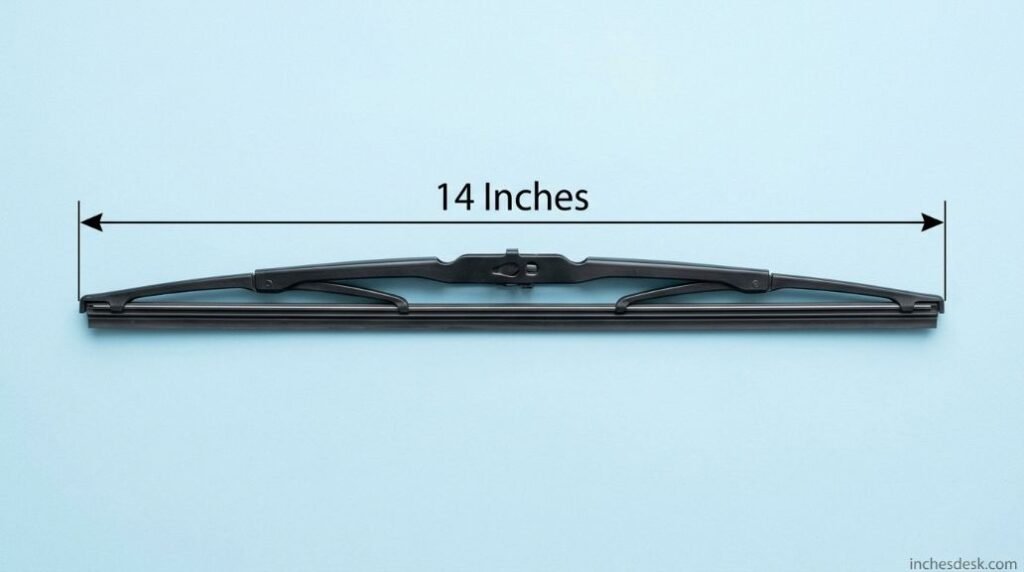
A 14-inch windshield wiper blade measures 14 inches along its specified length, equivalent to 35.56 cm. This size is used on some vehicles, particularly for certain rear windows and smaller windshield applications.
Wiper blades are useful examples because they are long, narrow, and easy to compare with a ruler. However, the blade’s advertised length may not include every part of its mounting mechanism, and the correct size varies by vehicle.
If you are replacing a wiper blade, consult your vehicle manual or a reliable fitment guide rather than choosing one based on length alone.
Kids’ 14-Inch Bicycle Wheel
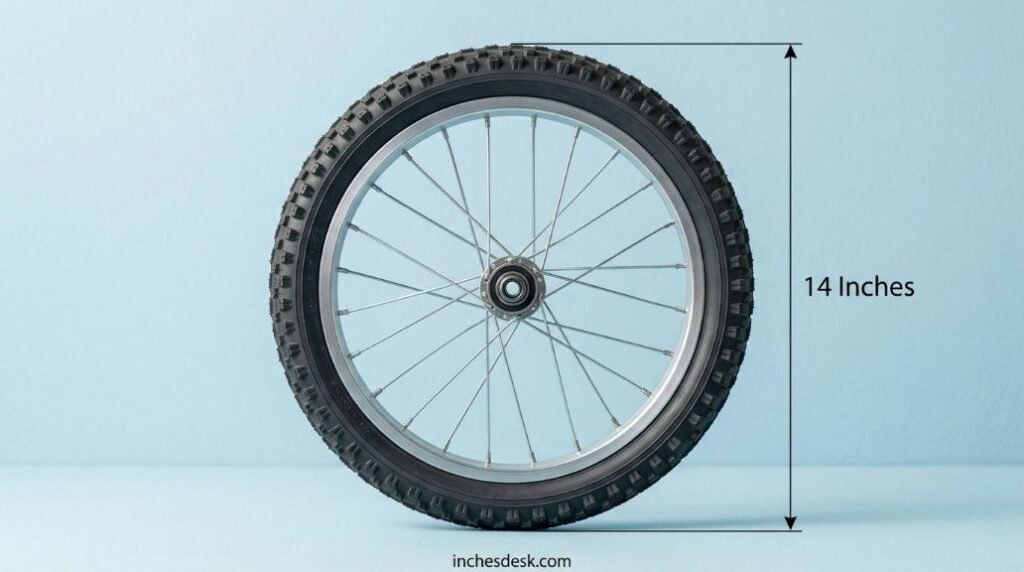
A children’s bicycle described as having 14-inch wheels offers another familiar example of this measurement. These bicycles are designed for young riders and often feature a compact frame, a low seat, and a manageable overall size.
The 14-inch designation generally refers to the wheel size category, not the bicycle’s total length or height. The actual outside diameter of the tire can differ from the nominal wheel measurement because of the tire’s construction and thickness.
This example is particularly helpful for parents shopping for a child’s first or next bicycle. Check the manufacturer’s height recommendations and the child’s fit on the bicycle before purchasing.
Kitchenaid-Style Stand Mixer (Height)
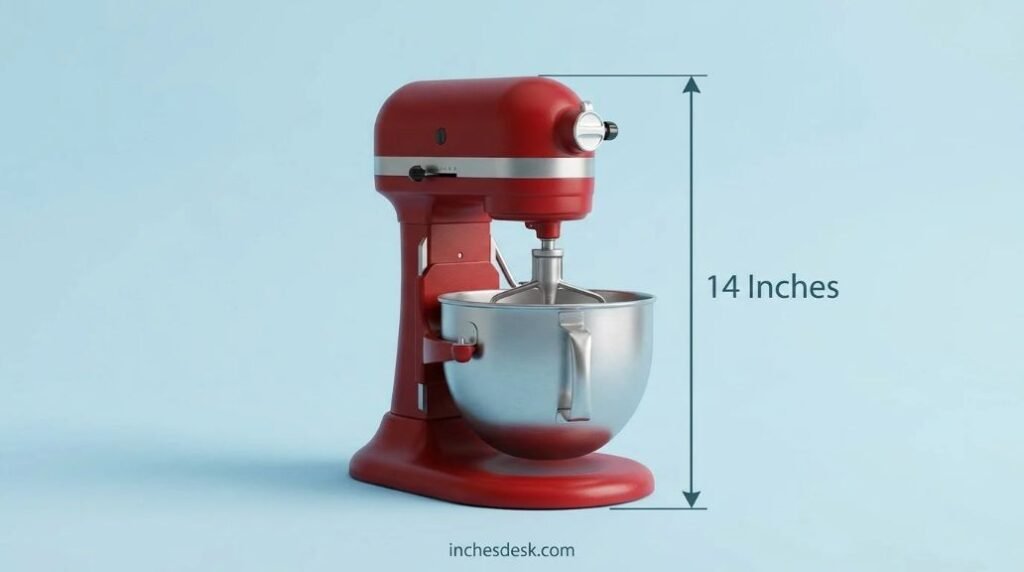
Some tilt-head stand mixers have an overall height close to 14 inches, although dimensions vary by model and brand. Their rounded body, mixing bowl, and raised head make them recognizable kitchen appliances for visualizing a measurement of approximately 35.56 cm.
A mixer around this height may fit beneath some kitchen cabinets, but you should measure the available clearance before buying one. Remember to account for the additional vertical space required when lifting the mixer head to remove the bowl or add ingredients.
For a practical comparison, imagine the appliance standing beside a 12-inch ruler. A mixer measuring 14 inches tall would extend 2 inches above the ruler’s top.
14-Inch Snare Drum
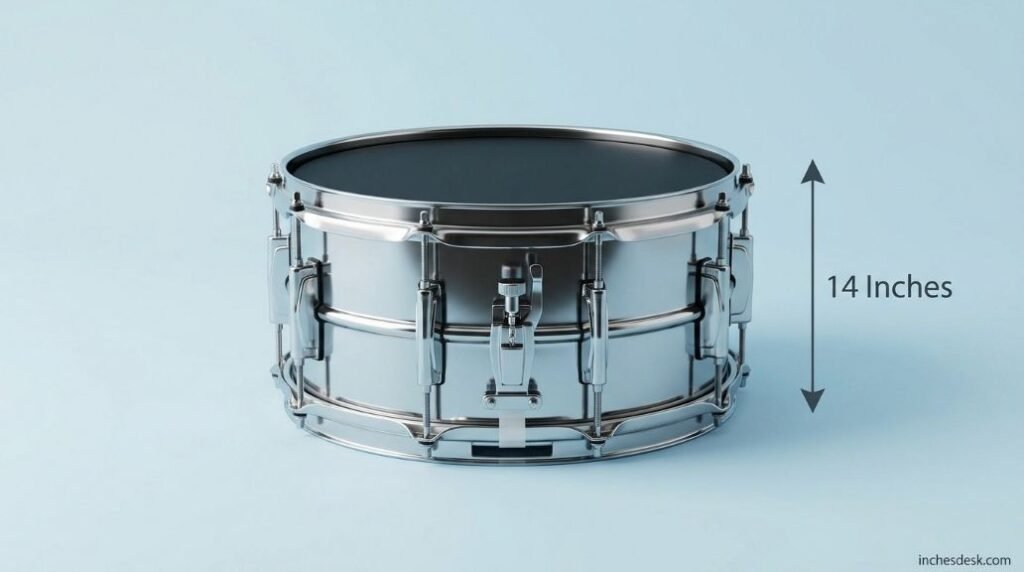
A 14-inch snare drum is a common drum size in many drum kits. The 14-inch measurement usually describes the drum’s diameter, rather than the height of the drum shell.
A 14-inch diameter equals 35.56 cm across. To picture this size, imagine drawing a straight line from one edge of the drumhead to the opposite edge through the center.
This is a useful example because it demonstrates that a measurement can describe an object’s width across a circle rather than its length from end to end. Drum depth is a separate dimension and varies between models.
Hi-Hat Cymbals
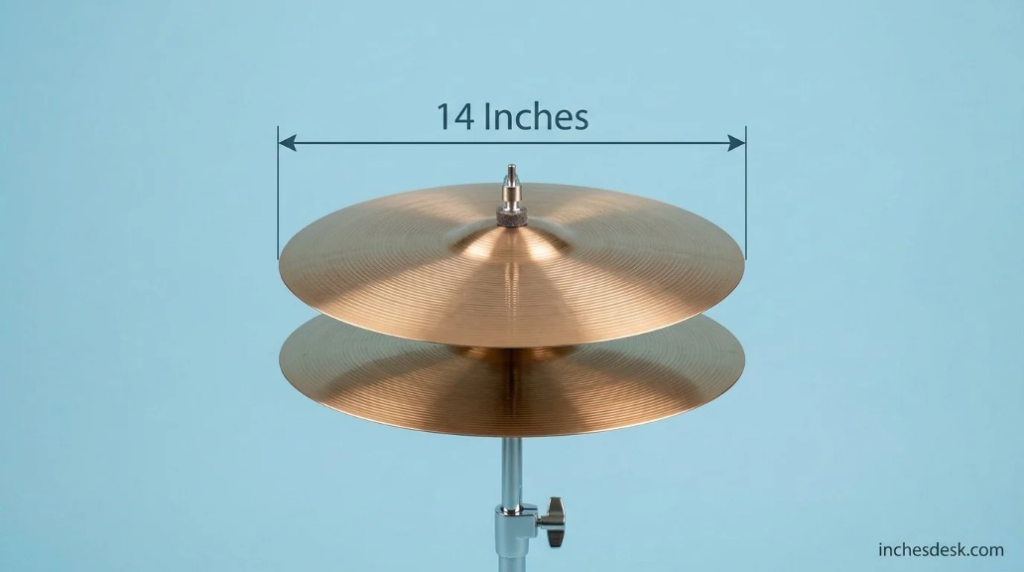
Hi-hat cymbals are a standard component of many drum kits, and 14-inch models are widely used. The measurement refers to the diameter of each cymbal, making the pair a good example of a circular object that measures approximately 35.56 cm across.
Hi-hats consist of two cymbals mounted horizontally on a stand. A pedal brings them together or separates them to produce different sounds.
Because the cymbals are thin and broad, they look quite different from a 14-inch pipe wrench or wiper blade despite sharing the same nominal measurement. This comparison illustrates how the shape of an object influences its appearance.
14-Inch Pipe Wrench
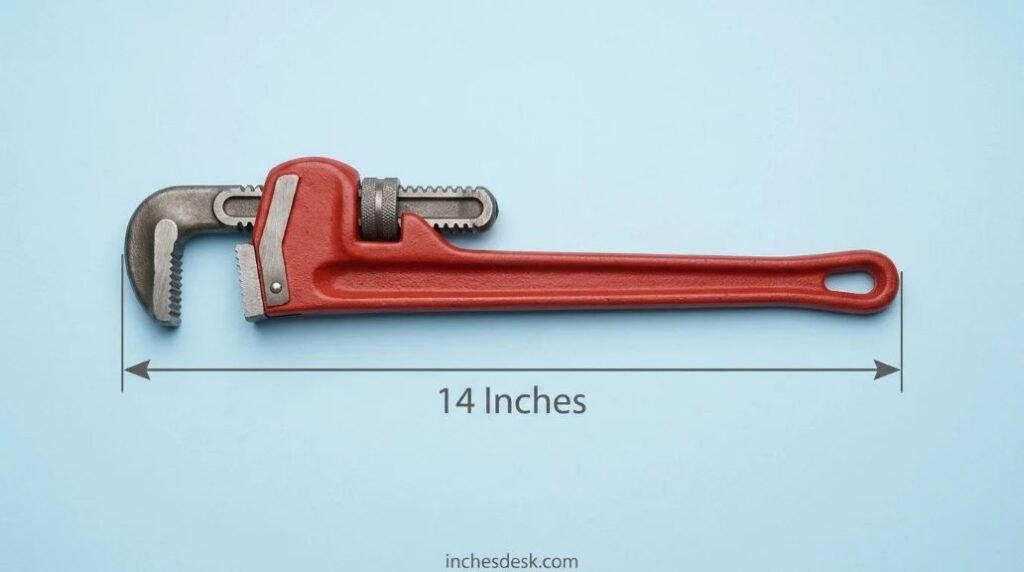
A 14-inch pipe wrench is a plumbing tool used to grip and turn threaded pipes and fittings. Its stated size typically refers to the tool’s nominal overall length, although exact dimensions can vary by manufacturer.
At approximately 35.56 cm, this wrench provides a practical reference for a handheld tool that is noticeably longer than a standard 12-inch ruler. Its long handle helps provide leverage when turning suitable pipe fittings.
Pipe wrenches come in multiple sizes, and the right choice depends on the pipe diameter, available working space, and the manufacturer’s specifications. Do not assume that a 14-inch wrench can accommodate a 14-inch pipe; tool length and pipe capacity are different measurements.
14-Inch Bolt Cutters
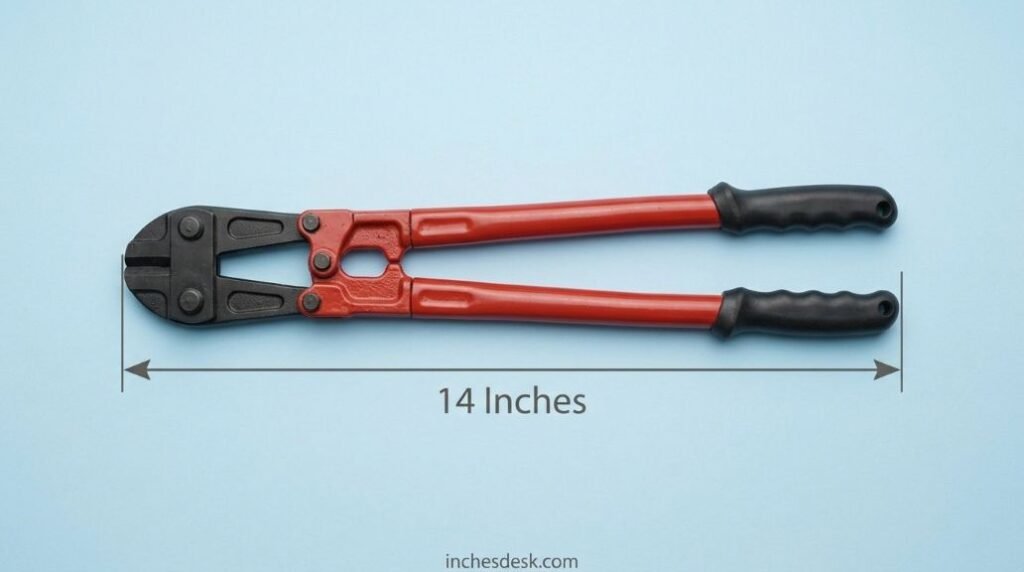
Fourteen-inch bolt cutters are compact cutting tools designed for certain types and sizes of metal fasteners, wire, and similar materials. Their handles extend to provide leverage, while the short cutting jaws concentrate force on the material.
A tool listed as 14 inches long is approximately 35.56 cm from one end to the other, depending on how the manufacturer defines its dimensions. This makes it a useful example of a tool that is longer than a ruler but still portable enough for many toolboxes.
Cutting capacity depends on the tool’s construction and the material being cut. Always follow the manufacturer’s guidance, wear appropriate eye protection, and avoid using bolt cutters on materials beyond their rated capacity.
14-Inch Chop Saw Blade
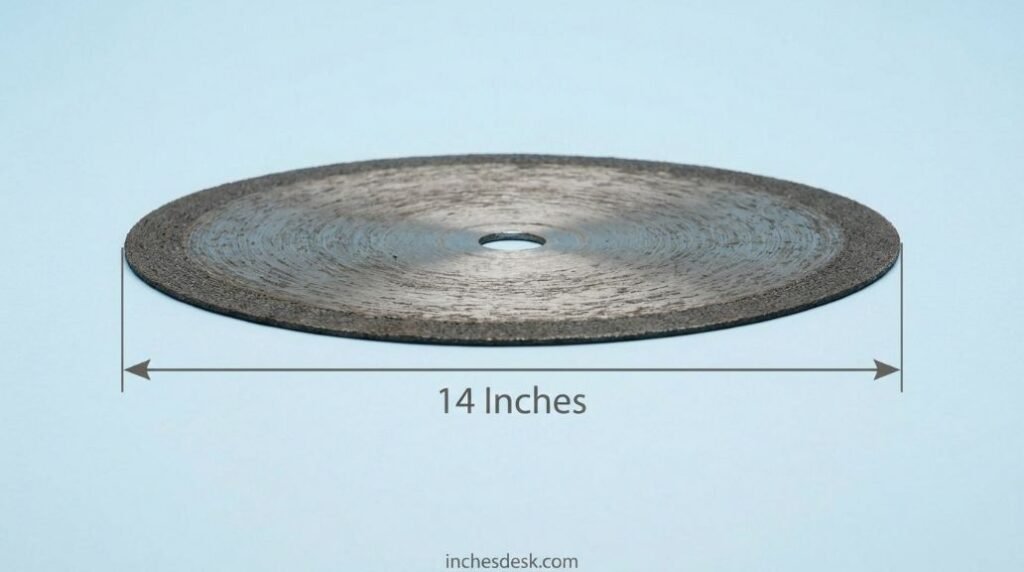
Some chop saws use 14-inch cutting discs, particularly in metalworking and construction applications. A 14-inch disc has a nominal diameter of 35.56 cm, measured straight across its center.
This circular shape makes the blade a useful reference for understanding the difference between diameter and length. Although the disc measures 14 inches across, the saw itself is considerably larger because it includes the motor, guard, base, and handle.
Not every 14-inch cutting disc is suitable for every chop saw. Before purchasing a replacement, confirm the required diameter, arbor size, material rating, maximum operating speed, and compatibility with the machine.
Small Car Or Trailer Wheel Rim
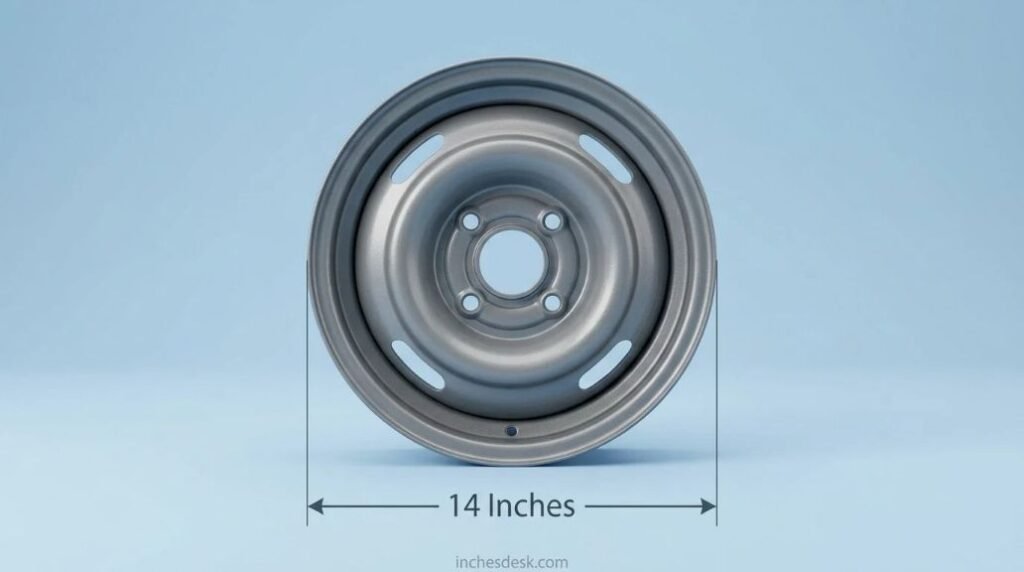
A small vehicle or trailer wheel rim may be described as a 14-inch rim. In this context, the measurement generally refers to the nominal rim diameter where the tire seats, rather than the wheel’s complete outside diameter.
This distinction matters because the tire extends beyond the metal rim. As a result, a wheel fitted with a 14-inch rim can have an overall outside diameter considerably greater than 14 inches.
When replacing a wheel, check the rim diameter, width, bolt pattern, offset, load rating, and tire compatibility. The number 14 alone is not enough to establish whether a wheel will fit a particular car or trailer.
Standard Round Toilet Seat (Width)
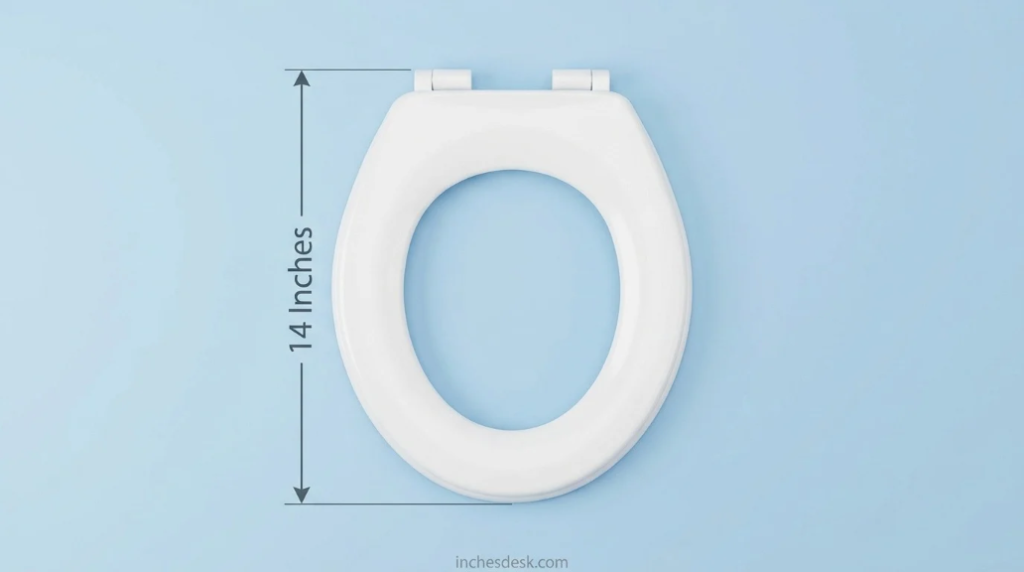
Some round toilet seats measure close to 14 inches across their widest section, making them a possible household reference for this measurement. However, toilet-seat dimensions vary by shape, model, and manufacturer, so 14 inches should be treated as an approximate example rather than a universal standard.
The width is measured from one outer side to the other at the widest point. It is different from the seat’s front-to-back length, which is another important dimension when selecting a replacement.
If you are buying a toilet seat, measure the existing seat and check the distance between the mounting holes. Matching the shape and mounting dimensions is essential for a secure fit.
Car Steering Wheel (Diameter)
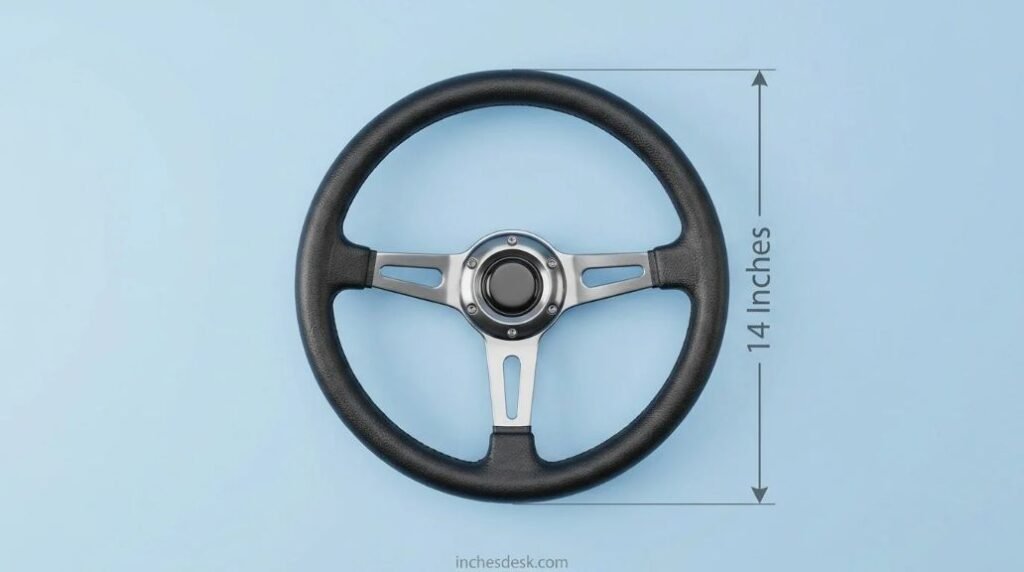
A car steering wheel can measure around 14 inches in diameter, depending on the vehicle and steering-wheel design. This is approximately 35.56 cm across, measured from one outer edge to the opposite edge through the center.
A steering wheel is a helpful example because its circular shape makes the measurement easy to visualize. It also shows why identifying the correct dimension matters: a wheel’s diameter is not the same as the circumference around its rim.
Steering-wheel sizes differ between vehicles. If you need a cover or replacement component, measure the specific wheel and check the product’s compatibility rather than assuming every car uses a 14-inch diameter.
Standard 2-Liter Hot Water Bottle
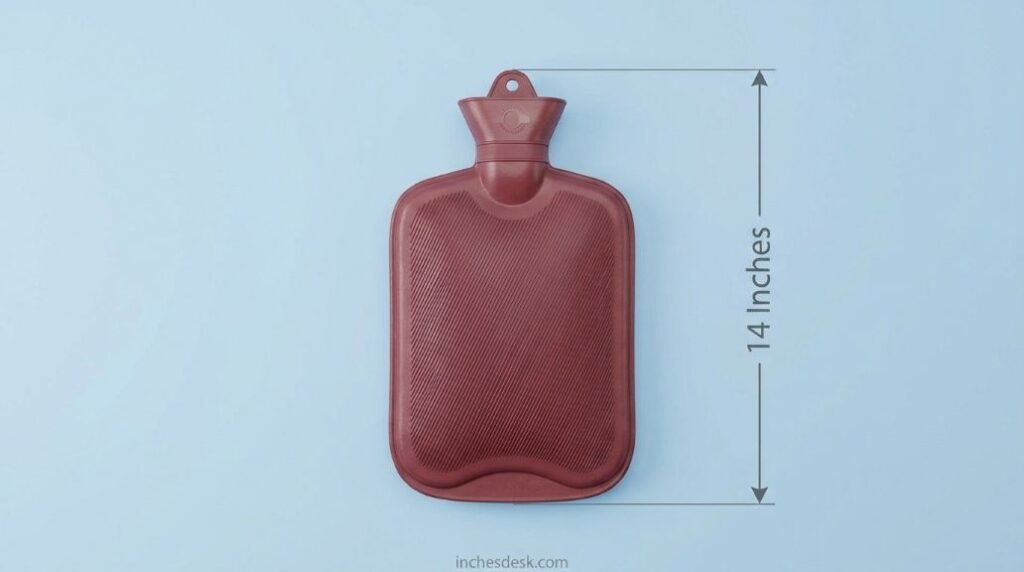
A 2-liter hot water bottle can be a useful reference for an object with a dimension near 14 inches, depending on its shape and design. These bottles are commonly made from flexible rubber or similar materials and feature a screw-top opening.
However, 2 liters describes capacity, not length. A bottle holding 2 liters of water does not automatically measure 14 inches tall or wide. Its dimensions depend on its shape, wall thickness, and manufacturer.
Use this example as a visual comparison only when the bottle’s actual dimensions are close to 14 inches. If you need a precise reference, check the product specifications or measure the bottle itself.
Where Is 14 Inches Commonly Used?
Fourteen inches is used in several everyday settings, including automotive parts, tools, musical instruments, children’s bicycles, and household equipment. Depending on the product, it may describe the length of an object, the diameter of a circular component, or a nominal size used to identify compatible parts.
Understanding where this measurement appears can help you interpret product descriptions and avoid sizing mistakes.
Automotive applications: Some vehicles use 14-inch windshield wiper blades, while certain cars and trailers have wheels with 14-inch nominal rim diameters. These measurements refer to different components, so they should not be confused with a vehicle’s overall dimensions.
Tools and construction: Pipe wrenches and bolt cutters are available in sizes around 14 inches. In these cases, the number generally describes the tool’s nominal length. Builders and DIYers may also encounter 14-inch dimensions when cutting boards, planning storage spaces, or measuring small components.
Music and entertainment: Fourteen-inch snare drums and hi-hat cymbals are familiar examples of circular equipment. Their size is typically specified by diameter, which helps musicians select compatible components and arrange their drum kits.
Children’s bicycles: A 14-inch bicycle is a common product category for young riders. The number refers to the nominal wheel size, not the bicycle’s total length. Choosing the right bicycle requires checking the child’s fit and the manufacturer’s sizing recommendations.
Household and kitchen equipment: Some stand mixers, toilet seats, and hot water bottles have dimensions near 14 inches. These are model-dependent examples rather than universal standards, so measuring the specific product is the best way to confirm its size.
Shopping and product packaging: Online listings often display dimensions in inches, especially for tools, replacement parts, appliances, and storage products. Knowing that 14 inches equals 35.56 cm makes it easier to compare those listings with products specified in centimeters or millimeters.
How To Measure 14 Inches Without A Ruler
You can measure 14 inches without a ruler by combining familiar objects, using a known paper dimension, or estimating the distance with your hand. Since 14 inches equals 35.56 cm, you can also use a metric measuring tool if one is available. These methods are useful for quick household estimates, DIY projects, and checking product sizes when a standard ruler is not nearby.
Method 1: Use a Standard Sheet of Paper
A standard US letter-size sheet of paper measures 8.5 inches wide and 11 inches long. Its longer edge gives you a convenient starting point for estimating 14 inches.
- Start with the paper’s 11-inch edge.
- Add another 3 inches using a familiar reference or visual estimate.
- The combined length is 14 inches.
This method is helpful when checking the approximate length of a small object or planning a simple household project. However, paper alone will not give you an exact 14-inch measurement unless you have a way to mark the additional 3 inches accurately.
Method 2: Use a Known 12-Inch Object
If you have an object with a confirmed length of 12 inches, you can use it as a starting point.
- Place the 12-inch object alongside the area you want to measure.
- Identify its endpoint.
- Extend the measurement by another 2 inches.
- Mark the final endpoint if you need to remember the measurement.
A verified 12-inch ruler or measuring stick works best. Other objects may be described as 12 inches long without having precisely that dimension, so check their specifications before relying on them.
Method 3: Use a Tape Measure in Centimeters
If you do not have an inch ruler but have a metric tape measure, measuring 14 inches is straightforward.
The conversion formula is:
Inches × 2.54 = centimeters
For 14 inches:
14 × 2.54 = 35.56 cm
Measure 35.56 cm on the tape measure to find the exact equivalent of 14 inches. If your tape measure displays only whole millimeters, use 356 mm as a practical rounded measurement.
This method is especially useful for furniture, replacement parts, craft projects, and home improvement tasks where accuracy matters.
Method 4: Estimate With Your Hand
Your hand can serve as a rough reference when you need to estimate a length quickly. However, hand sizes vary considerably from person to person.
For example, measure the span between your thumb and little finger when your hand is fully extended. If you know that span from a previous measurement, you can repeat it along the object to estimate its length.
Read More: 16 Inches: How Long Is It? (Size Guide + Everyday Objects)
Avoid assuming that one handspan always equals a particular number of inches. If you need a dependable estimate, establish your own hand measurement with a tape measure first.
Method 5: Use a Smartphone Measurement App
Some smartphones include built-in measuring tools or support augmented-reality measurement apps. Depending on the device and conditions, these apps can estimate the distance between two points.
To measure 14 inches:
- Open a compatible measurement app.
- Position the phone so the object and its endpoints are clearly visible.
- Follow the app’s instructions to identify the starting and ending points.
- Check whether the displayed result is in inches or centimeters.
Phone-based measurements can be useful for quick estimates, but their accuracy depends on the camera, lighting, surface conditions, and how clearly you identify the endpoints. Use a physical measuring tool when a precise measurement is essential.
Best method: For an accurate 14-inch measurement, use a ruler or tape measure. If you only need a rough comparison, a known 12-inch object plus another 2 inches is an easy way to visualize the length.
Common Mistakes When Estimating 14 Inches
Estimating 14 inches can be straightforward once you know the conversion, but several common mistakes can lead to incorrect measurements. These errors often occur when people confuse length with diameter, assume that product labels describe overall dimensions, or rely too heavily on visual comparisons.
Confusing Inches With Feet
One common mistake is confusing 14 inches with 14 feet. These are very different lengths.
- 14 inches = 1 foot 2 inches
- 14 feet = 168 inches
Remember that one foot contains 12 inches. Therefore, 14 inches is only slightly longer than one foot, not a measurement of several feet.
Assuming Every Product Labeled 14 Inches Measures Exactly 14 Inches
A product’s advertised size does not always describe its complete outside length. For example, a 14-inch bicycle wheel may use a nominal sizing convention, while a 14-inch chop saw blade is identified by its nominal diameter.
Before buying a product, check whether the listed measurement refers to its overall length, width, height, diameter, or a specific component.
Confusing Diameter With Circumference
Diameter and circumference describe different measurements of a circular object.
- Diameter: The straight-line distance across a circle through its center.
- Circumference: The total distance around the outside edge of a circle.
A circular object with a 14-inch diameter has a circumference of approximately 44 inches, not 14 inches.
This distinction is particularly important when measuring wheels, drums, cymbals, and other round objects.
Forgetting to Convert Inches Correctly
When switching between imperial and metric measurements, using the wrong conversion factor can produce inaccurate results.
Use these formulas:
| Conversion | Formula | Result for 14 inches |
| Inches to centimeters | Inches × 2.54 | 35.56 cm |
| Inches to millimeters | Inches × 25.4 | 355.6 mm |
| Inches to feet | Inches ÷ 12 | 1.167 feet |
Forgetting the decimal point or confusing centimeters with millimeters can create a substantial error. Remember that 35.56 cm equals 355.6 mm.
Relying Only on Visual Estimation
An object may appear to be 14 inches long when viewed from a distance, even if it is several inches shorter or longer. Perspective, object shape, and the surrounding environment can affect how large something looks.
Visual comparisons are useful for understanding size, but they are less reliable when cutting materials, installing replacement parts, or checking whether an item fits inside a cabinet.
For projects requiring accuracy, measure the object directly rather than estimating by sight.
Ignoring Available Space and Clearance
Even if an object measures exactly 14 inches, it may not fit into a space that is also 14 inches wide. Handles, mounting brackets, protruding parts, and installation requirements can increase the space needed.
For example, before placing a 14-inch appliance beneath a cabinet, check the available height and leave sufficient clearance for ventilation or opening moving parts where required.
FAQs
How Long Is 14 Inches In Cm?
14 inches equals 35.56 centimeters (cm). To convert inches to centimeters, multiply the inch measurement by 2.54. Therefore, 14 × 2.54 = 35.56 cm. This conversion is useful when comparing product dimensions, measuring household items, or working with metric specifications.
How Many Mm Are In 14 Inches?
14 inches equals 355.6 millimeters (mm). Multiply 14 by 25.4 because one inch equals 25.4 millimeters. For practical measurements using whole millimeters, you can round 355.6 mm to approximately 356 mm.
Is 14 Inches Bigger Than 1 Foot?
Yes, 14 inches is 2 inches longer than 1 foot. One foot contains 12 inches, so 14 inches equals 1 foot 2 inches. This makes it slightly longer than a standard 12-inch ruler.
Is 14 Inches The Same As 35 Cm?
No, 14 inches is slightly longer than 35 cm. 14 inches equals 35.56 cm, which is 0.56 cm, or 5.6 mm, longer than 35 cm. Although the difference is small, use the exact conversion when precise measurements are required.
How Tall Is 14 Inches?
14 inches is 35.56 cm tall when measured vertically. It is equivalent to 1 foot 2 inches. The height of an object depends on its orientation, so a 14-inch measurement could describe its height, width, or length depending on how it is positioned.
What Is A Good Household Item That Is 14 Inches?
A useful reference is a 12-inch ruler with an additional 2 inches added to its length. You can also compare 14 inches with a sheet of US letter paper, which is 11 inches along its longer edge, plus another 3 inches. These comparisons help visualize the measurement, but the additional length must be estimated unless you have a measuring tool.
How Can I Measure 14 Inches Without A Ruler?
You can estimate 14 inches using a known 12-inch object and adding another 2 inches, or use a metric tape measure to find 35.56 cm. A smartphone measuring app can also provide an estimate. For precise work, a calibrated tape measure or ruler is the most reliable option.
Is 14 Inches Considered Large?
Whether 14 inches is large depends on the object. It is a relatively long measurement for a handheld tool or a small household component, but short for furniture or larger equipment. At 35.56 cm, it provides a useful reference for tools, musical instruments, and certain automotive parts.
Conclusion
Fourteen inches measures 1 foot 2 inches, 35.56 cm, or 355.6 mm. It is 2 inches longer than a standard 12-inch ruler and offers a useful reference for understanding the dimensions of everyday objects.
From windshield wiper blades and pipe wrenches to snare drums and bicycle wheels, many products have dimensions close to 14 inches. However, some use nominal sizing, so it is essential to distinguish between overall length, height, width, and diameter.
When you need a quick estimate, compare the measurement with a familiar 12-inch ruler and add 2 inches. For DIY projects, shopping, repairs, or installation work, use a proper measuring tool to confirm the exact dimensions before making a decision.
