
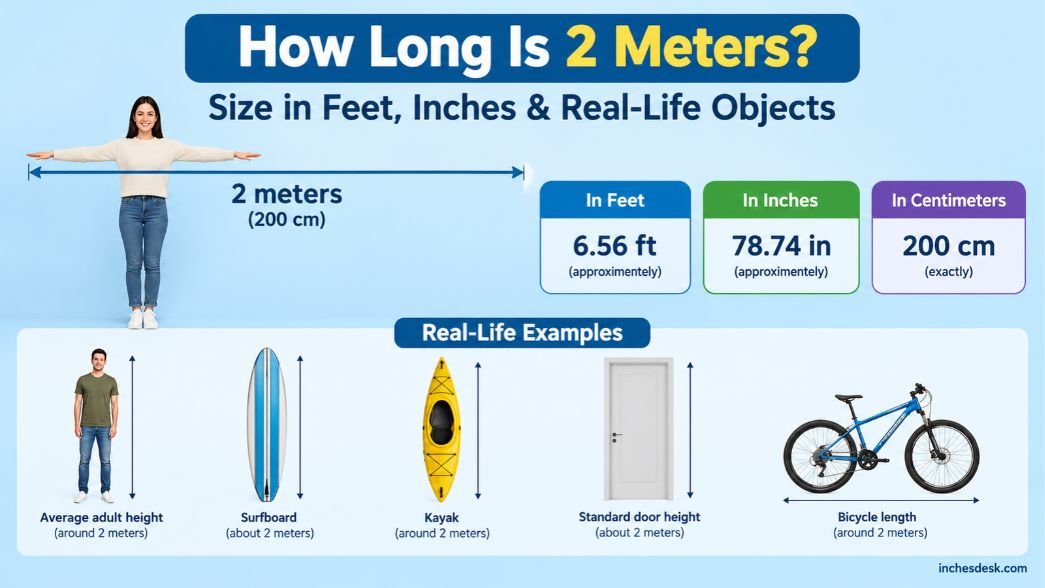
How Long Is 2 Meters?
2 meters is equal to 6.56 feet, 78.74 inches, or 200 centimeters. It is slightly longer than 6 feet 6 inches and provides a useful reference length for measuring furniture, sleeping equipment, household spaces, and other everyday objects.
If you use the metric system, 2 meters is a straightforward measurement. If you are more familiar with feet and inches, picturing a length of approximately 6 feet 6.7 inches can make it easier to understand.
Here are the essential conversions at a glance:
- Meters: 2 m
- Feet: 6.56 ft
- Feet and inches: 6 ft 6.74 in
- Inches: 78.74 in
- Centimeters: 200 cm
- Millimeters: 2,000 mm
- Yards: 2.19 yd
To convert meters into other units, multiply the measurement by the appropriate conversion factor. For example, multiply 2 by 3.28084 to convert meters to feet:
2 × 3.28084 = 6.56168 feet
Rounded to two decimal places, the result is 6.56 feet.
For a quick visual reference, imagine a line stretching across a large portion of a typical bedroom or the length of a full-sized single bed. Many single beds are close to 2 meters long, although their exact dimensions vary by country and model.
Remember that 2 meters describes length, not height or area. When checking whether an item will fit into a room, vehicle, or storage space, measure the relevant dimension rather than relying entirely on a visual estimate.
2 Meters Conversion Chart
Two meters equals 200 centimeters, 2,000 millimeters, 78.74 inches, and approximately 6.56 feet. The conversion chart below provides the most commonly used equivalents, making it easier to switch between metric and imperial measurements for schoolwork, shopping, DIY projects, and construction tasks.
| Measurement unit | Equivalent to 2 meters |
|---|---|
| Kilometers | 0.002 km |
| Meters | 2 m |
| Centimeters | 200 cm |
| Millimeters | 2,000 mm |
| Micrometers | 2,000,000 µm |
| Feet | 6.56 ft |
| Feet and inches | 6 ft 6.74 in |
| Inches | 78.74 in |
| Yards | 2.19 yd |
How to convert 2 meters into other units
Use these formulas to calculate the equivalent measurement:
- Meters to feet: Multiply meters by 3.28084.
- 2×3.28084=6.56 feet.
- Meters to inches: Multiply meters by 39.3701.
- 2×39.3701=78.74 inches.
- Meters to centimeters: Multiply meters by 100.
- 2×100=200 centimeters.
- Meters to millimeters: Multiply meters by 1,000.
- 2×1,000=2,000 millimeters.
- Meters to yards: Multiply meters by approximately 1.09361.
- 2×1.09361≈2.19 yards.
When converting feet into feet and inches, separate the whole-number portion from the decimal portion. For 6.56168 feet, the whole-number portion is 6 feet. Multiply the remaining 0.56168 feet by 12 to get approximately 6.74 inches. Therefore, 2 meters is approximately 6 feet 6.74 inches.
How Long Is 2 Meters Visually?
Two meters is approximately 6 feet 6.7 inches long, or about the length of a typical single bed. To picture this distance, imagine a straight line stretching across a small bedroom, the length of a large sleeping bag, or the height of a very tall adult when measured from head to toe.
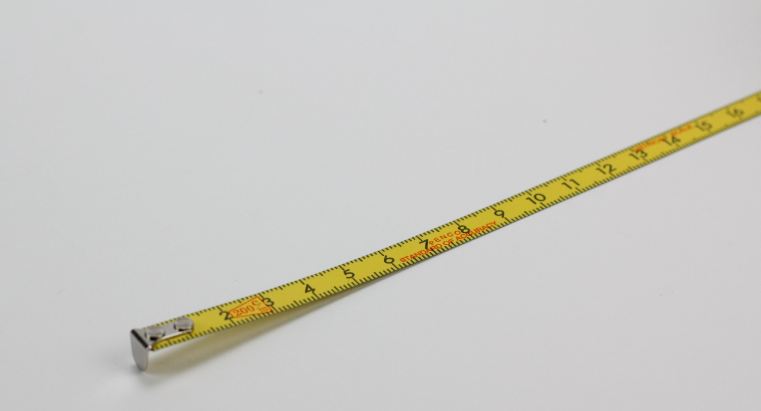
If you are used to measuring in feet and inches, 2 meters is a little longer than 6 feet. It is also longer than a standard doorway’s height in many homes, although doorway dimensions vary by country and building.
Here are a few ways to visualize the measurement:
- Compared with a person: 2 meters is taller than most adults, making it a useful reference for imagining a vertical measurement.
- Compared with furniture: The length of many single beds is close to 2 meters, depending on the mattress size and bed frame.
- Compared with a room: A 2-meter line would cover a substantial portion of a small bedroom’s width.
- Compared with a measuring tape: A standard 2-meter tape measure, when fully extended, gives you a direct reference for the distance.
One practical trick is to mark two points on the floor exactly 2 meters apart. Step back and look at the space between them. This can help you estimate the length of furniture, fabric, or other objects before measuring them precisely.
Keep in mind that 2 meters of length is not the same as 2 square meters of area. Length measures the distance between two points, while square meters measure a surface. For example, a space measuring 2 meters by 1 meter has an area of 2 square meters.
10 Things That Are About 2 Meters Long
Single Hospital Bed

A single hospital bed can be close to 2 meters long, depending on its design and intended patient size. Many adult hospital beds have mattress lengths around 190–210 centimeters, with the overall bed frame sometimes extending farther.
This makes a hospital bed a useful reference when picturing 2 meters. If you have seen a standard adult bed in a hospital room, imagine its length from the head end to the foot end.
For accurate measurements, distinguish between the mattress length and the total bed length. The frame, headboard, and footboard may add several centimeters or more.
Double Bass

A double bass is a large string instrument used in orchestras, jazz groups, and other musical performances. A full-size instrument can measure roughly 1.8–2 meters in total height, depending on its model and design.
Although the double bass is normally measured vertically rather than horizontally, its overall size provides a useful visual comparison for a 2-meter distance.
If you imagine the instrument standing upright on the floor, its height is close to the measurement you are trying to picture. Smaller double basses are also available, so not every instrument reaches this size.
Adult Sleeping Bag

An adult sleeping bag is another familiar object that can measure approximately 2 meters long. Many standard adult models fall around 180–210 centimeters, while longer versions are available for taller users.
When a sleeping bag is laid flat and fully extended, its length is easy to compare with a 2-meter measurement. This makes it especially useful for campers choosing equipment or estimating how much room they need inside a tent.
Remember that the advertised length may refer to the maximum overall dimension rather than the comfortable sleeping area. Check the product specifications if you need a precise fit.
Bunk Bed Frame
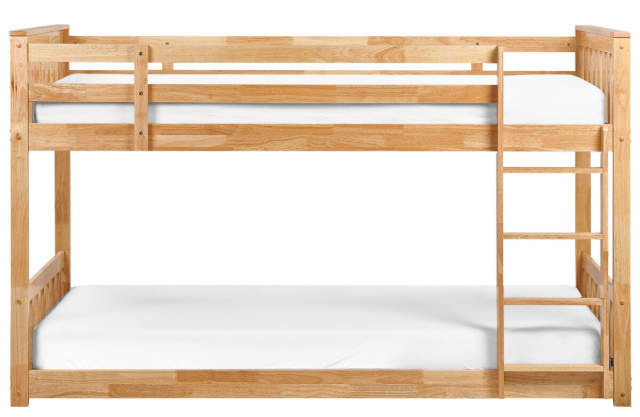
Many bunk bed frames are approximately 2 meters long, particularly those designed for standard single mattresses. Depending on the mattress size and construction, the frame may measure around 190–210 centimeters or more.
A bunk bed is a useful reference because its length is easy to see along the side rails. Picture the distance from the headboard to the footboard of one bunk, rather than measuring the height of the entire structure.
This comparison is helpful when planning a children’s bedroom, arranging furniture, or checking whether a bunk bed will fit along a wall. Always measure the complete frame, as it may be longer than the mattress it supports.
Tatami Mat
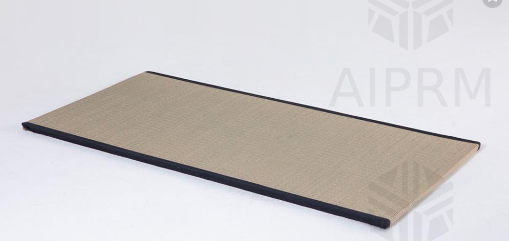
A traditional Japanese tatami mat can have a length close to 1.8–2 meters, depending on the regional format. Tatami mats are rectangular floor coverings traditionally used in Japanese rooms, and their dimensions vary by location and application.
A larger tatami mat offers a useful reference for understanding a length close to 2 meters. However, there is no single universal tatami size, so it should be treated as an approximation rather than an exact measuring standard.
If you are planning a floor layout or buying tatami mats, check the listed length and width separately. The total floor area depends on both dimensions, not length alone.
Pool Cue Rack or Pool Lane Rope Sections
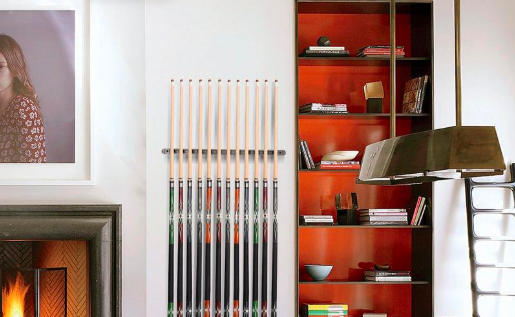
Pool-related equipment can help illustrate a distance of around 2 meters, although the dimensions differ considerably between items.
A pool cue is often approximately 1.45 meters long, which is noticeably shorter than 2 meters. A longer cue storage arrangement or a section of swimming pool lane rope may extend to around 2 meters or beyond, depending on the setup.
For a clear comparison, imagine measuring a section of lane rope laid straight along a pool deck. A 2-meter section provides a useful reference, but pool lane ropes are not manufactured to one universal 2-meter section length.
If you need this comparison for a particular sport or equipment purchase, use the manufacturer’s dimensions rather than assuming all pool equipment has the same size.
Tall Floor Lamp
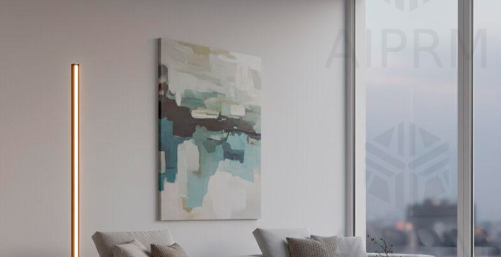
A tall floor lamp can approach 2 meters in height, although many common floor lamps are shorter, often around 1.5–1.8 meters. Extra-tall decorative or commercial models may reach approximately 2 meters.
Picture a floor lamp standing beside a sofa. A model that reaches close to the ceiling in a room with a standard ceiling height can help you visualize the measurement vertically.
This example is useful when selecting lighting for a living room or office. Check the lamp’s total height, including any shade or decorative top, before purchasing it for a space with limited clearance.
Standard Shower Curtain Rod Set
Many shower curtain rods are adjustable to fit openings around 1.5–2 meters wide, making them a useful reference for a horizontal distance close to 2 meters.
Imagine a rod stretching across the opening of a bathtub or shower area. When extended to 200 centimeters, it spans exactly 2 meters from one end to the other.
Not every shower curtain rod reaches this length. Some models are designed for narrower shower spaces, while others extend beyond 2 meters. If you are replacing a rod, measure the wall-to-wall opening and check the product’s adjustment range.
Large Floor Cushion or Body Pillow Bed
An extra-long body pillow, floor cushion, or mattress-style floor pad can approach 2 meters in length. Some body pillows measure around 150 centimeters, while longer sleeping cushions and floor pads may reach 180–200 centimeters.
These items are useful visual references because they are often laid out in a straight line. Imagine a long floor cushion stretched from one end to the other across a bedroom floor.
However, ordinary body pillows are often shorter than 2 meters. For a reliable comparison, look for products explicitly listed at 200 centimeters long.
Camping Cot
A full-size camping cot is often close to 2 meters long, with many adult models measuring approximately 180–210 centimeters. Its length provides a practical comparison for anyone shopping for camping gear or planning a sleeping area inside a tent.
When the cot is unfolded, look at the distance between its head and foot ends. This gives you a good sense of how much space 2 meters occupies.
The overall frame may be longer than the usable sleeping surface. If you are checking whether a cot will fit inside a tent, measure both the cot and the tent’s interior dimensions, leaving additional room for movement and storage.
People and Animals That Are About 2 Meters
A height or body length of 2 meters equals 200 centimeters, or approximately 6 feet 6.7 inches. This is taller than most adults, but some basketball players and other athletes reach this height. Certain animals can also measure around 2 meters in body length or height, depending on the species and how the measurement is taken.
Here are several useful comparisons to help you visualize the distance.
- A very tall adult: Someone who is 2 meters tall stands approximately 6 feet 6.7 inches from head to foot. This is considerably taller than the average adult in most populations.
- A professional basketball player: Some basketball players are around or above 2 meters tall, making their height a practical reference for this measurement.
- A large kangaroo: Some large kangaroos can approach 2 meters in height when standing upright, although their size varies by species and individual.
- An emperor penguin: An adult emperor penguin can reach approximately 1.2 meters in height, so two penguins stacked vertically would be roughly comparable to 2 meters, though this is only a visual analogy.
- A large dog stretched out: Certain large dog breeds can approach 2 meters in total nose-to-tail length when fully stretched, although their standing height is much less.
It is important to distinguish between height and length when comparing people and animals. A person who is 2 meters tall measures that distance vertically, while an animal measuring 2 meters from nose to tail occupies that length horizontally.
For a quick mental picture, imagine a line extending from the floor to the top of a very tall adult’s head. If that person is 2 meters tall, the line represents the measurement exactly.
2 Meters in Real-World Use
A 2-meter measurement appears in many practical situations, from buying furniture to planning building projects. Knowing its equivalent in feet, inches, and centimeters helps you estimate dimensions when product listings or measuring tools use different units.
Here are some common situations where understanding 2 meters is useful.
- Furniture shopping: A bed frame or sofa may be close to 2 meters long. Checking its dimensions in centimeters helps you determine whether it will fit against a wall or in a bedroom.
- Home improvement: A 2-meter length of timber, pipe, or trim can be useful for smaller construction and repair projects. Before cutting, confirm the measurement and account for the width of the cutting blade where necessary.
- Interior design: When arranging furniture, 2 meters can help you estimate the distance between a sofa and a television stand or the available space along a wall.
- Clothing and fabric: Two meters of fabric can provide material for certain sewing projects, depending on the garment pattern, fabric width, and design.
- Camping: A sleeping bag or camping cot measuring close to 2 meters may suit an adult, but the user’s height and the product’s usable interior length matter.
- School assignments: Converting 2 meters into centimeters, millimeters, feet, and inches is a common exercise in measurement and unit conversion.
- Sports and fitness: A 2-meter distance can serve as a short spacing reference for drills, equipment placement, or indoor exercise layouts.
- Gardening: A 2-meter garden stake, plant support, or length of hose can help with basic layout and installation tasks.
When working with physical objects, use the unit that matches the tool or product specification. For example, if a shelf is listed as 200 centimeters long and your available wall space is 210 centimeters, the shelf should fit in principle, leaving 10 centimeters of total clearance. You would still need to account for brackets, surrounding obstacles, and installation requirements.
How to Measure 2 Meters Without a Ruler
You can estimate 2 meters without a ruler by using familiar objects, counting your steps, or measuring with your arm span. Two meters equals 200 centimeters or approximately 6 feet 6.7 inches, so choosing a reference with a known or predictable size can help you judge the distance.
Here are five practical methods you can use at home, outdoors, or on a job site.
1. Use your arm span
For many adults, the distance between the fingertips of both outstretched arms is roughly similar to their height. If you are close to 2 meters tall, your arm span may also be close to 2 meters.
However, arm spans vary from person to person. This method is best for a rough estimate rather than an exact measurement.
2. Count your steps
An ordinary walking step may cover approximately 60–80 centimeters, depending on your height and walking style. That means you may cover 2 meters in roughly 3 average walking steps.
For a more reliable estimate:
- Walk naturally across the distance.
- Count your steps from the starting point.
- Measure one step separately if you have access to a tape measure later.
- Adjust your estimate based on your usual step length.
Avoid assuming that everyone covers the same distance per step. Shorter steps may require four or more steps to cover 2 meters, while longer strides may cover it in fewer.
3. Use floor tiles
Floor tiles can be a convenient measuring reference if you know their dimensions. For example, if your tiles are 50 centimeters long, four tile lengths equal 2 meters.
The calculation is straightforward:
- One tile length = 50 cm.
- Four tile lengths = 4×50=200 cm.
- Therefore, four tile lengths = 2 meters.
Remember to check the actual tile size. Tiles that look similar may measure 30, 40, 50, or 60 centimeters, and grout lines can affect a rough visual estimate.
4. Use a standard door
A standard interior door can help you picture a distance close to 2 meters vertically. Many interior doors measure around 1.9–2.0 meters high, although dimensions differ by country and building.
Compare the door’s height with the distance you want to estimate. If the door is approximately 2 meters tall, its height provides a useful reference for measuring a wall, tall object, or vertical clearance.
Do not assume every door is exactly 2 meters high. If precision matters, check its specifications or measure it directly.
5. Use a piece of string or rope
If you have string or rope, you can create a reusable 2-meter measuring guide when a measuring tape is available.
- Measure and mark a length of 200 centimeters.
- Mark both endpoints clearly.
- Stretch the string straight without pulling it excessively.
- Use it as a reference for other objects or spaces.
This method is particularly useful for gardening, arranging furniture, and estimating distances outdoors. If the string stretches easily, choose a non-elastic material to maintain a consistent measurement.
Which method is best?
| Method | Accuracy | Best use |
|---|---|---|
| Arm span | Rough estimate | Quick visual comparisons |
| Walking steps | Rough estimate | Estimating outdoor distances |
| Floor tiles | Moderate if tile size is known | Indoor measurements |
| Door height | Moderate if door dimensions are known | Vertical comparisons |
| Marked string | Good if measured accurately | DIY and household tasks |
For work involving furniture fitting, construction, or cutting materials, use a proper measuring tape whenever possible. Estimation methods are useful for getting a sense of scale, but small errors can add up when precision is required.
2 Meters vs Other Lengths
Two meters is longer than 2 yards and 6 feet, but shorter than 7 feet. It equals 200 centimeters, 78.74 inches, or approximately 6.56 feet, making it easy to compare with other common lengths used in schoolwork, shopping, and DIY projects.
The table below shows how 2 meters compares with several familiar measurements.
| Length | Equivalent in meters | Difference from 2 meters |
|---|---|---|
| 1 meter | 1 m | 1 meter shorter |
| 1.5 meters | 1.5 m | 0.5 meter shorter |
| 2 yards | 1.83 m | 0.17 meter shorter |
| 6 feet | 1.83 m | About 17.3 cm shorter |
| 2 meters | 2 m | Reference length |
| 7 feet | 2.13 m | About 13.4 cm longer |
| 2.5 meters | 2.5 m | 0.5 meter longer |
| 3 meters | 3 m | 1 meter longer |
2 meters vs. 6 feet
Two meters is longer than 6 feet.
To compare them, convert 2 meters into feet:
- 2×3.28084=6.56168 feet.
- Subtract 6 feet: 6.56168−6=0.56168 feet.
- Convert the difference into inches: 0.56168×12≈6.74 inches.
Therefore, 2 meters is approximately 6 feet 6.74 inches, making it about 6.74 inches longer than 6 feet.
2 meters vs. 2 yards
Two meters is longer than 2 yards.
Since 1 yard equals 0.9144 meters, 2 yards equals 1.8288 meters. The difference is:
2−1.8288=0.1712 meters.
That means 2 meters is 17.12 centimeters longer than 2 yards, or approximately 6.74 inches longer.
2 meters vs. 200 centimeters
These two measurements are exactly equal.
The metric system defines 1 meter as 100 centimeters, so:
2×100=200 centimeters.
There is no difference between 2 meters and 200 centimeters. They express the same length using different units.
2 meters vs. 1.8 meters
Two meters is 20 centimeters longer than 1.8 meters.
This difference can be significant when buying furniture or planning a room layout. For example, a 1.8-meter sleeping surface may be suitable for some users, while a 2-meter model provides an additional 20 centimeters of length.
FAQs
Is 2 meters longer than 6 feet?
Yes, 2 meters is longer than 6 feet by approximately 6.74 inches. Six feet equals 1.8288 meters, while 2 meters equals approximately 6 feet 6.74 inches. The difference is small enough to overlook when estimating by eye, but it can matter when measuring furniture, doorways, or building materials.
How many inches is 2 meters?
Two meters equals approximately 78.74 inches. To convert meters into inches, multiply the measurement by 39.3701. For 2 meters, the calculation is 2×39.3701=78.7402 inches, which rounds to 78.74 inches. For quick estimates, you can use 79 inches.
Is 2 meters the same as 2 yards?
No, 2 meters is longer than 2 yards. Two yards equals 1.8288 meters, while 2 meters equals approximately 2.19 yards. The difference is 17.12 centimeters, or about 6.74 inches. This distinction is useful when measuring fabric, sports equipment, furniture, or other items listed in different units.
How many steps is 2 meters?
Most adults can cover 2 meters in approximately 3 ordinary walking steps, although the exact number depends on stride length. If each step covers around 60–80 centimeters, three steps may cover between 1.8 and 2.4 meters. For a better estimate, walk naturally and measure your usual step length before using it to calculate longer distances.
Is 2 meters a long distance?
Two meters is a relatively short distance for walking, but it is substantial when measuring furniture, household objects, or available space. It equals 200 centimeters, approximately 6 feet 6.74 inches, and is close to the length of many single beds. Whether 2 meters feels long depends on the task: it may be plenty of space for a small item but insufficient for a larger piece of furniture.
Conclusion
Two meters equals 200 centimeters, 2,000 millimeters, 78.74 inches, or approximately 6.56 feet. It is slightly longer than 6 feet and about 6 feet 6.74 inches when expressed in feet and inches.
You can picture this length by comparing it with a single bed, a camping cot, or a long household object. Arm spans, floor tiles, and marked string can also help you estimate 2 meters when a measuring tape is unavailable.
For everyday tasks, rounded measurements are usually sufficient. However, when buying furniture, cutting materials, or checking whether an object fits into a specific space, use the exact dimensions and a reliable measuring tool to avoid costly mistakes.
