
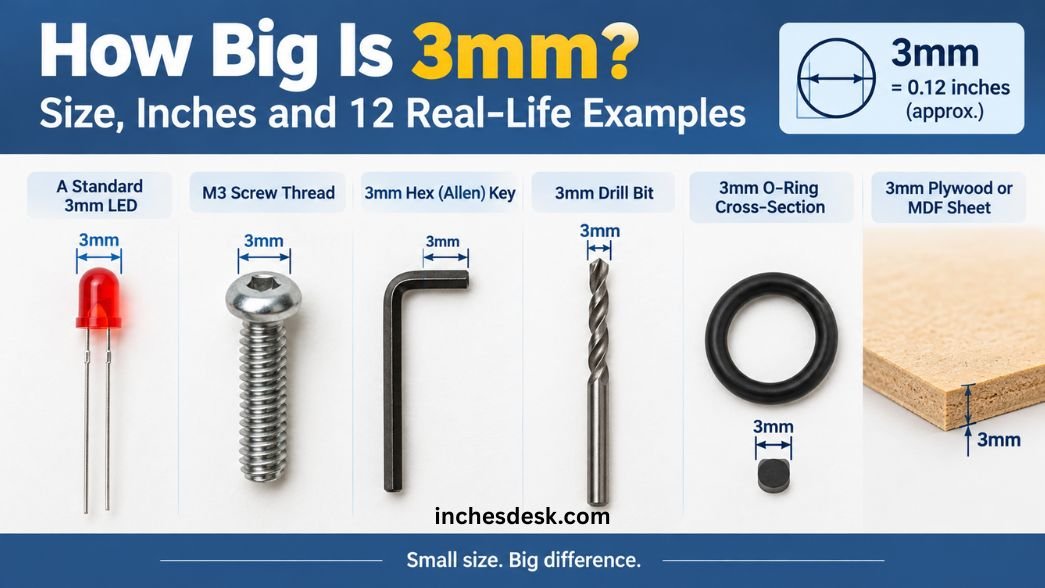
3mm is a small measurement equal to 0.3 centimeters, 0.003 meters, or approximately 0.118 inches. It is slightly smaller than 1/8 inch, making it a useful size to understand when working with small hardware, sheets, cords, tools, and other everyday materials.
3mm Conversion Chart
The following chart shows the most useful 3mm conversions in common measurement units.
| Measurement | Equivalent |
|---|---|
| Millimeters | 3 mm |
| Centimeters | 0.3 cm |
| Meters | 0.003 m |
| Inches | 0.1181 in |
| Feet | 0.00984 ft |
| Yards | 0.00328 yd |
| Micrometers | 3,000 µm |
To convert 3mm to inches, divide 3 by 25.4 because 1 inch = 25.4 millimeters:
3 ÷ 25.4 = 0.1181 inches
So, 3mm is approximately 0.12 inches. It is close to, but slightly smaller than, the commonly used 1/8-inch measurement, which equals 3.175mm.
For practical size comparisons, 3mm is also 0.3cm, or about three-tenths of a centimeter. This is small enough to be easy to overlook but large enough to be a common thickness or diameter in hardware, craft materials, electronics, and workshop applications.
How Big Is 3mm on a Ruler?
3mm on a metric ruler is the distance from the 0 mark to the third small millimeter line. On a standard metric ruler, each small division represents 1mm, so 3mm is three divisions from the starting edge or zero point. It is also 0.3cm or approximately 0.118 inches.
If your ruler shows centimeters with 10 small divisions between each centimeter mark, count three of those small divisions:
- 1 small division = 1mm
- 2 small divisions = 2mm
- 3 small divisions = 3mm
- 10 small divisions = 10mm = 1cm
When viewing 3mm on a ruler, the measurement is quite short. It occupies less than one-third of the space between the 0cm and 1cm marks. On an imperial ruler, 3mm is close to 1/8 inch, but it is slightly shorter because 1/8 inch equals 3.175mm.
For accurate measuring, place one end of the object exactly at the ruler’s 0 mark rather than relying on the physical edge of the ruler. Some rulers have a small gap or worn edge before the zero mark, which can introduce an error when measuring very small distances such as 3mm.
12 Everyday Things That Are About 3mm
A Standard 3mm LED
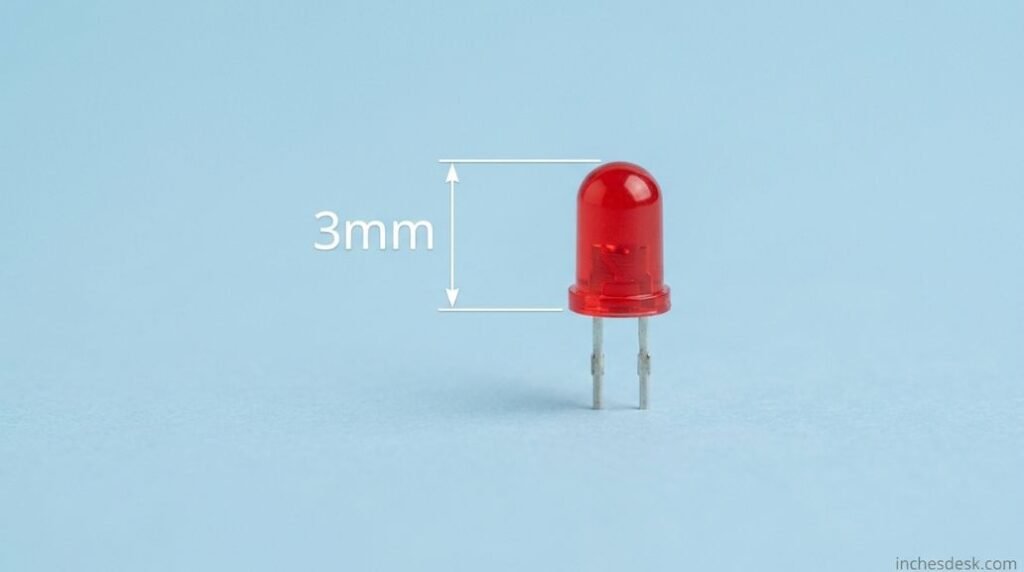
A 3mm LED is a common small electronic component with a round body approximately 3mm in diameter. These LEDs are used in indicator lights, hobby electronics, circuit boards, displays, and DIY projects.
Its compact size makes it a useful visual reference for 3mm. If you picture the circular body of a small indicator LED, its width is roughly the same as the distance represented by 3mm. The actual dimensions can differ slightly depending on the LED’s design, especially around the leads and body.
M3 Screw Thread
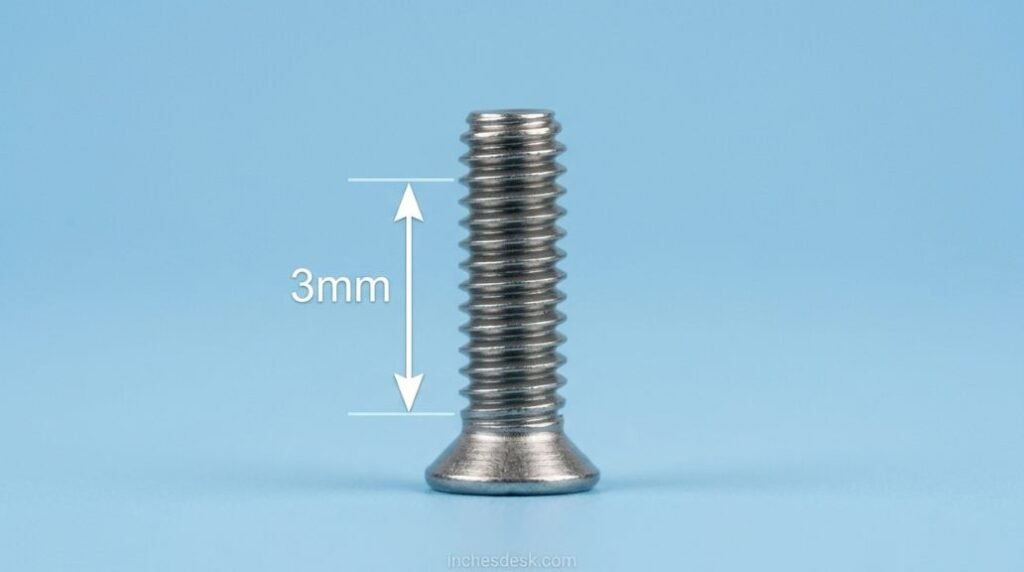
An M3 screw has a nominal thread diameter of 3mm. The “M” indicates a metric thread, while the number 3 refers to the nominal diameter in millimeters.
M3 fasteners are widely used in electronics, small machines, computer hardware, 3D printers, models, and general DIY projects. Keep in mind that the screw’s finished outside diameter and the exact thread profile involve manufacturing tolerances, so an M3 screw should be understood as a 3mm nominal size, not necessarily a perfectly measured 3.000mm diameter at every point.
3mm Hex (Allen) Key

A 3mm hex key, also called a 3mm Allen key, has a hexagonal cross-section designed to fit 3mm hexagonal socket fasteners.
This is a particularly useful workshop reference because the tool is easy to recognize and commonly found in furniture hardware, bicycles, machinery, electronics, and DIY tool sets. The 3mm designation refers to the size across the hexagonal section, rather than the overall length of the Allen key.
3mm Drill Bit

A 3mm drill bit has a nominal cutting diameter of 3mm. It is commonly used for creating small holes in materials such as wood, plastic, and metal when the appropriate bit and drilling method are selected.
Because drill bits are manufactured to specific nominal sizes, a 3mm bit gives a more practical representation of the measurement than many everyday objects. Its cutting portion is intended to produce a hole around 3mm in diameter, although the final hole size can vary with material, drill condition, technique, and bit design.
3mm O-Ring Cross-Section
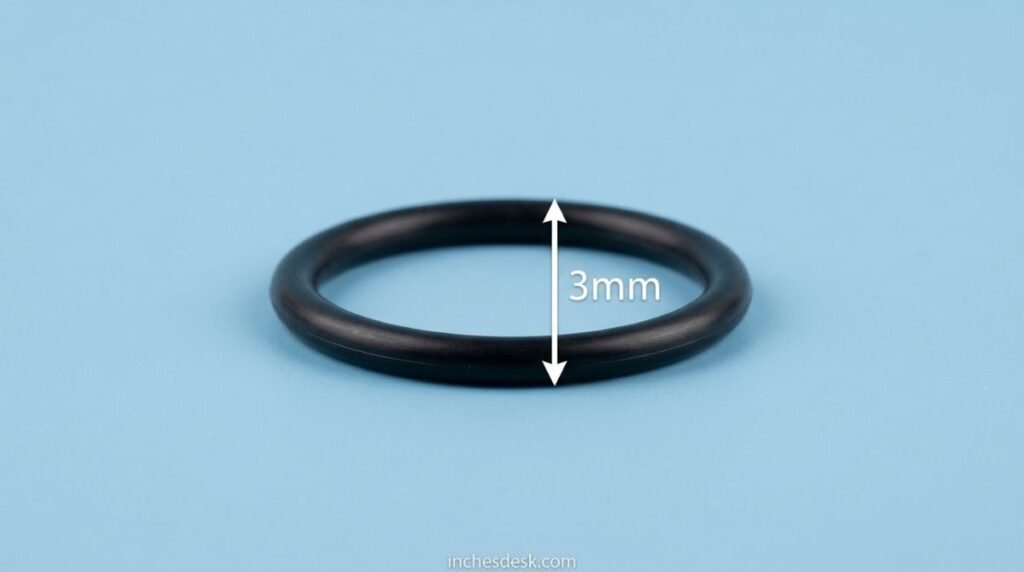
A 3mm O-ring cross-section refers to an O-ring whose round rubber cord has a nominal thickness of 3mm. O-rings are commonly used as seals in plumbing, machinery, automotive components, pumps, and other equipment.
The 3mm measurement describes the diameter of the O-ring’s circular cross-section, not the overall diameter of the ring. This distinction matters because an O-ring can have a 3mm-thick sealing cord while its overall inside or outside diameter is much larger.
3mm Plywood or MDF Sheet

A 3mm plywood or MDF sheet is approximately 3mm thick, making it a useful physical example of this measurement. Thin wood-based sheets of this size are commonly used for craft projects, model making, laser cutting, decorative work, and lightweight DIY construction.
When viewed from the edge, the sheet looks very thin compared with its much larger length and width. A 3mm sheet is also slightly thinner than 1/8 inch, which is 3.175mm. Actual sheet thickness can vary slightly depending on the manufacturer and material.
3mm Acrylic Sheet

A 3mm acrylic sheet has a nominal thickness of 3mm and is commonly used for signs, displays, protective panels, crafts, model making, and small fabrication projects.
Acrylic is rigid and transparent or translucent in many applications, so its thin edge provides a clear visual reference for 3mm. When buying acrylic, the stated thickness is normally the nominal sheet thickness, and manufacturing tolerances can cause small differences from the stated measurement.
3mm Glass Sheet
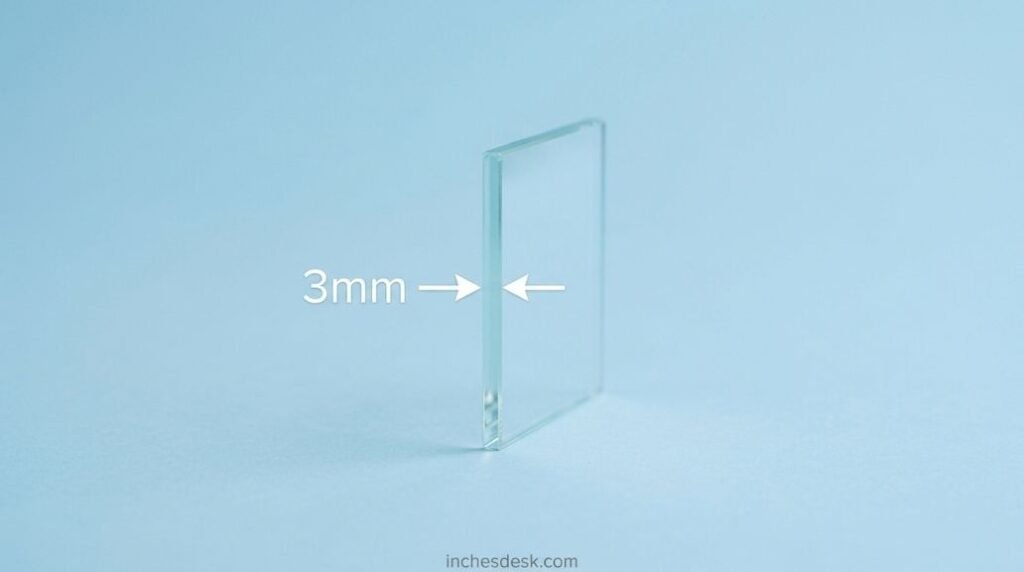
A 3mm glass sheet is approximately 3mm thick and can be found in certain picture frames, small decorative applications, glazing products, and other projects requiring relatively thin glass.
Because glass sheets are broad compared with their thickness, looking directly at the surface does not make 3mm easy to judge. The edge of the glass provides a much better visual reference. Handle glass carefully, since a thin sheet can still have sharp edges and may break if improperly handled.
Single-Wall Corrugated Cardboard (B-Flute)
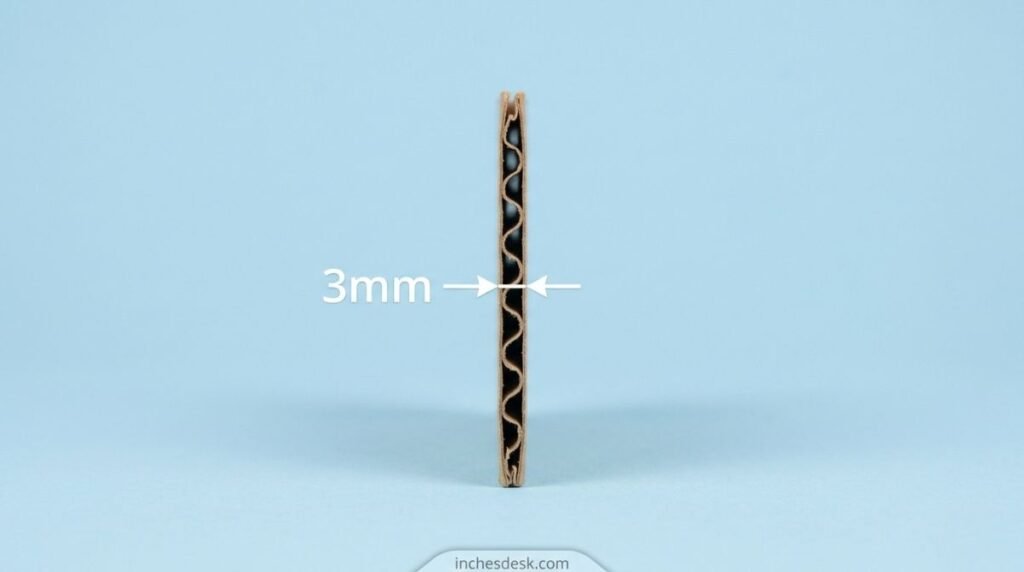
B-flute corrugated cardboard can be around 3mm thick, depending on the particular board specification and manufacturing tolerances. It has a fluted inner layer between paper liners, giving the material more stiffness than ordinary flat cardboard.
This makes it useful for packaging, shipping boxes, protective inserts, displays, and craft projects. Unlike a solid 3mm sheet, corrugated cardboard gets much of its thickness from its internal fluted structure, so its measured thickness can vary with compression and board construction.
3mm Paracord or Nylon Cord
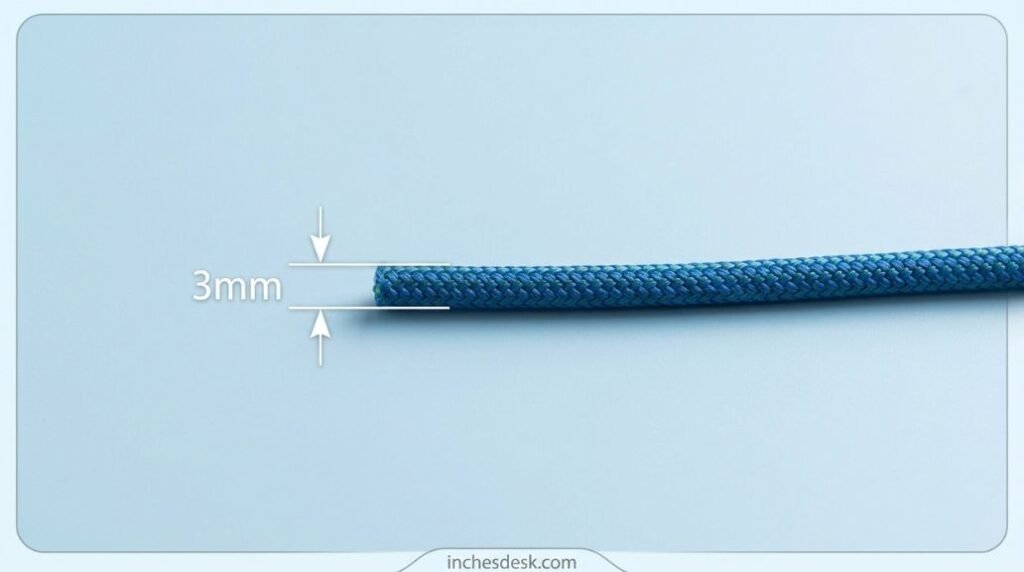
A 3mm paracord or nylon cord provides another practical way to visualize the measurement because its diameter is close to 3mm. Thin synthetic cords are used for crafts, lanyards, small tie-down applications, camping projects, and decorative work.
For cord, the 3mm figure describes its approximate diameter, not its length. Different manufacturers may produce slightly different diameters, and braided cord can compress or flatten when squeezed, so measuring it under pressure may produce a smaller reading.
Bamboo Skewer
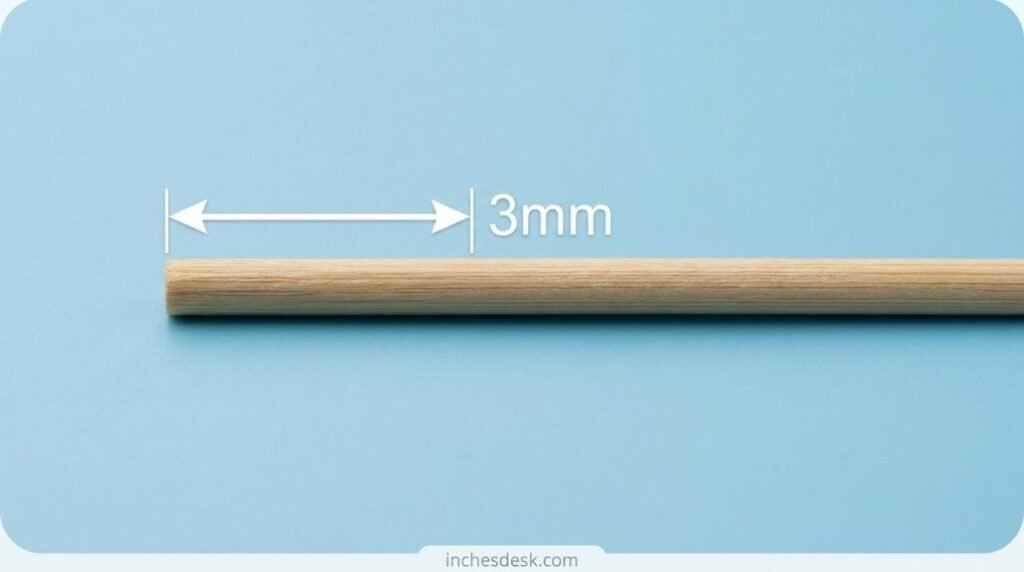
A bamboo skewer can provide a rough visual reference for 3mm, particularly near portions of the shaft that have a similar diameter. However, bamboo skewers are not standardized at exactly 3mm, and their diameter can taper along their length.
This makes a skewer useful for estimating 3mm rather than replacing an actual measurement. If an exact 3mm hole, slot, or component is required, use a metric ruler, caliper, drill bit, or another appropriate measuring tool rather than relying on the skewer alone.
3mm vs 1/8 Inch: What’s the Difference?
3mm is slightly smaller than 1/8 inch. Since 1 inch equals 25.4mm, 1/8 inch equals 3.175mm, making the difference between the two measurements 0.175mm.
| Measurement | Millimeters | Inches |
|---|---|---|
| 3mm | 3.000mm | 0.1181 in |
| 1/8 inch | 3.175mm | 0.125 in |
| Difference | 0.175mm | 0.0069 in |
To convert 1/8 inch to millimeters, use the standard conversion:
1/8 × 25.4 = 3.175mm
To compare it with 3mm:
3.175mm − 3mm = 0.175mm
The difference is small enough that the two sizes can look almost identical without accurate measuring tools. However, they are not exactly interchangeable in applications where a precise fit matters. For example, a hole, fastener, drill bit, or mechanical component designed around a specific metric or imperial size may require the correct dimension.
For casual visual estimation, you can think of 3mm as roughly 1/8 inch, but for machining, hardware selection, fabrication, or precision DIY work, use the stated measurement rather than treating the two sizes as identical.
How to Estimate 3mm Without a Ruler
You can estimate 3mm by comparing an object with a known 3mm dimension, such as a 3mm drill bit, M3 fastener, or 3mm hex key. These references are more reliable than trying to judge the distance with your fingers because 3mm is too small for accurate visual estimation by hand.
A few practical methods can help:
- Think of 0.3cm: 3mm is three-tenths of a centimeter, so it occupies less than one-third of the distance between the 0cm and 1cm marks on a metric ruler.
- Compare it with 1/8 inch: 3mm is just slightly smaller than 1/8 inch. The difference is only 0.175mm.
- Use a 3mm drill bit: The cutting diameter gives a direct physical reference for approximately 3mm.
- Use an M3 screw: The nominal thread diameter is 3mm, providing another practical reference.
- Use a 3mm hex key: The hexagonal section is designed around a 3mm nominal size.
For rough everyday work, these comparisons can help you recognize what 3mm looks like. For anything requiring a precise fit, however, estimation should not replace measurement. A digital caliper, metric ruler with millimeter divisions, or appropriate gauge will give a much more dependable result.
Where 3mm Matters in Real Life
3mm matters whenever a small difference in thickness, diameter, or clearance affects how an object fits or works. It appears in electronics, woodworking, fabrication, hardware, crafts, packaging, and mechanical projects, where a few millimeters can determine whether parts align correctly.
In DIY and woodworking, 3mm sheets of plywood, MDF, acrylic, and other materials are useful for model making, templates, decorative panels, signs, and lightweight projects. When cutting several pieces that need to fit together, even a small difference in material thickness can affect the final dimensions.
In hardware and mechanical work, 3mm is used for components such as M3 fasteners, drill bits, hex keys, and sealing materials. Choosing a 3mm tool or fastener when the project calls for a different size can lead to a poor fit or damaged components.
In electronics, small 3mm LEDs are a familiar example. Their compact size makes them suitable for indicator lights and other space-limited projects. The 3mm dimension can also matter when designing holes, mounting points, or enclosures around small components.
In crafting and model making, 3mm materials provide a useful balance between being thin and maintaining enough rigidity for many small structures. Acrylic, plywood, cardboard, and similar materials are often selected according to the required thickness.
In packaging and protective materials, a few millimeters can affect how much space remains around an item. A 3mm difference in padding, board thickness, or clearance may become significant when several layers are combined.
The key point is that 3mm is small, but it is not insignificant. For simple visual comparisons, it is easy to approximate. When parts must fit together accurately, however, measuring the actual dimension is much safer than relying on appearance alone.
Common Misconceptions About 3mm
One common misconception is that 3mm and 1/8 inch are exactly the same. They are very close, but they are different measurements. 3mm equals about 0.1181 inches, while 1/8 inch equals 3.175mm, creating a difference of 0.175mm.
Another misconception is that a product labeled 3mm will always measure exactly 3.000mm. In manufactured materials, the stated measurement is often a nominal size. Actual dimensions can vary within the manufacturer’s specified tolerance, particularly for materials such as plywood, acrylic, cardboard, cord, and sheet goods.
It is also easy to confuse 3mm thickness with 3mm diameter. A 3mm sheet is 3mm thick, while a 3mm cord or drill bit refers to a diameter. The same numerical measurement can describe completely different physical dimensions depending on the object.
Finally, a visual object that appears close to 3mm is not necessarily exactly 3mm. Items such as bamboo skewers, cords, and manufactured sheets can vary in size. For projects where accuracy matters, use an appropriate measuring tool rather than treating an everyday comparison as an exact standard.
FAQs
How many inches is 3mm?
3mm is approximately 0.1181 inches, which can be rounded to 0.12 inches for everyday use. It is slightly smaller than 1/8 inch, which measures 3.175mm.
Is 3mm the same as 1/8 inch?
No. 3mm and 1/8 inch are close but not exactly equal. Three millimeters equals approximately 0.1181 inches, while 1/8 inch equals 3.175mm. The difference is 0.175mm.
How thick is 3mm?
A thickness of 3mm equals 0.3cm or approximately 0.118 inches. It is a relatively thin dimension commonly seen in sheets, panels, acrylic, plywood, glass, cardboard, and other materials.
How can I measure 3mm?
Use a metric ruler, digital caliper, or another tool with millimeter markings. On a standard metric ruler, 3mm is three small divisions from the zero mark. For greater precision, a caliper is more suitable than a basic ruler.
What does 3mm look like?
3mm is a very small distance, measuring three millimeters across. For a practical reference, a 3mm drill bit, 3mm hex key, or M3 fastener can help you visualize the size. These examples are more useful for estimation than trying to judge 3mm by eye.
Is 3mm bigger than 2mm?
Yes. 3mm is 1mm larger than 2mm, which means it is 50% larger than 2mm when comparing the numerical measurements. In centimeters, 3mm is 0.3cm and 2mm is 0.2cm.
Is 3mm smaller than 5mm?
Yes. 3mm is 2mm smaller than 5mm. A 5mm dimension is approximately 0.197 inches, while 3mm is approximately 0.118 inches, so the difference is noticeable when the objects are placed side by side.
Conclusion
3mm is equal to 0.3cm, 0.003 meters, and approximately 0.1181 inches. It is a small measurement that appears in many practical applications, including 3mm drill bits, M3 hardware, thin sheets, LEDs, cords, and other small components.
For quick estimation, remember that 3mm is just slightly smaller than 1/8 inch. When precision matters, use a metric ruler or caliper because small differences can affect how components fit, align, or function.
