
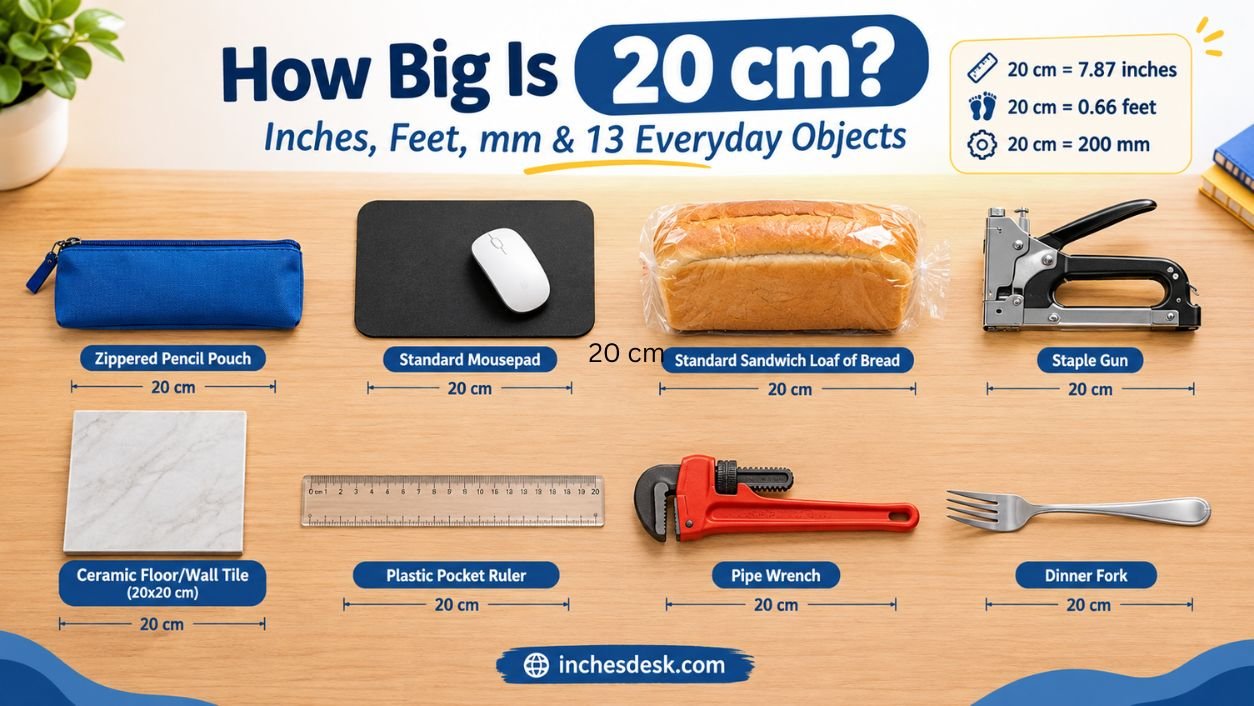
20 cm is equal to 7.87 inches, 200 millimeters, or about 0.66 feet. It is roughly two-thirds of a foot and provides a useful everyday reference for measuring objects such as rulers, tiles, bananas, stationery, and small household items. This guide explains exactly how big 20 cm is and gives practical comparisons to make the measurement easier to visualize.
20 cm at a Glance (Conversion Table & Quick Answer)
| Measurement Unit | 20 cm Equivalent |
| Millimeters | 200 mm |
| Centimeters | 20 cm |
| Meters | 0.2 m |
| Inches | 7.87 inches |
| Feet | 0.656 ft |
| Yards | 0.219 yd |
For a quick visual reference, imagine a 20 cm line stretching from one end to the other. It is slightly shorter than an 8-inch line, because 8 inches equals about 20.32 cm. This small difference is useful to remember when estimating measurements without a ruler.
How to Convert 20 cm to Inches & Other Units
To convert 20 cm to inches, divide 20 by 2.54, giving approximately 7.87 inches. For millimeters, multiply by 10 to get 200 mm. For meters, divide by 100 to get 0.2 m. These simple conversion methods let you switch 20 cm into the units most commonly used in everyday measurements.
20 cm to Inches Formula & Conversion Chart
The standard formula for converting centimeters to inches is:
Inches = Centimeters ÷ 2.54
For 20 cm:
20 ÷ 2.54 = 7.874 inches
So, 20 cm = 7.87 inches when rounded to two decimal places.
| Conversion | Result |
| 20 cm to inches | 7.87 inches |
| 20 cm to millimeters | 200 mm |
| 20 cm to meters | 0.20 m |
| 20 cm to feet | 0.656 ft |
| 20 cm to yards | 0.219 yd |
If you need to convert inches back to centimeters, use the reverse formula:
Centimeters = Inches × 2.54
For example, 8 inches × 2.54 = 20.32 cm, which means 20 cm is just 0.32 cm shorter than 8 inches. This is a useful comparison when estimating 20 cm using an imperial measurement reference.
What Does 20 cm Look Like? (Visual Guide & Printable Scale)
20 cm looks like a line slightly shorter than 8 inches and exactly one-fifth of a meter. A 20 cm measurement can be visualized as the length of a small ruler, a medium-sized stationery item, or the diameter of a compact round object. For the most accurate reference, use a printed 20 cm scale at 100% print size.
A simple visual breakdown is:
- 20 cm = 200 mm
- 20 cm = 7.87 inches
- 20 cm = 0.2 meters
- 20 cm = about 0.66 feet
If you are creating a printable 20 cm scale, the line should measure exactly 20 cm from end to end after printing. When printing, choose 100% scale or Actual Size rather than “Fit to Page,” because automatic scaling can make the printed measurement inaccurate.
For a quick mental reference, picture a standard 15 cm school ruler and extend the length by another 5 cm. That gives you exactly 20 cm. You can also divide a 20 cm line into four equal sections of 5 cm each, making it easier to estimate smaller distances.
For physical projects, remember that a visual comparison is only an estimate. If a measurement needs to be precise, verify it with a properly calibrated ruler, tape measure, or measuring tool rather than relying solely on an everyday object.
13 Everyday Objects That Are Around 20 cm Long
Zippered Pencil Pouch
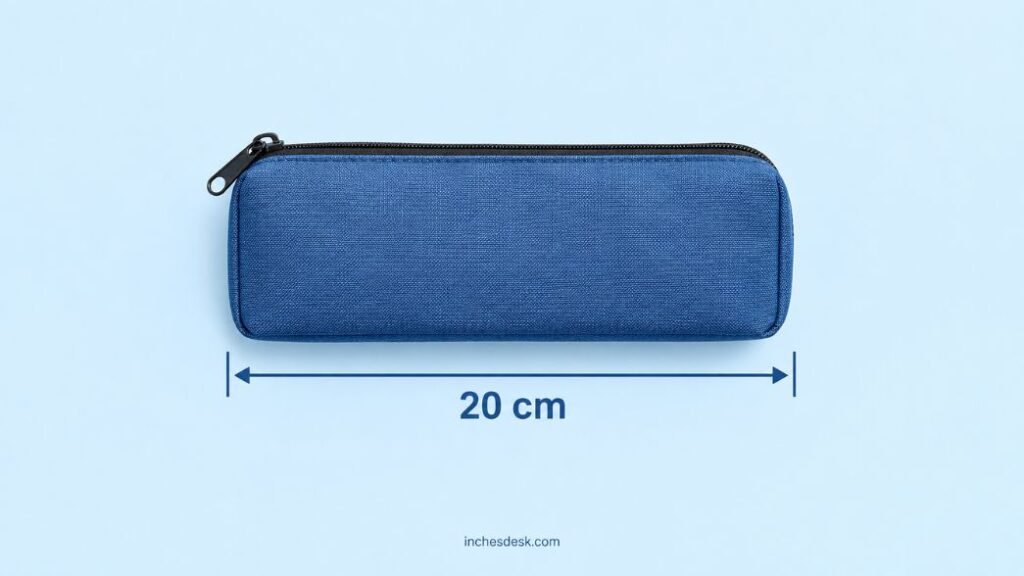
A zippered pencil pouch can be around 20 cm long, making it a convenient everyday reference for visualizing this measurement. Many compact school and office pencil cases are designed to hold several pencils, pens, erasers, and other small stationery items, and a length close to 20 cm gives them enough room without making them difficult to carry.
If you are trying to picture 20 cm without a measuring tool, imagine a pencil pouch lying flat on a desk. A pouch measuring approximately 20 cm from one end to the other would be almost 7.87 inches long. Its width and depth can vary considerably, so the length is the useful dimension for this comparison.
Standard Mousepad
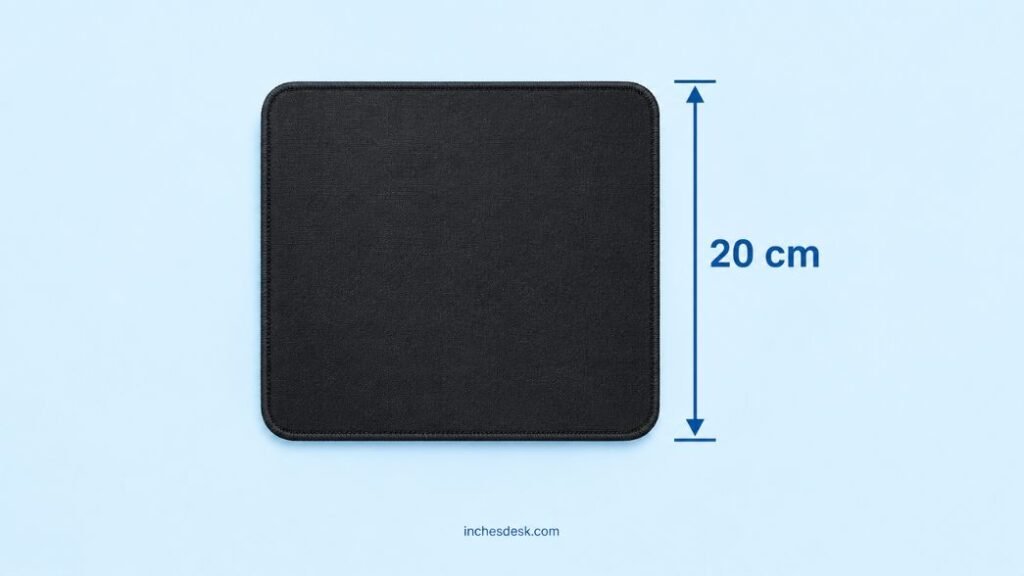
A standard mousepad can be around 20 cm long, particularly compact mousepads designed for smaller desks or simple computer setups. A mousepad measuring approximately 20 cm across provides a useful visual reference because its flat rectangular shape makes the length easy to compare.
A 20 cm mousepad is about 7.87 inches long. Depending on the design, the width may be similar to or greater than the length, so only the stated dimension should be used when estimating 20 cm.
Standard Sandwich Loaf of Bread
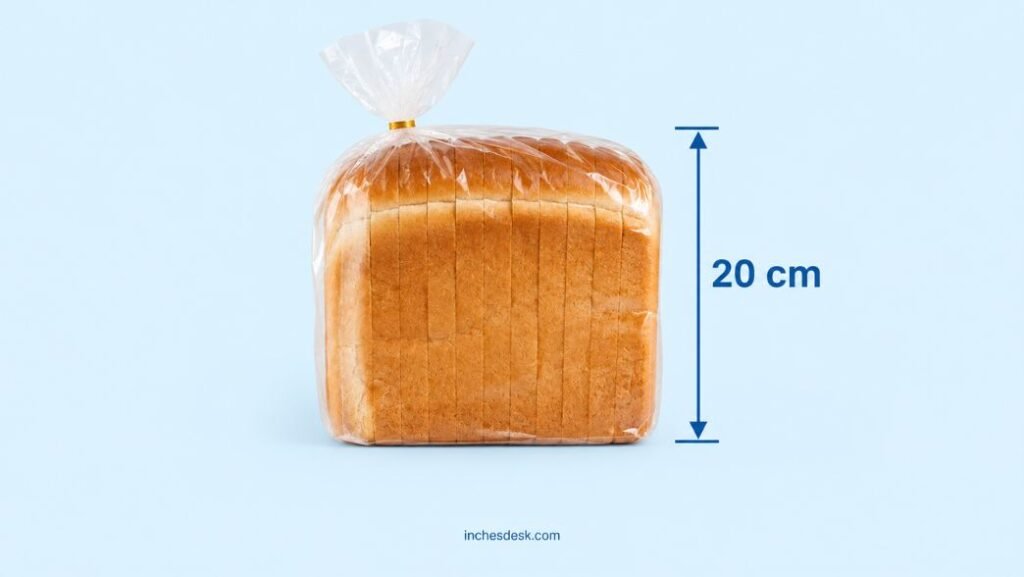
A sandwich loaf of bread can have a length close to 20 cm, although the exact size varies depending on the loaf style and how it is packaged. A compact loaf can therefore provide a familiar kitchen reference for understanding the approximate length of 20 cm.
If you picture a loaf measuring about 20 cm from one end to the other, you are looking at roughly 7.87 inches. Bread is flexible and its shape can change slightly, so it works better as a visual comparison than as a precision measuring tool.
Staple Gun
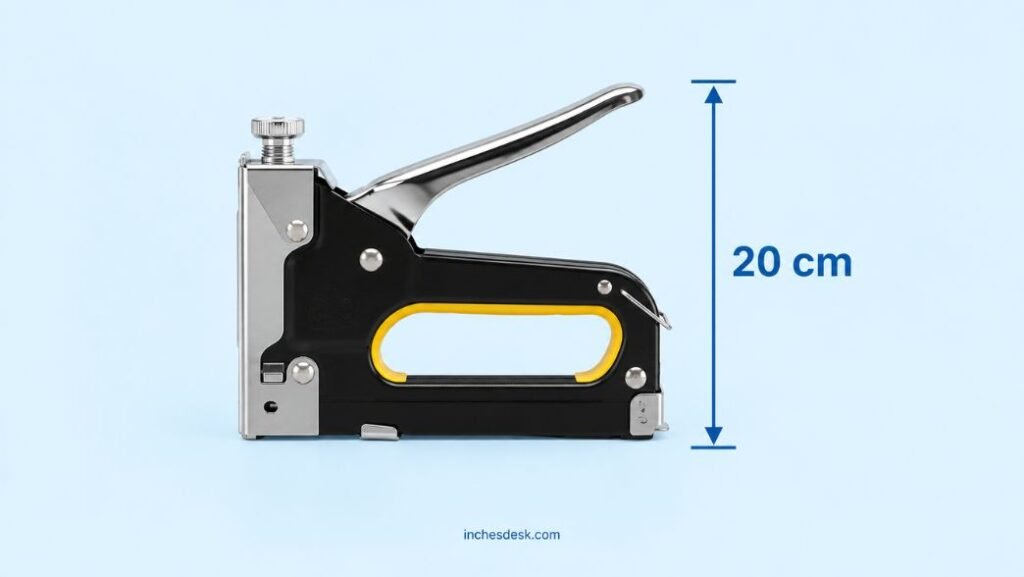
A compact staple gun can be around 20 cm long, measured from the rear of the handle toward the front of the tool. Larger models can be considerably longer, but smaller manual staple guns may fall close to this measurement.
At 20 cm, the staple gun would measure approximately 7.87 inches. Its handle and trigger can make the overall shape appear larger than the actual end-to-end length, so measure from the furthest points when comparing it with a 20 cm reference.
Ceramic Floor/Wall Tile (20×20 cm)

A 20 × 20 cm ceramic tile is exactly 20 cm along each side, making it one of the clearest physical examples of this measurement. Because the tile is square, both its length and width provide a direct 20 cm reference.
Each side measures 200 mm or 7.87 inches. A tile of this size also covers 400 square centimeters of surface area. This makes a 20 × 20 cm tile useful for visualizing both a linear measurement and a square area.
Plastic Pocket Ruler
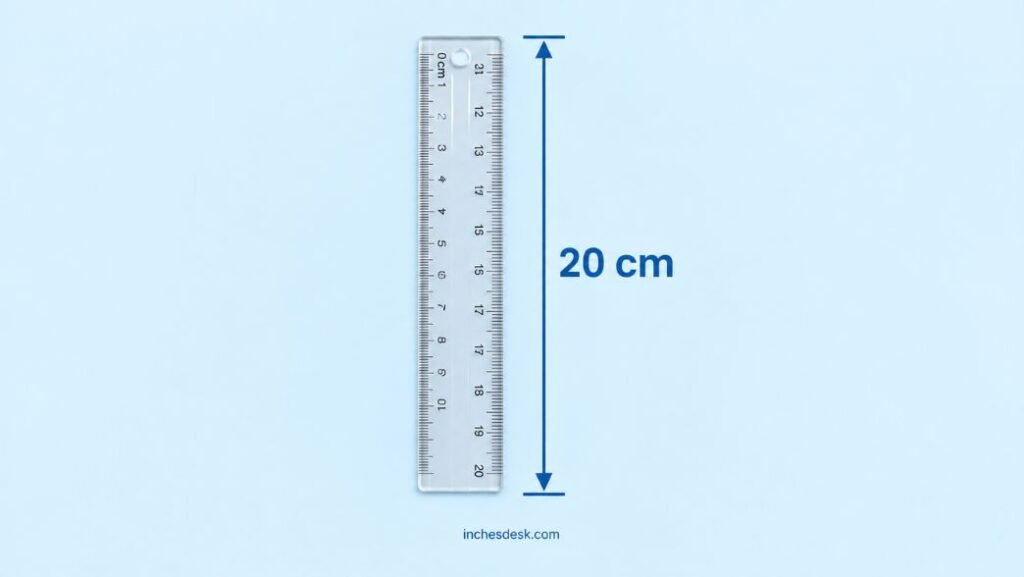
A 20 cm plastic pocket ruler is exactly 20 cm long when its measurement markings extend across that full length. Small metric rulers are especially useful because they provide a direct reference rather than an estimate based on an unrelated object.
A 20 cm ruler is equal to 200 mm and approximately 7.87 inches. If the ruler also includes inch markings, you can immediately see that 20 cm falls just short of the 8-inch mark.
Pipe Wrench
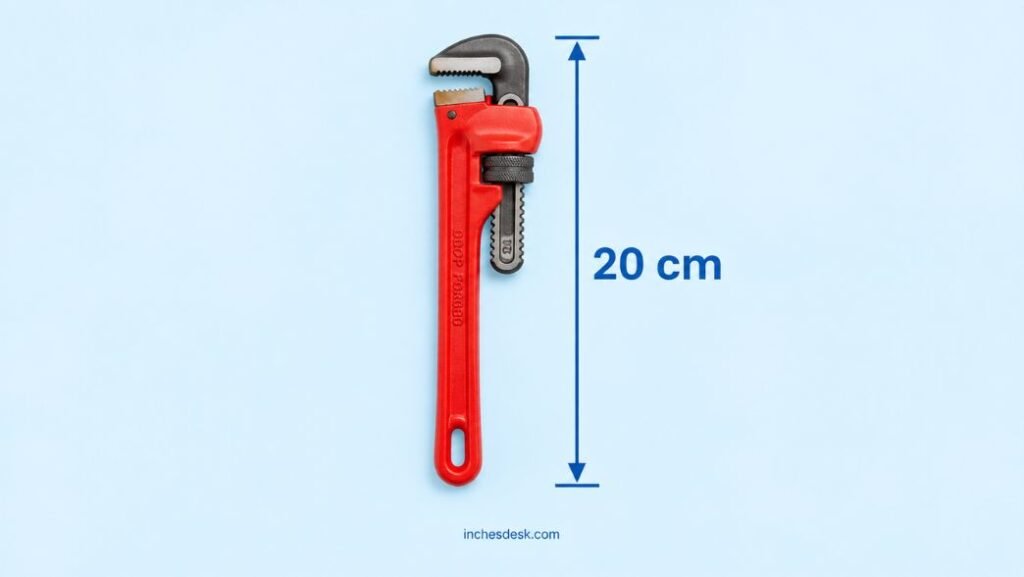
A small pipe wrench may be approximately 20 cm long, although pipe wrenches come in many different sizes. Compact models intended for smaller plumbing tasks can have an overall length close to this measurement.
A 20 cm pipe wrench would be about 7.87 inches from the end of its handle to the opposite end of the tool. Because wrench sizes vary widely, use the manufacturer’s stated overall length when an exact dimension matters.
Dinner Fork
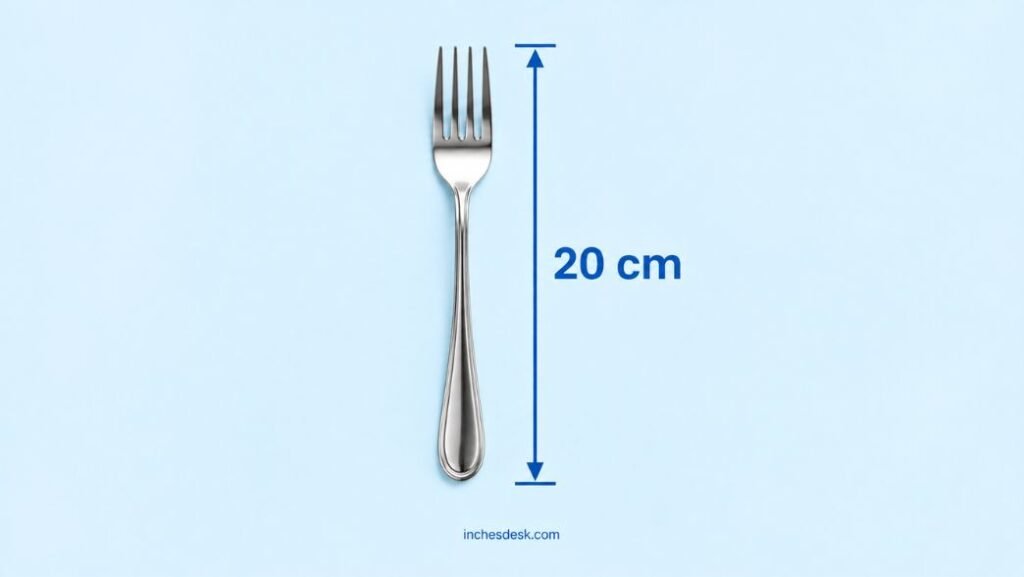
A dinner fork is often close to 20 cm long, making it a familiar kitchen object for estimating this measurement. The total length is measured from the tips of the tines to the end of the handle.
A fork measuring 20 cm would be approximately 7.87 inches long. Some dinner forks are shorter or longer depending on their design, so this comparison should be treated as an approximate visual guide rather than a universal standard.
Standard Drinking Straw
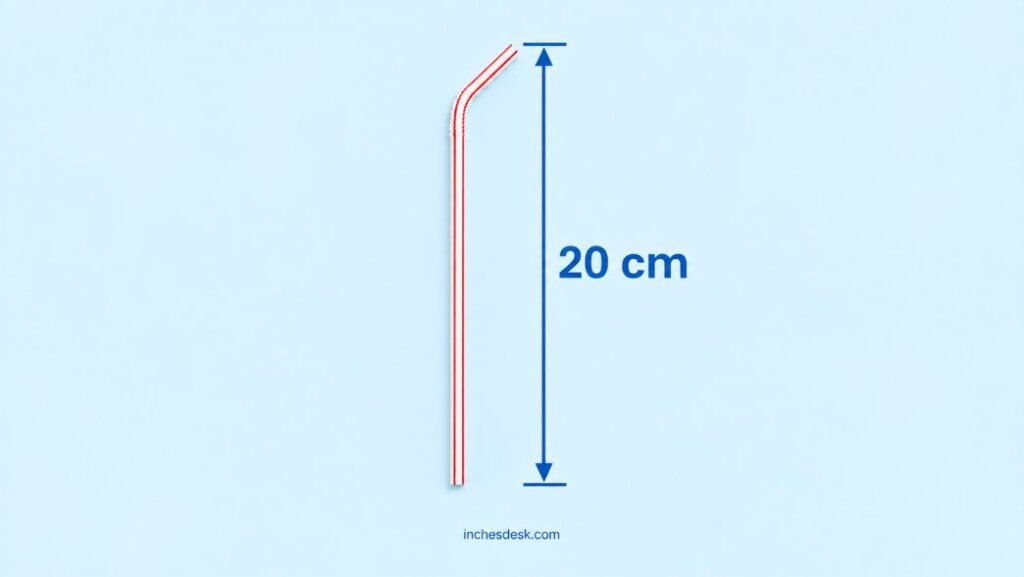
A standard drinking straw can be around 20 cm long, particularly reusable or disposable straws designed for ordinary drinking glasses and cups. Straight straws are especially easy to compare because their length can be measured from one end directly to the other.
At 20 cm, the straw would measure about 7.87 inches. Bent, telescoping, and extra-long straws can have different dimensions, so the particular straw should be measured if precise sizing is required.
Large Banana
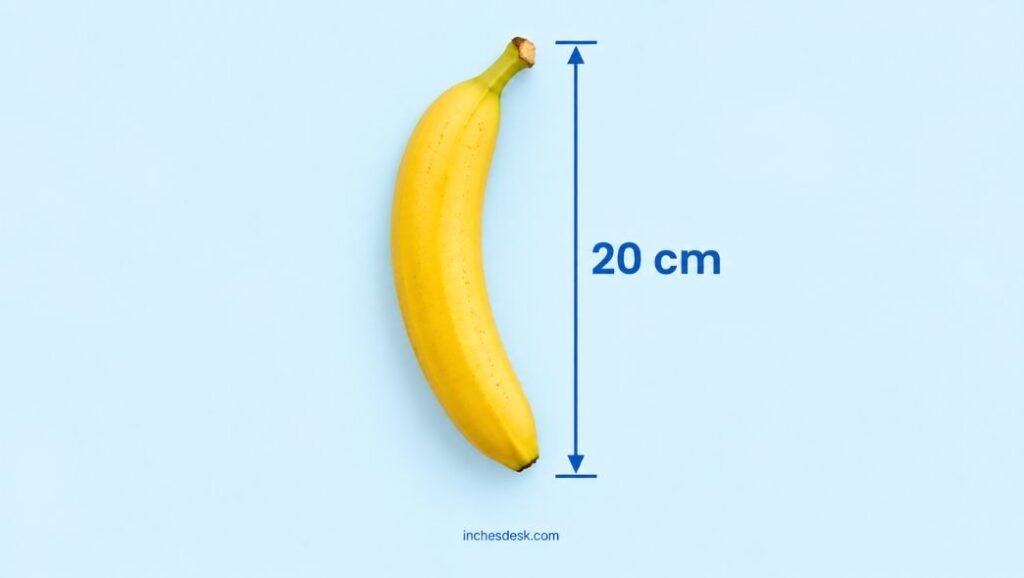
A large banana can approach 20 cm in length, measured along its outer curve from the stem end toward the opposite tip. Bananas naturally vary in size, so not every large banana will reach exactly 20 cm.
A banana around this length gives a useful everyday comparison because it is easy to hold and visually estimate. A 20 cm banana is approximately 7.87 inches, although its curved shape means the straight-line distance between its ends may be slightly different from its surface length.
Shoe Horn
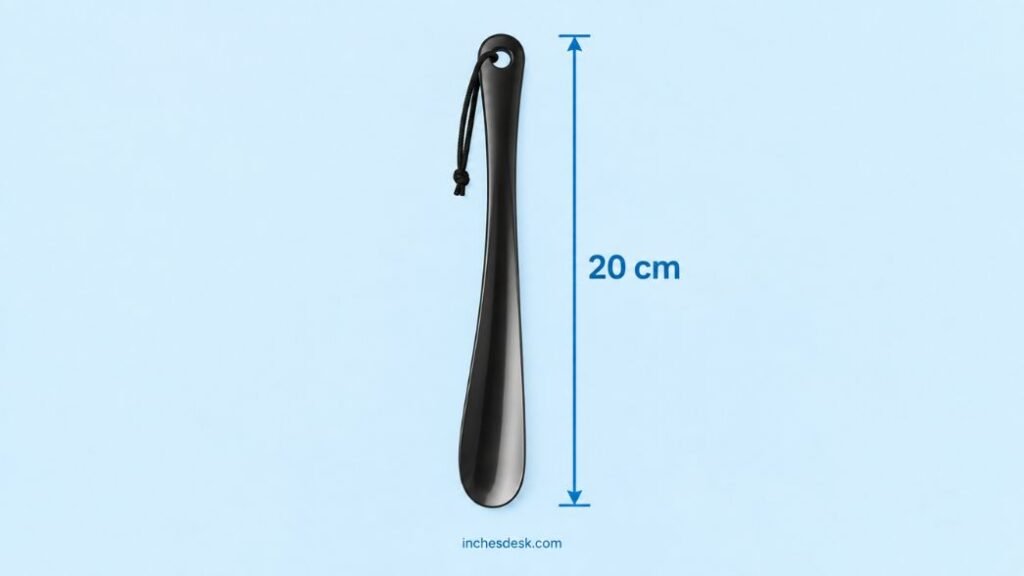
A compact shoe horn can be close to 20 cm long, particularly travel-sized models designed to help put on shoes without bending down as far. Longer shoe horns are also common, so size varies considerably between designs.
A shoe horn measuring 20 cm would be 200 mm or approximately 7.87 inches long. Its narrow, elongated shape makes it a useful visual reference for understanding what a 20 cm straight object looks like.
PC Case Fan (200 mm)
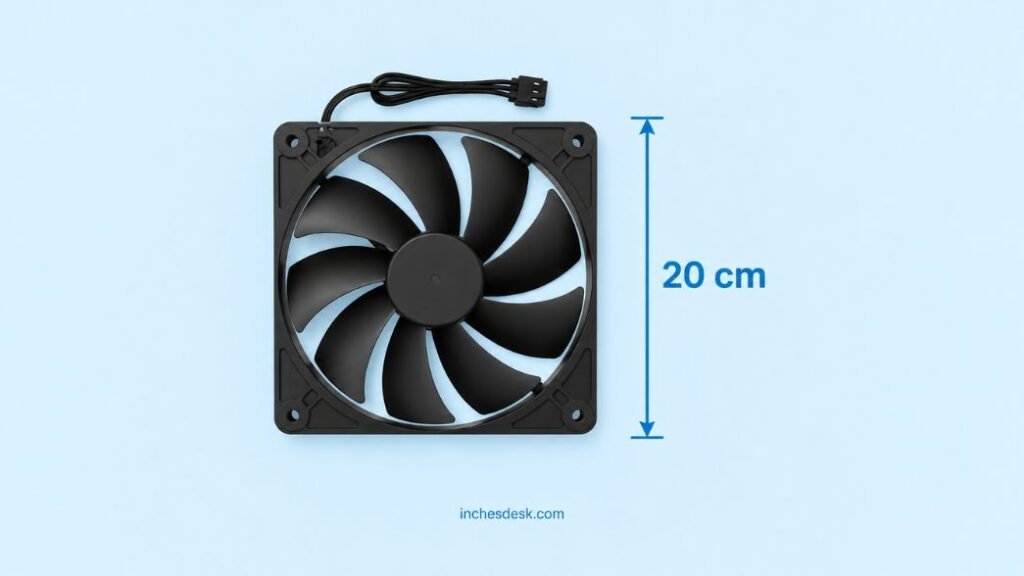
A 200 mm PC case fan provides an exact 20 cm reference for its nominal width and height. Since 200 mm equals 20 cm, the fan’s square frame measures approximately 20 cm across when referring to its nominal fan size.
This makes a 200 mm computer fan particularly useful for visualizing the measurement. Each side is approximately 20 cm, or 7.87 inches. The actual external frame dimensions can vary slightly by manufacturer, so the product specifications should be checked for installation work.
8-Inch Personal Pizza / Cake Tin (Diameter)

An 8-inch round pizza or cake tin has a diameter of 20.32 cm, which is extremely close to 20 cm. This makes it a practical visual reference when trying to picture the size of a 20 cm circle.
Because 20 cm equals 7.87 inches, an 8-inch diameter is only about 0.32 cm larger. The comparison is useful for understanding why a 20 cm round object looks almost the same size as an 8-inch pizza or cake tin, although they are not exactly identical measurements.
How to Measure 20 cm Without a Ruler (Everyday Hacks)
You can estimate 20 cm without a ruler by comparing it with familiar objects such as a 20 cm ruler, a 20 × 20 cm tile, a dinner fork, or an approximately 20 cm pencil pouch. These methods are useful for quick estimates, but they should not replace a measuring tool when exact dimensions are required.
Here are several practical ways to estimate 20 cm:
- Use an 8-inch reference: Since 8 inches equals 20.32 cm, an 8-inch object is only about 0.32 cm longer than 20 cm. This provides a close visual estimate.
- Use a 15 cm ruler: If you have a standard 15 cm ruler, imagine or mark another 5 cm beyond its end. Together, the two distances equal 20 cm.
- Use your hand carefully: The width or span of a person’s hand varies significantly, so this is only a rough reference. If you already know that a particular hand measurement is close to 20 cm, it can be useful for quick estimates.
- Compare with a 20 × 20 cm tile: A square tile labeled 20 × 20 cm gives you an exact reference for both length and width.
- Use a 200 mm object: Because 20 cm = 200 mm, an object specifically labeled 200 mm can provide a direct metric comparison.
- Estimate with an everyday object: A dinner fork, compact shoe horn, large banana, or suitable pencil pouch may be close to 20 cm. Place the object alongside the item you want to estimate and compare their end-to-end lengths.
For better accuracy, avoid measuring around curves when possible. A curved banana, for example, can have a longer surface length than its straight-line distance. When precision matters, use a ruler, tape measure, or another calibrated measuring instrument.
How 20 cm Compares to Common Sizes (10 cm, 15 cm, 25 cm, 30 cm)
20 cm sits exactly between 10 cm and 30 cm, while it is 5 cm longer than 15 cm and 5 cm shorter than 25 cm. Comparing these measurements side by side makes it easier to judge the size of 20 cm when working with everyday objects, crafts, school projects, or DIY tasks.
| Measurement | Difference From 20 cm | Inches | Feet |
| 10 cm | 10 cm shorter | 3.94 in | 0.328 ft |
| 15 cm | 5 cm shorter | 5.91 in | 0.492 ft |
| 20 cm | Reference | 7.87 in | 0.656 ft |
| 25 cm | 5 cm longer | 9.84 in | 0.820 ft |
| 30 cm | 10 cm longer | 11.81 in | 0.984 ft |
20 cm vs. 10 cm
20 cm is exactly twice as long as 10 cm. If you place two 10 cm lengths end to end, their combined length is exactly 20 cm. This makes 10 cm a particularly simple reference for estimating 20 cm.
20 cm vs. 15 cm
20 cm is 5 cm longer than 15 cm. A 15 cm ruler or similar object can therefore be used as a starting point, with another 5 cm added to reach the full 20 cm.
20 cm vs. 25 cm
20 cm is 5 cm shorter than 25 cm. If you are familiar with a 25 cm object, removing approximately one-fifth of that length gives a rough visual idea of 20 cm.
20 cm vs. 30 cm
20 cm is 10 cm shorter than 30 cm, meaning it is two-thirds of 30 cm. Since 30 cm is close to the length of a typical school or office ruler, this comparison can help when estimating 20 cm without a dedicated measuring tool.
Common Applications: Where Is 20 cm (200 mm) Used Standardly?
20 cm, or 200 mm, is a useful metric measurement found in many everyday products, tools, construction materials, and technical specifications. It is commonly used for dimensions such as object length, width, diameter, spacing, and component size. The exact application depends on the product or industry, so 20 cm should not be assumed to be a universal standard.
In home improvement and construction, 20 cm can appear as a tile dimension, board measurement, spacing reference, or product specification. A 20 × 20 cm tile, for example, has a side length of exactly 20 cm. Converting this measurement to millimeters gives 200 mm, which is often the preferred format on technical drawings and product specifications.
In computer hardware, 200 mm is used as a nominal size for some large PC case fans. A 200 mm fan is approximately 20 cm across, although the exact outside dimensions of the frame can differ slightly between manufacturers. When installing hardware, checking the manufacturer’s dimensions is more reliable than relying only on the nominal fan size.
In stationery and school supplies, 20 cm can describe the length of compact rulers, pencil cases, folders, craft materials, and other small items. It is also a convenient size for drawing, cutting, and measuring because it is long enough for many small projects without requiring a large measuring tool.
In kitchen and household products, measurements around 20 cm can describe the diameter of pans, cake tins, plates, utensils, storage containers, and other objects. For example, an 8-inch round pan has a diameter of 20.32 cm, which is very close to 20 cm but is not exactly the same.
For DIY and tradespeople, knowing that 20 cm = 200 mm is particularly useful when switching between metric units. A specification written as 200 mm and one written as 20 cm describe the same linear distance. However, always check whether a measurement refers to length, width, height, diameter, or another dimension before using it in a project.
FAQs
How many inches is 20 cm?
20 cm equals 7.87 inches. The exact calculation is 20 ÷ 2.54 = 7.874 inches, which rounds to 7.87 inches.
Is 20 cm the same as 8 inches?
No. 20 cm is approximately 7.87 inches, while 8 inches equals 20.32 cm. The difference is only 0.32 cm, so the two measurements are very close but not identical.
How many millimeters are in 20 cm?
There are exactly 200 mm in 20 cm. Since 1 centimeter contains 10 millimeters, multiply 20 by 10 to get 200 mm.
How many feet is 20 cm?
20 cm equals approximately 0.656 feet. It is considerably less than one foot; one foot is exactly 30.48 cm.
What everyday object is about 20 cm long?
Several everyday objects can be around 20 cm long, including a compact pencil pouch, dinner fork, shoe horn, drinking straw, or large banana. Their actual dimensions vary, so they should be treated as visual references rather than exact measuring tools.
How can I measure 20 cm without a ruler?
You can estimate 20 cm by using an object with a known or nearly known dimension. An 8-inch object is about 20.32 cm, making it a close reference. For an exact measurement, however, use a calibrated ruler or measuring tape.
What is 20 cm in meters?
20 cm equals 0.2 meters. To convert centimeters to meters, divide the centimeter measurement by 100: 20 ÷ 100 = 0.2 m.
