
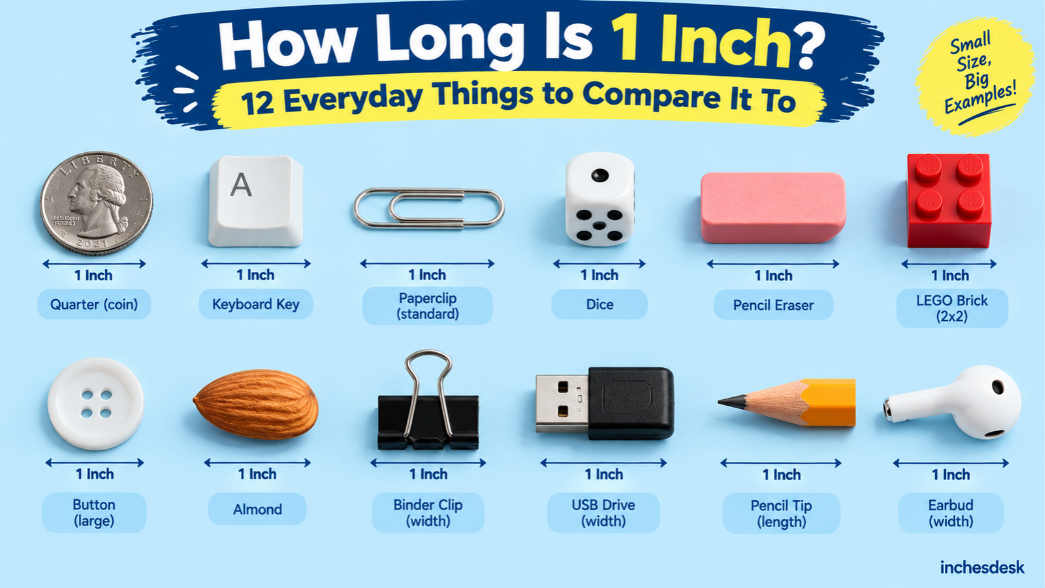
1 inch is exactly 2.54 centimeters, or 25.4 millimeters. It is one-twelfth of a foot and one thirty-sixth of a yard. If you need a quick mental picture, 1 inch is roughly the width of an adult’s thumb at the knuckle, or about the diameter of a US quarter.
This guide gives you the exact numbers, a way to read 1 inch on any ruler, twelve real objects that land close to that length, and a few tricks for when no ruler is within reach.
Conversion Table
| Inches | Centimeters | Millimeters | Feet (approx.) |
|---|---|---|---|
| 1/16 in | 0.159 cm | 1.59 mm | 0.0052 ft |
| 1/8 in | 0.318 cm | 3.18 mm | 0.0104 ft |
| 1/4 in | 0.635 cm | 6.35 mm | 0.0208 ft |
| 1/2 in | 1.27 cm | 12.7 mm | 0.0417 ft |
| 3/4 in | 1.905 cm | 19.05 mm | 0.0625 ft |
| 1 in | 2.54 cm | 25.4 mm | 0.0833 ft |
| 2 in | 5.08 cm | 50.8 mm | 0.1667 ft |
| 12 in | 30.48 cm | 304.8 mm | 1 ft |
Here is the step-by-step math for a common case, converting 3 inches to centimeters:
- Start with the length: 3 in
- Multiply by the conversion factor: 3 × 2.54
- Result: 7.62 cm
How to Read 1 Inch on a Ruler
On a standard US ruler, 1 inch is the distance from the 0 mark to the longest numbered line labeled “1.” The long line at 1 is the biggest tick between 0 and 2, and the numbers printed along the edge count whole inches.
Between each pair of numbered lines, the inch is divided into smaller units, and the tick length tells you the fraction:
- Longest tick (between numbers): 1/2 inch
- Next longest: 1/4 and 3/4 inch
- Medium ticks: 1/8 inch increments
- Shortest ticks: 1/16 inch increments
So there are 16 small spaces in 1 inch on most rulers. If a measurement lands on the third short tick past the 1, it is 1 and 3/16 inches.
The most common mistake is starting from the end of the ruler instead of the 0 line. Many rulers have a small blank margin before the zero, which adds roughly 1/16 to 1/8 inch of error if you ignore it. Another frequent slip is mixing up the metric edge and the inch edge on a dual-scale ruler. Check which side you are reading before you cut or buy anything.
12 Everyday Objects That Are About 1 Inch Long
Ferrero Rocher chocolate
A wrapped Ferrero Rocher is close to 1 inch across in its round form, making it a handy edible reference. Treat it as approximate, since the foil wrapper adds a little bulk.
Cherry tomato
A small cherry tomato typically measures around 1 inch in diameter. Larger varieties run closer to 1.5 inches, so pick the smaller ones when comparing.
Gumball (standard vending size)
The classic gumball from a coin-operated machine is commonly around 1 inch across. It is one of the more consistent everyday items because machines are built for a fixed size.
Small walnut in shell
A small in-shell walnut often measures about 1 inch across its narrow dimension. Shell size varies by variety, so use it for a rough check rather than a precise one.
Standard guitar pick
A standard guitar pick is roughly 1.2 inches at its widest point, so it runs slightly over 1 inch. Many players keep one in a wallet, which makes it a surprisingly practical reference.
5/8-inch hex nut
A 5/8-inch hex nut measures about 1 inch across the corners (point to point), even though its wrench size is 5/8 inch across the flats. This is a good example of why the measurement point matters in hardware.
1-inch brass brad (paper fastener)
A 1-inch brass brad is sold by its shaft length, so the metal prong measures 1 inch by design. Check the package label to confirm the size before using it as a reference.
Mini craft clothespin
Mini craft clothespins are commonly sold at about 1 inch long, sometimes labeled 1 in or 25 mm. Always confirm on the package, because sizes vary by brand.
25 mm wooden craft bead
A 25 mm bead is 0.984 inches, which is effectively 1 inch. It is a precise reference since the size is stated in millimeters by the seller.
Small jingle bell (craft size)
Craft-size jingle bells come in several diameters, and the 1-inch option is a common one. As with clothespins, rely on the labeled size rather than assuming.
Quail egg
A quail egg is typically about 1 inch long, with a width a bit under that. It is a good natural comparison if you cook with them.
Golf ball marker
Many golf ball markers measure close to 1 inch across, though designs differ. Flat coin-style markers are the most reliable for this purpose.
How to Measure 1 Inch Without a Ruler
To estimate 1 inch without a ruler, use the width of your thumb at the knuckle, which is close to 1 inch for many adults. Hand-based estimates vary from person to person, so calibrate yours once against a real ruler.
Here is a quick method:
- Place a ruler next to your thumb and note where the knuckle width falls.
- Remember the result (for example, your thumb is 1.1 inches).
- Use that as your personal reference, adjusting for the difference.
Other options when you have nothing else:
- A US quarter has a diameter of 0.955 inch (24.26 mm), which is just under 1 inch.
- A standard credit card is 3.37 inches long and 2.13 inches wide, so one-third of its length is close to 1.1 inches.
- A sheet of US letter paper is 8.5 by 11 inches, so you can fold it to find fractions of an inch.
For anything that needs accuracy, such as woodworking, sewing, or ordering parts, use a real ruler or tape measure. Body-based estimates are fine for rough planning only.
1 Inch vs 1 Centimeter: Visual Comparison
1 inch is about 2.54 times longer than 1 centimeter. Picture a centimeter as roughly the width of a standard pencil’s thickness or a fingernail on a small hand, while an inch is closer to a thumb’s knuckle width.
| Measurement | Metric | Imperial | Difference |
|---|---|---|---|
| 1 inch | 2.54 cm | 1 in | Baseline |
| 1 centimeter | 1 cm | 0.394 in | About 39% of an inch |
| 1 millimeter | 0.1 cm | 0.039 in | About 1/25 of an inch |
To convert centimeters to inches, divide by 2.54. For example, 10 cm ÷ 2.54 = 3.94 in.
A practical tip: on a dual-scale ruler, line up the 1 on the inch side and look across to the metric side. You will see it falls just past the 2 cm mark and just before 3 cm, landing at 2.54 cm.
Where “1 Inch” Shows Up Beyond Length
The term “1 inch” appears in many contexts besides plain length, and it does not always mean a literal 25.4 mm measurement. Knowing the context avoids costly mix-ups.
- Pipe and tubing: A “1-inch pipe” refers to a nominal size, and its actual outer diameter is larger than 1 inch.
- Lumber: A “1-inch board” is usually thinner than a full inch after milling, typically about 3/4 inch.
- Screens and displays: Screen sizes are measured diagonally in inches, so “1 inch” on a spec sheet is a diagonal figure, not a width.
- Rainfall and snowfall: An inch of rain means water depth over a surface, not a length of anything.
- Hardware and fasteners: Bolts, screws, and nails are often sized by length in inches, but thread diameter is listed separately.
- Photography and sensors: A “1-inch sensor” is a naming convention and does not measure 1 inch across.
When something is described as “1 inch,” check whether it means the true dimension or a nominal label.
Why the Inch Is Defined This Way
The inch is defined as exactly 25.4 millimeters, a value set by the 1959 international yard and pound agreement. Before that, different countries used slightly different inches, which caused small but real discrepancies in trade and engineering.
The unit itself is much older. Early inches were tied to body parts, such as the width of a thumb, and later to physical standards like barleycorns laid end to end. As industry grew, those loose definitions were no longer precise enough.
In 1959, the United States, United Kingdom, Canada, Australia, New Zealand, and South Africa agreed to define the yard as 0.9144 meters. Because there are 36 inches in a yard, this fixed the inch at 25.4 mm exactly. The math is straightforward:
- 1 yard = 0.9144 m
- 1 yard = 36 inches
- 0.9144 m ÷ 36 = 0.0254 m = 25.4 mm
That is why the 2.54 conversion factor is exact rather than rounded.
Why Knowing 1 Inch Matters
A solid sense of 1 inch helps you judge sizes quickly, avoid measuring errors, and buy or build the right thing the first time. It is a base unit for dozens of everyday decisions.
- Shopping: Online listings often give dimensions in inches. Knowing how big 1 inch is helps you picture jewelry, phone accessories, and small hardware before you buy.
- DIY and trades: Fasteners, trim, and spacing are all specified in inches and fractions. Small errors add up quickly across a project.
- Students: Science, math, and design classes regularly require converting between inches and centimeters.
- Sewing and crafts: Seam allowances are commonly 1/4 to 5/8 inch, so being accurate matters.
A habit worth building is keeping one or two personal reference points, like your thumb knuckle or a coin, so you can sanity-check a measurement even when a tape measure is not handy.
FAQs
What objects are about 1 inch long?
Objects close to 1 inch include a gumball, a small cherry tomato, a quail egg, a 25 mm craft bead, and a mini craft clothespin. A US quarter is about 0.955 inch, so it is also a close match. Always allow for small variations between brands and varieties.
How many cm is 1 inch?
1 inch equals exactly 2.54 centimeters. To convert inches to centimeters, multiply by 2.54. For example, 5 inches × 2.54 = 12.7 cm.
How many mm is 1 inch?
1 inch equals exactly 25.4 millimeters. To convert inches to millimeters, multiply by 25.4. For example, 2 inches × 25.4 = 50.8 mm.
How big is 1 inch on a phone screen?
On a phone screen, 1 inch is about 2.54 cm, but the number of pixels it covers depends on the screen’s pixel density. A display with 400 pixels per inch (PPI) shows 1 inch as roughly 400 pixels. Check your phone’s specs for its exact PPI, and note that on-screen rulers may be slightly inaccurate without calibration.
How do I measure 1 inch without a ruler?
Use a US quarter (0.955 inch), your thumb’s knuckle width, or one-third of a credit card’s length (about 1.1 inches). For better accuracy, compare your chosen reference against a real ruler once so you know its exact size.
Is a quarter exactly 1 inch?
No, a US quarter is not exactly 1 inch. It measures 0.955 inch (24.26 mm) in diameter. That makes it about 0.045 inch shy of a full inch, which is close enough for rough estimates but not for precise work.
