
How Long Is 50 Feet?
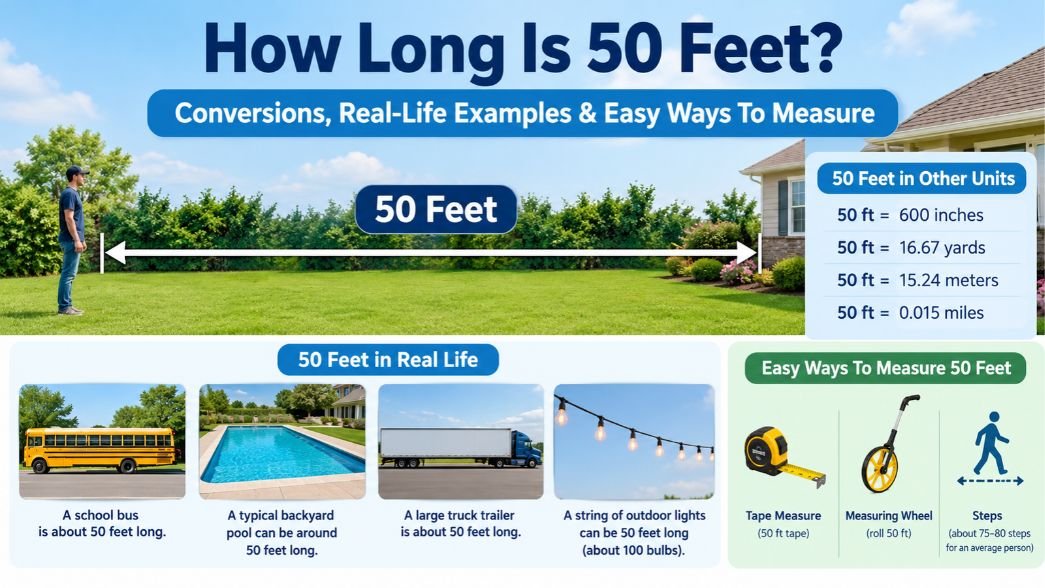
50 feet is equal to 600 inches, 16.67 yards, 15.24 meters, or 1,524 centimeters. It is a distance of 50 one-foot lengths placed end to end. To visualize it, imagine a long garden hose stretched across a yard, a large outdoor area, or a line extending across several parking spaces.
Fifty feet is a useful measurement for home improvement, landscaping, construction, sports, and outdoor projects. It can help you estimate how much fencing you need, choose the correct length of cable, plan a garden layout, or determine whether a particular space is large enough for your needs.
For a quick reference, 50 feet is slightly longer than 15 meters and about the length of five 10-foot sections placed together. Although it may not seem especially long when written on paper, it covers a substantial distance when you walk it from one end to the other.
Here are the essential measurements for understanding 50 feet:
- In inches: 600 inches
- In yards: 16.67 yards
- In meters: 15.24 meters
- In centimeters: 1,524 centimeters
- In millimeters: 15,240 millimeters
50 Feet In Inches, Yards, Meters & Centimeters
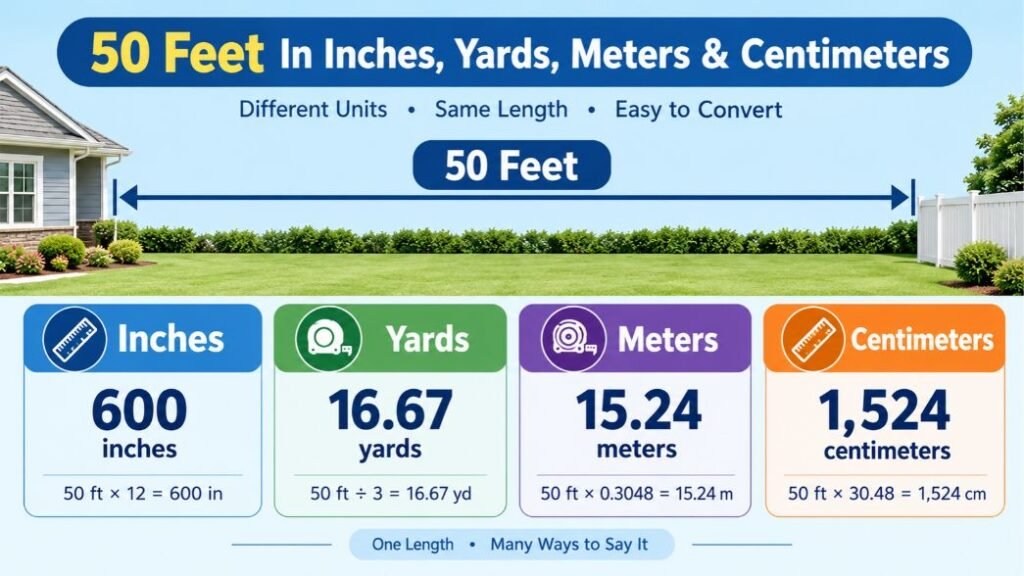
You can convert 50 feet into other units by multiplying or dividing by the appropriate conversion factor. The basic method is simple: multiply feet by 12 to get inches, divide by 3 to get yards, and multiply by 0.3048 to get meters.
Use this conversion table when you need an accurate measurement for a DIY project, shopping decision, school assignment, or construction task.
| Unit | Conversion | Result |
| Inches | 50 × 12 | 600 inches |
| Feet | Original measurement | 50 feet |
| Yards | 50 ÷ 3 | 16.67 yards |
| Meters | 50 × 0.3048 | 15.24 meters |
| Centimeters | 15.24 × 100 | 1,524 centimeters |
| Millimeters | 1,524 × 10 | 15,240 millimeters |
The following formulas explain how to calculate each conversion yourself.
- Feet to inches: Multiply the number of feet by 12. For 50 feet, 5012=600 inches.
- Feet to yards: Divide the number of feet by 3. For 50 feet, 503=16.666 yards, or approximately 16.67 yards.
- Feet to meters: Multiply the number of feet by 0.3048. For 50 feet, 500.3048=15.24 meters.
- Meters to centimeters: Multiply the number of meters by 100. Therefore, 15.24100=1,524 centimeters.
Remember that 15.24 meters is the exact metric equivalent of 50 feet. The yard conversion is repeating, so 16.67 yards is rounded to two decimal places.
12 Everyday Things That Are About 50 Feet Long
Garden Hose
A 50-foot garden hose is a common option for watering lawns, flower beds, vegetable gardens, and outdoor plants. When fully extended, it covers a distance of 50 feet from one end to the other, making it a convenient real-world reference for this measurement.
For example, if your outdoor tap is near the house and your garden bed is 40 feet away, a 50-foot hose may provide enough length to reach it. However, the actual reach can be shorter when the hose must curve around corners, pass behind obstacles, or connect to a sprinkler.
A garden hose is especially useful for visualizing 50 feet because you can lay it along a driveway or lawn and see the full distance. If you are buying one, remember that its listed length generally refers to the hose itself, not the extra reach provided by a nozzle or other attachment.
Heavy-Duty Extension Cord
A 50-foot heavy-duty extension cord provides another practical example of this distance. These cords are used for powering suitable outdoor tools, workshop equipment, and temporary electrical setups where the outlet is some distance from the work area.
Imagine stretching an extension cord from an outdoor outlet to a workbench positioned across a large garage or yard. Its 50-foot length gives you a useful reference for how far electricity can be carried along the cord, subject to the equipment’s requirements and safe-use limits.
Not every extension cord is suitable for every tool. Check the cord’s wire gauge, current rating, outdoor-use rating, and the tool manufacturer’s recommendations before use. For high-power equipment, an undersized or excessively long cord can cause voltage drop and overheating.
Cat6 Ethernet Cable
A 50-foot Cat6 Ethernet cable illustrates how a relatively thin cable can cover a considerable distance. Cat6 cables connect devices such as computers, routers, network switches, and other Ethernet-compatible equipment.
For instance, you might need a 50-foot cable to connect a computer in one room to a router or network switch located elsewhere in a building. The cable can also help you visualize a straight-line distance of 50 feet when planning a home or small-office network.
Ethernet cable length is measured along the cable rather than as a straight-line distance between devices. If the cable must travel along walls, around door frames, or through cable-management channels, measure the intended route before ordering. A 50-foot cable may not cover a route that is exactly 50 feet long on a floor plan.
Open-Reel Fiberglass Tape Measure
An open-reel fiberglass tape measure can be used to measure distances of 50 feet and much longer. Unlike a compact retractable tape designed for furniture or smaller household projects, an open-reel measuring tape has a long flexible blade or tape that can be extended across an outdoor area.
A 50-foot measuring tape lets you mark the length of a fence line, measure a garden, lay out a small construction project, or check the distance between two points. Fiberglass versions are useful for many outdoor measuring tasks because the tape is flexible and does not rust like a steel blade, although it still needs proper care.
To measure 50 feet accurately, secure the starting point and extend the tape along the intended line. Keep it straight and avoid unnecessary slack. If you are measuring a boundary or setting out posts, make sure the tape follows the correct line rather than bending around objects.
Pressure Washer Hose
A 50-foot pressure washer hose is another useful example of a long, flexible product. It can provide extra reach when cleaning driveways, patios, exterior walls, and other surfaces without moving the pressure washer as frequently.
For example, a pressure washer positioned at the edge of a driveway may need a long hose to reach the far end. A 50-foot hose gives you a clear idea of the distance involved, although the practical working range depends on the layout and the location of the machine.
Pressure washer hoses must be rated for the machine’s operating pressure, temperature, and connections. Never replace a hose with an ordinary garden hose unless the equipment is specifically designed for it. Check the manufacturer’s specifications before selecting a replacement or extension.
Chain-Link Fence Roll
A 50-foot chain-link fence roll can represent a substantial stretch of fencing material. Chain-link fencing is commonly used around gardens, yards, play areas, and other outdoor spaces where a durable boundary is needed.
If you unroll 50 feet of fencing in a straight line, the material spans the same distance as 50 one-foot sections placed end to end. This makes it easier to imagine the length when planning a property boundary or estimating how much fencing to purchase.
However, a 50-foot roll does not automatically mean that it will cover exactly 50 feet of finished fence line. Installation may require trimming, tensioning, overlaps, or adjustments around gates and corners. Measure the planned fence route and account for posts and other installation requirements before buying materials.
Landscape Fabric (Weed Barrier) Roll
Landscape fabric, sometimes called weed barrier fabric, is used beneath mulch, gravel, and other landscaping materials to help manage weeds. A roll measuring 50 feet in length provides a practical example of how far this material can extend through a garden or planting area.
For instance, if you are creating a long flower bed along a fence, a 50-foot roll may cover much of the bed’s length. Its total coverage also depends on the width of the roll. A roll that is 3 feet wide covers a different area than one that is 6 feet wide, even if both are 50 feet long.
To estimate the amount you need, measure the length and width of the area separately. Allow extra material where sections must overlap, around plants, or at the edges of the bed. This prevents you from assuming that 50 linear feet will cover an entire area regardless of its width.
RG6 Coaxial Cable
An RG6 coaxial cable is commonly used for television signals, satellite installations, and certain other communications applications. A 50-foot length provides a helpful example of a cable that can run between a connection point and a device located some distance away.
Imagine routing a coaxial cable from a suitable entry point to a television in another part of a house. The total cable length must account for the path along walls, through cable channels, and around corners rather than simply measuring the direct distance between the two locations.
Cable quality, connector type, and installation conditions can affect signal performance. Before purchasing a 50-foot cable, consider the intended application and check whether the cable and connectors meet the requirements of your equipment.
Boat Dock Line
A 50-foot boat dock line can help you picture the distance used when securing or positioning a boat, although the appropriate line length depends on the boat, dock arrangement, and water conditions.
Boat lines may be used to secure a vessel to a dock, connect it to a suitable mooring point, or provide additional reach in particular docking situations. A 50-foot line stretched out on land offers a visible reference for the length, but it should not be treated as the standard line length for every boat.
When choosing a dock line, consider the boat’s size, the distance between attachment points, expected movement, and the line’s material and strength. A line that is too long or too short for the setup may make secure docking more difficult.
Little League Intermediate (50/70) Pitching Distance
Baseball provides a useful way to think about measured distances, but the 50-foot pitching distance is not the standard pitching distance for Little League Intermediate (50/70) baseball.
In the Intermediate 50/70 division, the pitching distance is typically 50 feet from the pitching rubber to home plate, while the bases are set 70 feet apart. This makes the pitching distance a direct example of a 50-foot measurement in a sports setting.
The 50-foot distance is measured from the front of the pitching rubber toward the rear point of home plate according to the applicable field-layout rules. If you are marking out a practice area or preparing a field, consult the current league rules to confirm the required layout and measurement method.
Air Compressor Hose
An air compressor hose measuring 50 feet offers another example of a long flexible line used for work. Pneumatic tools, inflation equipment, and certain workshop accessories may rely on compressed air delivered through a suitable hose.
A 50-foot hose can help you understand the distance between a compressor and a work area. For example, you may want to keep the compressor in one part of a garage while using an air-powered tool farther away.
The hose must be rated for the compressor’s operating pressure and compatible with the fittings and tools being used. Longer hoses can also affect pressure delivery, especially when the hose diameter is too small for the airflow required. Check the equipment manufacturer’s recommendations before selecting a hose.
Christmas Light String
A 50-foot Christmas light string can stretch across a long porch, along part of a roofline, or around a section of a garden. It provides an easy visual reference for 50 feet because the light string can be laid out along the area you want to decorate.
For example, if a porch and adjoining railing together require about 45 feet of lighting, a 50-foot string may appear sufficient. However, the actual amount needed depends on the route, spacing, and whether you want the lights to hang loosely or follow corners.
Check the product packaging to see whether the stated length includes the illuminated section only or also includes the lead wire. For outdoor use, choose lights rated for outdoor conditions and follow the manufacturer’s connection limits and installation instructions.
section 3 and 4 Please write in English language.
50 Feet Compared To Other Common Distances

Fifty feet is easier to visualize when you compare it with familiar distances, such as the length of a car, the width of a room, or the dimensions of a sports area. At 50 feet (15.24 meters), the distance is long enough to span a large residential yard or cover a significant portion of a driveway.
Here are several comparisons to help you understand how far 50 feet extends.
| Common distance or object | Approximate length | Comparison with 50 feet |
| Standard passenger car | 14–16 feet | 50 feet is about 3–3.5 car lengths |
| Large SUV | 16–18 feet | 50 feet is roughly 3 SUV lengths |
| Pickup truck | 18–22 feet | 50 feet is about 2–3 truck lengths |
| Three 10-foot sections | 30 feet | 50 feet is 20 feet longer |
| Five 10-foot sections | 50 feet | Exactly the same length |
| 10-yard distance | 30 feet | 50 feet is 20 feet longer |
| 20-yard distance | 60 feet | 50 feet is 10 feet shorter |
| 100-foot measuring tape | 100 feet | 50 feet is half its full length |
Object dimensions vary by model, so vehicle comparisons are estimates rather than exact measurements.
Visualizing 50 Feet in a Parking Area
Imagine three average passenger cars parked bumper to bumper. If each car is approximately 15 feet long, the combined length is about 45 feet. Adding another 5 feet brings you to 50 feet.
This comparison is useful when estimating the length of a driveway, checking space for outdoor equipment, or planning where to place objects. Keep in mind that the gaps between parked vehicles can increase the total distance.
Comparing 50 Feet With a Yard
A 50-foot distance can span a large section of a residential lawn. If you have a garden that measures 25 feet across, walking from one edge to the opposite edge and back would cover approximately 50 feet.
This is also a useful way to estimate the length of garden borders, irrigation lines, temporary fencing, or outdoor lighting. If accuracy matters, use a measuring tape instead of relying entirely on visual estimates.
Comparing 50 Feet With Sports Distances
Sports fields provide another reference for understanding measured distances. A 50-foot distance is equal to 16 feet and 8 inches less than 22 yards, or approximately 16.67 yards in total.
In baseball, a 50-foot pitching distance is used in the Little League Intermediate (50/70) division. That gives players, parents, and coaches a practical example of how much space 50 feet occupies on a field.
For other sports, the relevant dimensions depend on the level of play and the rules being followed. Always check the official measurements before laying out a court, field, or practice area.
How To Measure 50 Feet Without A Tape Measure
You can estimate 50 feet without a tape measure by counting your steps, using a known object length, or combining shorter measured sections. These methods are helpful for quick estimates in a yard, garage, driveway, or open work area. For construction, fencing, and other tasks where precision matters, use a suitable measuring tape or another verified measuring tool.
1. Count Your Walking Steps
Walking is one of the easiest ways to estimate a 50-foot distance. An adult’s ordinary walking step may cover around 2 to 2.5 feet, although stride length varies with height, pace, and walking style.
Using that range, you can estimate the number of steps required to cover 50 feet:
| Average distance per step | Steps needed for 50 feet |
| 2 feet | 25 steps |
| 2.25 feet | About 22 steps |
| 2.5 feet | 20 steps |
How to use this method:
- Choose a straight, unobstructed path.
- Walk naturally from the starting point, counting each step.
- Use your usual step length to estimate the total distance.
- Repeat the walk if you want to improve the estimate.
For better accuracy, calibrate your stride first. Walk a distance you know is 10 feet, count your steps, and use that result to estimate how many steps cover 50 feet. This is more reliable than assuming that everyone has the same stride length.
2. Use a Known Object as a Reference
If you know the length of an object, you can use it to estimate 50 feet by imagining or marking repeated sections.
For example, a 10-foot board provides a simple reference. Five 10-foot lengths placed end to end equal exactly 50 feet.
Other useful reference points include:
- A 5-foot section: Ten sections equal 50 feet.
- A 10-foot section: Five sections equal 50 feet.
- A 25-foot measuring tape: Two full lengths equal 50 feet.
- A 50-foot garden hose: Its full extended length provides a direct reference, provided the stated length is accurate.
If you are using an object that is not exactly the length you expect, the final estimate will also be approximate. Avoid relying on furniture or household objects unless you know their actual dimensions.
3. Measure Using a 100-Foot Measuring Tape
If you have access to a 100-foot tape, measuring 50 feet is straightforward. Extend the tape along the intended route and stop at the 50-foot mark.
A long tape is particularly useful for marking fence lines, planning landscaping, laying out construction areas, and measuring distances across open ground. Keep the tape straight and taut without pulling it beyond its intended tension.
If you only have a 25-foot tape, measure the first 25 feet, mark the endpoint, and measure another 25 feet from that point. The combined distance is 50 feet.
For accurate results, make sure the second measurement begins exactly where the first ends. Overlapping or leaving a gap between sections can change the final length.
4. Use Floor Tiles or Ground Markings
Repeated floor tiles, paving stones, or existing ground markings can help you estimate 50 feet if their dimensions are known.
For instance, if a row of square paving tiles measures 2 feet per tile along the direction you are measuring, 25 tiles in a straight line cover 50 feet. If each tile measures 1 foot along that direction, you need 50 tiles.
The calculation is simple:
Number of sections = Total distance ÷ Length of each section
For a 50-foot distance using 2-foot sections:
50 ÷ 2 = 25 sections
Check whether the tiles are installed edge to edge and whether their stated dimensions match their actual measurements. Mortar joints, gaps, and irregular paving patterns can affect the total.
5. Use a Smartphone Measuring App
Some smartphones include built-in measurement tools or support apps that estimate distances using the camera and augmented reality. These can help you assess a room, yard, or other accessible area without carrying a physical tape measure.
However, camera-based measurements depend on the device, software, lighting, surface visibility, and how clearly the app detects reference points. Errors can accumulate over longer distances, particularly outdoors.
For a quick estimate of 50 feet, a measuring app may be convenient. For cutting materials, installing fence posts, or setting sports-field dimensions, verify the measurement with a physical tape or an appropriate professional measuring instrument.
Which Method Is Best?
The best method depends on how accurate your measurement needs to be.
| Method | Best use | Accuracy |
| Counting steps | Quick outdoor estimates | Low to moderate |
| Known object lengths | Rough planning and comparisons | Depends on known dimensions |
| Measuring tape | DIY, fencing, and construction | High when used correctly |
| Floor tiles or paving stones | Estimating familiar spaces | Depends on tile dimensions and layout |
| Smartphone measuring app | Convenient preliminary measurements | Varies by device and conditions |
For casual planning, counting steps or comparing known lengths may be sufficient. For work involving exact cuts, property boundaries, or equipment placement, a measuring tape is the safer choice.
Where 50 Feet Matters In Real Life
A distance of 50 feet is useful in many everyday situations, from home improvement and landscaping to electrical installations and sports. Understanding this measurement helps you estimate material requirements, plan layouts, and decide whether a product will reach the area where you need it.
Here are some practical situations where knowing how long 50 feet is can make a difference.
1. Home Improvement and Construction
In home improvement projects, 50 feet can represent the length of a wall section, a temporary work area, a cable route, or a portion of an outdoor structure. Contractors and DIYers often work with materials sold in predetermined lengths, so converting 50 feet into inches or meters helps when comparing product specifications.
For example, if you are planning a 50-foot fence line, you can convert the distance to 600 inches or 15.24 meters to match the units used on a building plan. You should also account for gates, corners, posts, overlaps, and other installation requirements before purchasing materials.
2. Gardening and Landscaping
Fifty feet is a useful reference when laying out a garden, installing landscape fabric, planning irrigation, or arranging outdoor lighting. A garden bed measuring 50 feet long may require several sections of weed barrier, depending on the roll width and the amount of overlap needed.
Gardeners can also use this distance to estimate hose requirements. If a water source is 40 feet from the far end of a planting area, a 50-foot hose may provide enough length, provided the route does not involve too many bends or obstacles.
For accurate planning, measure the actual route rather than the straight-line distance between two points.
3. Electrical and Network Installations
Electrical extension cords, Ethernet cables, and coaxial cables are frequently available in lengths that include 50 feet. This makes the measurement relevant when connecting equipment across a garage, office, home, or outdoor work area.
A 50-foot cable may be long enough to connect two devices in separate parts of a building, but the required length depends on how the cable must be routed. Allow for corners, vertical runs, connection points, and safe cable management.
For electrical equipment, always select a cord with the appropriate rating and wire gauge. Network and coaxial cables should also meet the requirements of the connected devices.
4. Sports and Recreational Areas
Sports provide practical examples of measured distances. In Little League Intermediate (50/70) baseball, the pitching distance is 50 feet, while the bases are positioned 70 feet apart.
Knowing the measurement helps coaches and parents understand the field layout and prepare appropriate practice areas. If you are marking a training space, measure from the correct reference points and follow the applicable league rules.
Outside organized sports, 50 feet can also serve as a reference for setting up backyard games, positioning recreational equipment, or measuring the distance between activity stations.
5. Driveways, Yards, and Outdoor Spaces
A 50-foot distance can cover a considerable part of a residential driveway or yard. If your driveway is 25 feet long, walking from one end to the other and back gives you a total walking distance of approximately 50 feet.
This comparison is useful when estimating space for outdoor storage, planning a walkway, or deciding where to position garden features. However, a walking distance of 50 feet is not the same as a straight-line measurement if the route curves or changes direction.
6. Buying Materials and Equipment
Product descriptions often list lengths in feet, yards, or meters. Understanding that 50 feet equals 15.24 meters helps you compare garden hoses, cables, ropes, fabric rolls, and other long products.
Suppose one cable is advertised as 15 meters long and another as 50 feet long. The 50-foot cable is slightly longer because 15 meters equals approximately 49.21 feet.
When comparing products, look beyond the headline length. Check the usable length, width, diameter, compatibility, and any installation allowance needed for your project.
Faqs
How Many Inches Are In 50 Feet?
There are 600 inches in 50 feet. Since 1 foot equals 12 inches, multiply 50 by 12 to calculate the total.
How Many Meters Is 50 Feet?
50 feet equals exactly 15.24 meters. To convert feet to meters, multiply the measurement by 0.3048.
How Many Yards Is 50 Feet?
50 feet equals 16⅔ yards, or approximately 16.67 yards. Since one yard contains 3 feet, divide 50 by 3.
How Many Steps Is 50 Feet?
Walking 50 feet typically takes around 20 to 25 ordinary steps if your average step covers 2 to 2.5 feet. Your actual step count depends on your stride length, walking pace, and physical characteristics.
Is 50 Feet Longer Than A Car?
Yes, 50 feet is much longer than a typical passenger car. Most passenger cars are approximately 14 to 16 feet long, so a 50-foot distance is roughly equivalent to three car lengths or slightly more.
Is 50 Feet A Long Distance?
Fifty feet is a relatively long distance for an indoor space but a moderate distance outdoors. It is equal to 15.24 meters, which can span a large room, much of a residential driveway, or a substantial section of a garden.
Conclusion
Fifty feet equals 600 inches, 16⅔ yards, 15.24 meters, or 1,524 centimeters. These conversions make it easier to understand the measurement and use it for home improvement, landscaping, sports, and everyday planning.
You can visualize 50 feet by imagining a 50-foot garden hose, five consecutive 10-foot sections, or approximately three passenger cars lined up end to end. For quick estimates, counting steps or using known object lengths can help. When accuracy matters, a measuring tape is the most reliable option.
Whether you are buying cable, planning a fence, measuring a yard, or setting up a practice area, understanding how long 50 feet is helps you make better measurements and more informed decisions.
