
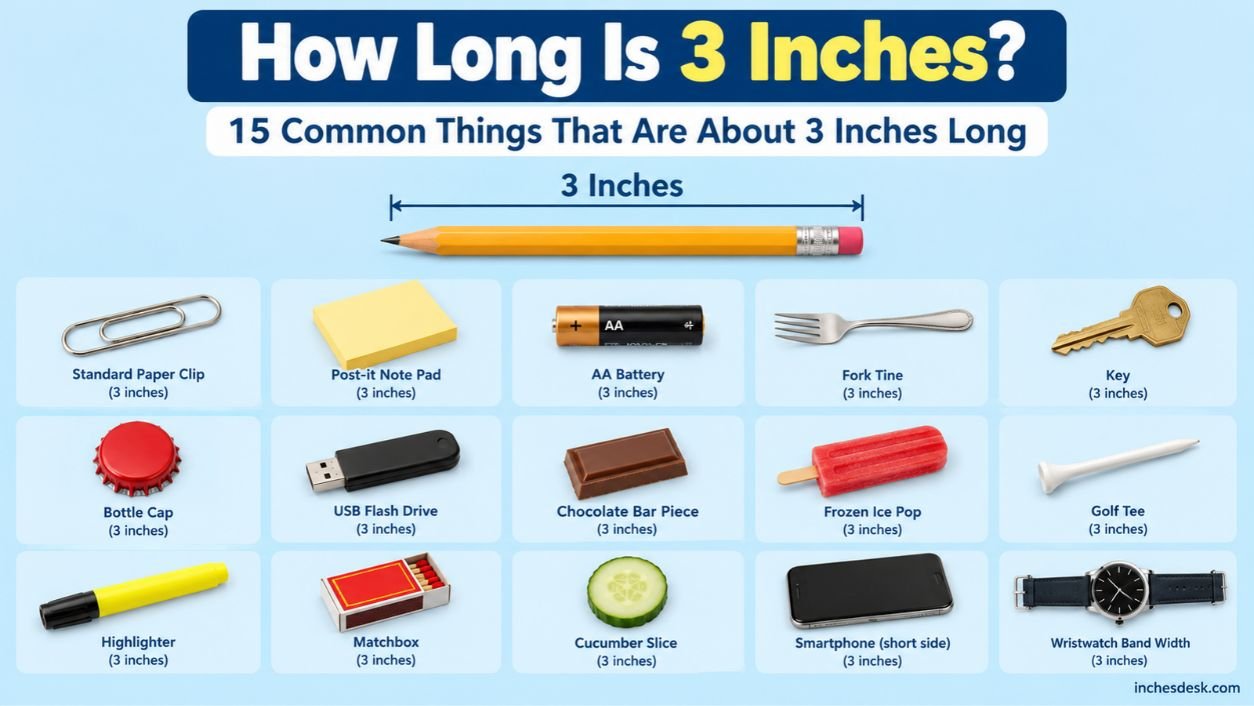
How Long Is 3 Inches?
3 inches is equal to 7.62 centimeters, 76.2 millimeters, or 0.25 feet. It is one-quarter of a foot and measures slightly less than the length of a standard smartphone’s width. Knowing this measurement helps when comparing everyday objects, completing DIY projects, checking product dimensions, or estimating small distances without a ruler.
To convert 3 inches into another unit, multiply the inch measurement by the appropriate conversion factor. Since 1 inch equals 2.54 centimeters, the calculation is straightforward.
Conversion formula:
3 inches × 2.54 = 7.62 cm
Here is a quick reference table showing how 3 inches compares across common measurement units.
| Measurement Unit | Equivalent of 3 Inches |
| Inches | 3 inches |
| Centimeters | 7.62 cm |
| Millimeters | 76.2 mm |
| Feet | 0.25 ft |
| Yards | 0.0833 yd |
| Meters | 0.0762 m |
What Does 3 Inches Look Like?
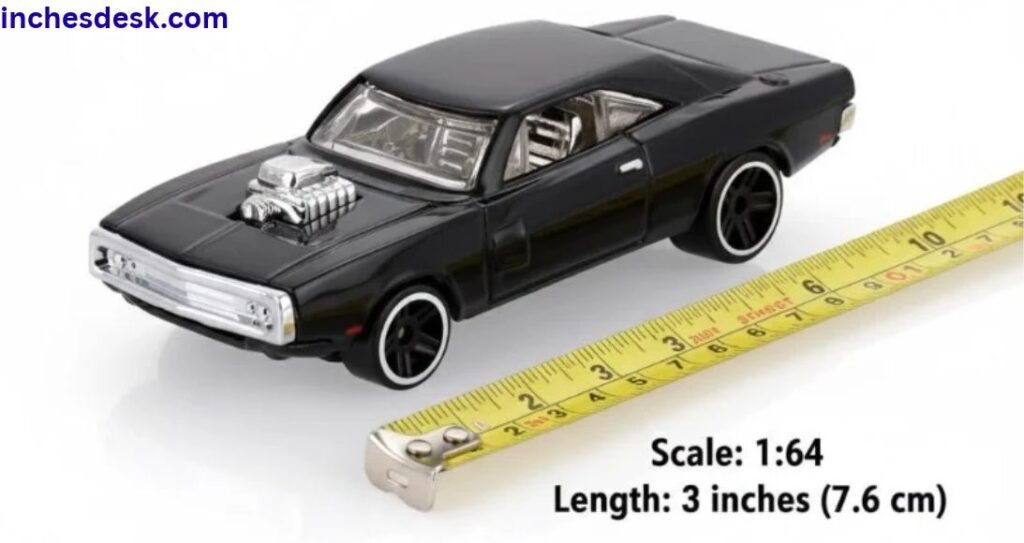
Three inches is about 7.62 centimeters long, making it easy to visualize as a short everyday object or the length of a few small items placed together. Imagine a line stretching from one end of a small toy car to the other, or a little longer than the length of a typical adult thumb. These comparisons provide a practical sense of the measurement when you do not have a ruler nearby.
Here are a few simple ways to picture 3 inches in everyday life:
- A small toy car: Many Hot Wheels and Matchbox-style cars measure around 2.5 to 3 inches long, depending on the model.
- A cotton swab: The stick of a standard cotton swab is often close to 3 inches long, although some are longer or shorter.
- A large paper clip: A jumbo paper clip can measure approximately 2 to 3 inches from end to end.
- A small fruit: A kiwi or a small lemon may measure close to 3 inches in one dimension.
- A hand reference: Three inches is roughly the width of some adult fingers placed side by side, but hand sizes vary considerably.
The easiest way to understand this length is to picture a straight line measuring 7.62 cm from one endpoint to the other. The measurement refers to length, not the distance around an object. For instance, a round can may have a diameter of about 3 inches, but its circumference will be much greater.
15 Common Things That Are About 3 Inches Long
1. 10d Common Nail
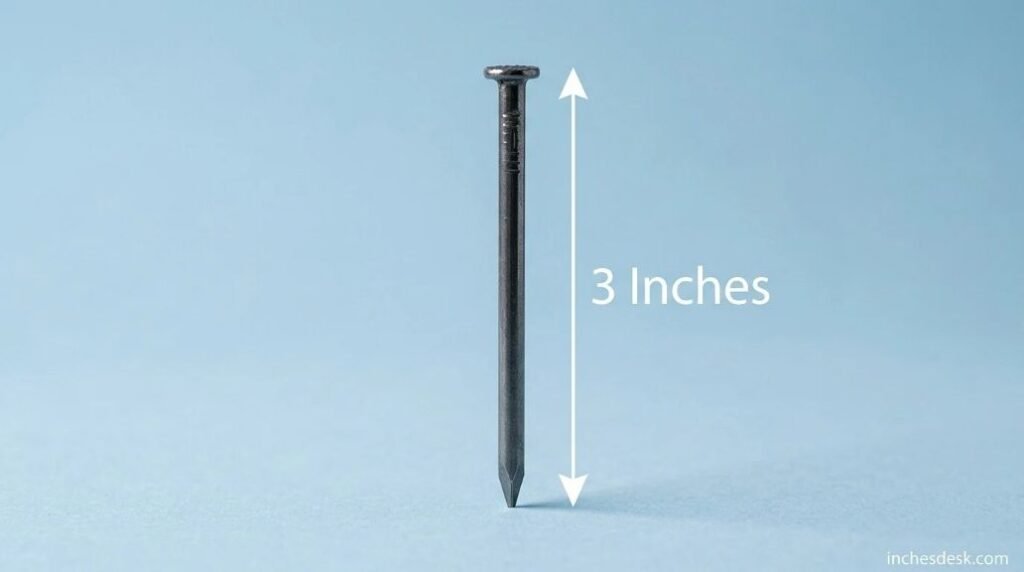
A 10d common nail is a useful reference for understanding a length close to 3 inches. In the United States, a standard 10d common nail is typically 3 inches long, measured from the nail’s tip to the underside of its head.
This type of nail is used in general construction and wood framing. Its familiar size makes it a practical example for DIY enthusiasts, carpenters, and anyone who works with lumber. Keep in mind that nail length can differ by nail type, even when the penny size designation is similar.
2. Cotton Swab (Q-tip)
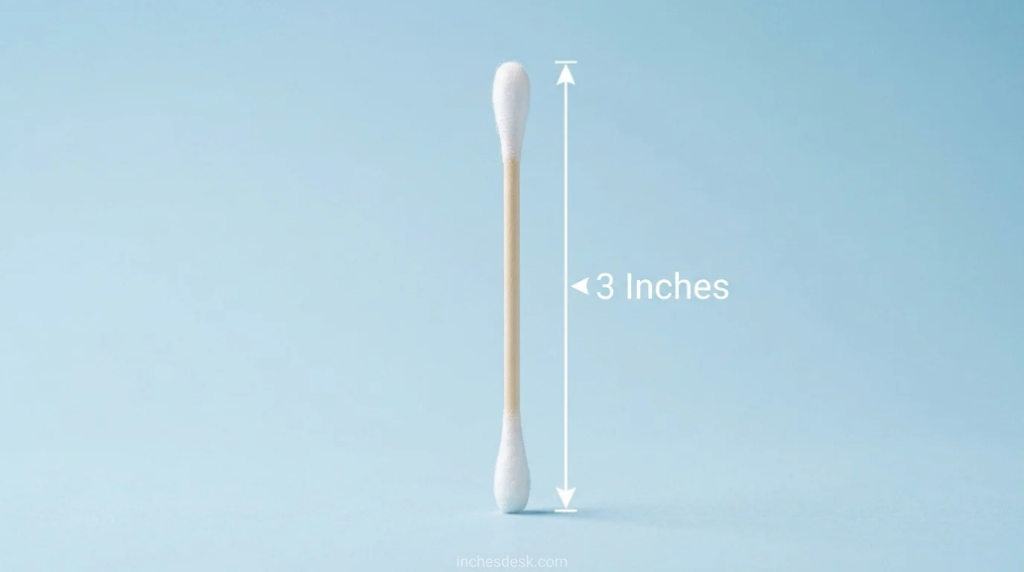
A cotton swab is another familiar object that can help you picture a length near 3 inches, although many standard cotton swabs are longer than this. The total length depends on the manufacturer and whether the stick is made of paper, plastic, or another material.
If you have a shorter cotton swab at home, place it horizontally on a flat surface and compare its length with an imaginary 3-inch line. This is useful for a quick visual estimate, but check the actual dimensions if you need an accurate measurement for a craft or project.
3. Cinnamon Stick
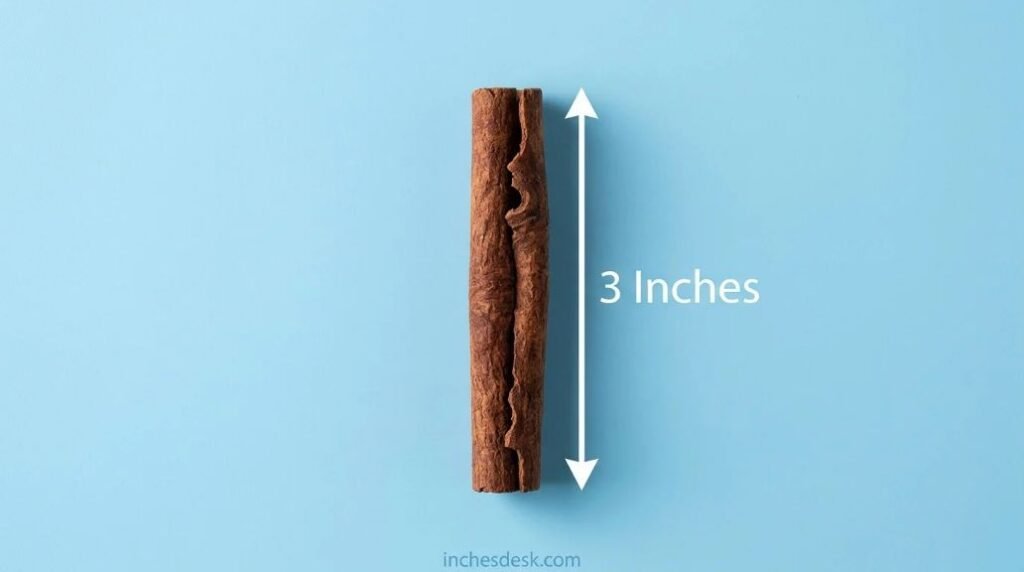
A short cinnamon stick can measure approximately 3 inches long, making it a convenient kitchen reference. Cinnamon sticks are made from the dried inner bark of cinnamon trees, and their lengths vary depending on how they are cut and packaged.
A stick measuring 3 inches is about 7.62 cm from end to end. You may encounter cinnamon sticks of this length in spice jars, tea recipes, and mulled beverage preparations. Because natural cinnamon sticks are irregular, measure the longest straight dimension rather than following the curves of the bark.
4. Hot Wheels or Matchbox Toy Car
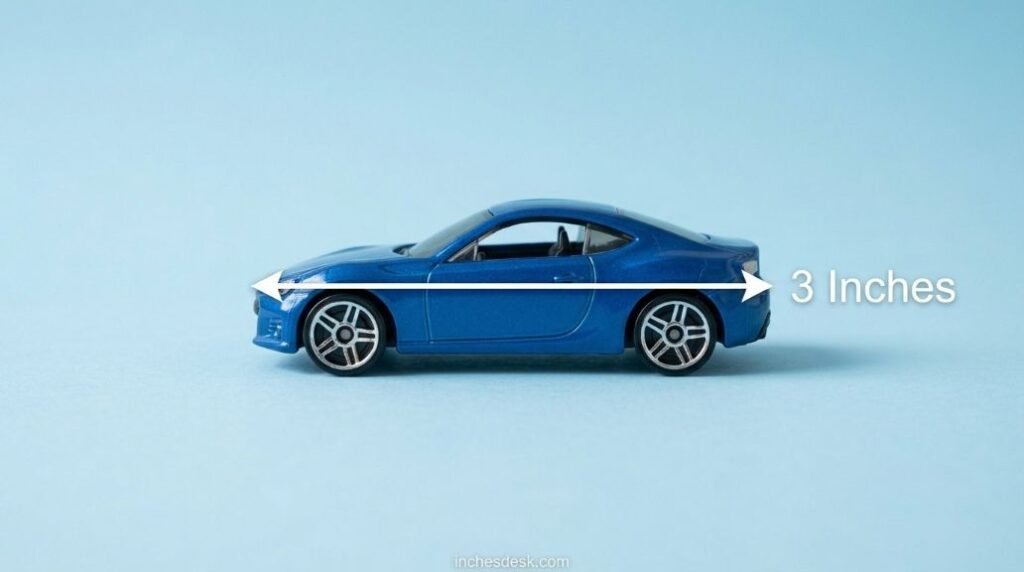
Many Hot Wheels and Matchbox-style die-cast toy cars measure around 3 inches long, making them one of the easiest objects to use as a size reference. Their compact bodies fit comfortably in a child’s hand and are commonly used in imaginative play and toy collections.
Not every model is the same size. A compact car may be shorter, while a truck, bus, or elongated sports car may be longer. If you have a small die-cast car nearby, compare its front-to-back length with 3 inches to get a quick visual estimate.
5. Standard 15 oz Food Can

A standard 15-ounce food can is a useful example of an object that may measure close to 3 inches across its diameter. Many cans of vegetables, beans, and similar foods have a diameter around this size, although their heights vary by manufacturer and packaging style.
The key distinction is that 3 inches may describe the can’s width, not its height. To compare the can with a 3-inch measurement, measure straight across the circular top through its center. Do not assume every 15-ounce can has identical dimensions.
6. Stick of Classroom Chalk

A short piece of classroom chalk can provide another visual reference for 3 inches. Chalk sticks are commonly used for writing and drawing on chalkboards, and their dimensions vary depending on the manufacturer and whether the stick has been used.
A new chalk stick may be longer than 3 inches, while a well-used piece may be close to that length. If you find a chalk piece measuring approximately 7.62 cm, it offers a handy reference for small measurements in classroom activities, art projects, and simple crafts.
7. Lemon

A small lemon can measure around 3 inches from one end to the other. Lemons come in different shapes and sizes, so this comparison works best with a smaller fruit rather than a large, elongated variety.
A lemon measuring 3 inches in length is approximately 7.62 cm long. This reference is useful in the kitchen when estimating the size of ingredients for recipes, arranging fruit for serving, or comparing produce at a grocery store. Remember that a lemon’s length and width are different measurements.
8. Kiwi Fruit

A medium or large kiwi fruit may approach 3 inches in length, depending on its variety and growing conditions. Its oval shape makes it easy to visualize a short measurement when viewed from one end to the other.
Kiwis are useful examples because they are common grocery-store fruits with a clearly defined longest dimension. However, smaller kiwis may be noticeably shorter, and some larger fruits may exceed 3 inches. For an accurate comparison, measure the fruit along its longest straight axis.
9. Fortune Cookie

A fortune cookie can be close to 3 inches across its widest dimension, depending on the bakery or manufacturer. These crisp, folded cookies are often served at the end of meals in Chinese American restaurants.
Because fortune cookies have a curved, folded shape, their width is more useful as a reference than their thickness. A cookie measuring approximately 3 inches across can help you picture the distance, but not every fortune cookie will match this size. Some are smaller, while larger specialty versions may be wider.
10. Jumbo Paper Clip

A jumbo paper clip is a convenient office-supply reference for a length approaching 3 inches. Larger paper clips are designed to hold several sheets of paper together, and their overall dimensions are greater than those of standard small paper clips.
Measure the paper clip from its outermost end to the opposite end to estimate its overall length. Avoid measuring along the wire’s curved path, because that measures the wire itself rather than the straight-line distance between its endpoints. Jumbo paper clips come in multiple sizes, so the exact length depends on the product.
11. Stick of Chewing Gum

A stick of chewing gum can be a useful reference for a length near 3 inches, particularly when comparing longer rectangular gum pieces or strips. However, traditional individual sticks are often shorter than 3 inches, and modern gum products come in many shapes and sizes.
For a more reliable comparison, check the dimensions of the gum packaging or measure the piece directly. This example is especially useful when explaining the difference between an object’s length and its thickness, since a gum stick is typically long and narrow.
12. Medium Orange

A medium orange may measure about 3 inches in diameter, although some oranges are significantly wider. Its rounded shape provides a good example of how a length measurement can describe the width of an object rather than its height.
To visualize 3 inches, imagine a straight line passing through the center of the orange from one side to the other. That line represents its diameter. This is a useful everyday comparison for grocery shopping, food preparation, and understanding produce dimensions.
13. Adult Palm Width

The width of an adult palm can be close to 3 inches, measured across the broad part of the palm without including the thumb. However, palm width differs with hand size, age, and individual anatomy, so it is not a dependable substitute for a measuring tool.
To use your hand as a reference, place your palm flat and compare its width with the distance you want to estimate. If your palm is approximately 3 inches wide, it can help you visualize that length quickly. For woodworking, fitting components, or other precision tasks, measure your palm first rather than assuming it matches the standard.
14. Wooden Clothespin

A wooden clothespin can be close to 3 inches long, depending on its design. These small household tools use a spring mechanism to grip clothing on a washing line, and traditional wooden versions are also popular for craft projects.
A clothespin measuring 3 inches provides a convenient reference because its length is easy to see from the gripping end to the opposite tip. Smaller craft clothespins may be much shorter, while oversized versions can be longer. Check the specific clothespin before relying on it for an accurate measurement.
15. Standard Birthday Candle

A short birthday candle may measure approximately 3 inches long, making it another familiar reference for this measurement. Birthday candles are available in different lengths, including short candles for cupcakes and longer varieties designed for cakes.
To compare a candle with 3 inches, measure its length from the bottom to the top before placing it in a cake. Decorative candles with shaped tops or extended picks may have different overall dimensions. Since candles are narrow, they are especially helpful for visualizing length rather than width.
3 Inches vs 3 Centimeters: What’s the Difference?
Three inches and 3 centimeters are very different lengths. 3 inches equals 7.62 centimeters, while 3 centimeters equals approximately 1.18 inches. Therefore, 3 inches is about 2.54 times longer than 3 centimeters. Understanding this difference is useful when reading product specifications, following craft instructions, or comparing measurements in imperial and metric units.
The main difference comes from the conversion factor: 1 inch equals exactly 2.54 centimeters.
| Measurement | Inches | Centimeters | Millimeters |
| 3 inches | 3 in | 7.62 cm | 76.2 mm |
| 3 centimeters | 1.18 in | 3 cm | 30 mm |
| Difference | 1.82 in | 4.62 cm | 46.2 mm |
To convert inches to centimeters, multiply the inch value by 2.54. To convert centimeters to inches, divide the centimeter value by 2.54.
For example, converting 3 inches to centimeters works as follows:
- Start with 3 inches.
- Multiply 3 by 2.54.
- The result is 7.62 centimeters.
This distinction matters when ordering hardware, measuring furniture components, or purchasing materials online. If a product specification calls for a 3-inch part, choosing a 3-centimeter part instead could leave you with an item that is much too short.
How to Measure 3 Inches Without a Ruler
You can estimate 3 inches without a ruler by using familiar household objects, your hand, or a known measurement on another item. Since 3 inches equals 7.62 centimeters, you can also use a metric measuring tool if one is available. These methods work well for quick estimates when shopping, crafting, or completing simple DIY tasks, although a proper measuring tool is best when accuracy matters.
Here are five practical ways to estimate 3 inches without a ruler.
1. Use a 10d common nail: A standard 10d common nail is typically 3 inches long. If you have one available, use the distance from the tip to the underside of the head as a reference. This method is especially useful for carpentry and other DIY projects.
2. Compare the length with a small toy car: Many die-cast toy cars are approximately 3 inches long. Place the car next to the object you want to measure and compare their endpoints. Remember that larger vehicles and different toy models may have different dimensions.
3. Use your hand as a reference: The width of an adult palm or the combined width of several fingers may be close to 3 inches. However, hand sizes vary considerably. If you need a repeatable estimate, measure your hand once using a ruler and remember its dimensions.
4. Use a phone or another familiar object: If you know the dimensions of your smartphone, you can use its width or another measured feature as a reference. Compare the target length with a known portion of the device rather than assuming every phone has the same size.
5. Estimate using centimeters: If you have a metric measuring tape, a centimeter-marked object, or a measuring guide, locate a span of 7.62 cm. This is the precise metric equivalent of 3 inches. If your measuring tool only shows whole centimeters, 7.6 cm is a practical approximation.
Tips for Estimating 3 Inches Accurately + Common Mistakes
Estimating 3 inches accurately starts with choosing a reliable reference, identifying the correct endpoints, and understanding whether you are measuring length, width, or diameter. Since 3 inches equals 7.62 cm, keeping this conversion in mind helps you check your estimate and avoid common measurement errors. Everyday objects are useful for rough comparisons, but their dimensions should not be assumed to be exact.
Here are some practical tips for improving your estimates.
Choose a reference object with a known size: A standard 10d common nail is typically 3 inches long, making it a useful reference. If you use a toy car, paper clip, or clothespin instead, remember that its dimensions may differ from those of similar products.
Measure between the correct endpoints: For a straight object, measure from one end to the other. For a round object, distinguish between its diameter (the distance across the center) and circumference (the distance around it). These measurements describe different dimensions and cannot be substituted for one another.
Keep the object straight: When comparing two objects, place them on a flat surface and align one end of each. This makes it easier to see whether their lengths match. Measuring along a curved surface can produce a different result from measuring the straight-line distance between two endpoints.
Check the unit before measuring: Inches and centimeters are not interchangeable. Three inches equals 7.62 cm, whereas 3 cm equals only about 1.18 inches. Always check whether a product label, instruction manual, or project plan uses imperial or metric units.
Read More: How Long Is 2 Inches? 16 Everyday Items to Visualize It
Avoid relying entirely on body measurements: Finger widths, palm sizes, and thumb lengths vary from person to person. They can help you estimate a short distance, but they should not be treated as universal standards.
Common mistakes include assuming every small object measures 3 inches, confusing an object’s diameter with its height, and rounding measurements too aggressively. For example, rounding 7.62 cm to 8 cm may be acceptable for a rough visual comparison, but it introduces a difference of 0.38 cm.
Where 3 Inches Matters in Real Life
A measurement of 3 inches may seem small, but it plays a useful role in everyday activities, from home improvement and crafting to shopping and cooking. Knowing that 3 inches equals 7.62 cm or 76.2 mm helps you understand product dimensions, follow instructions, and estimate the size of objects when a measuring tool is not immediately available.
Home improvement and DIY projects: Three inches can describe the length of a nail, the width of a small component, or the depth of a fitting. When working with wood, cabinetry, or household repairs, checking the exact measurement helps prevent parts from being too short or too large for their intended purpose.
Shopping and product dimensions: Online listings often provide dimensions in inches, particularly for tools, accessories, storage products, and household items. Understanding what 3 inches looks like helps you judge whether a small item will fit in a drawer, organizer, container, or other limited space. Always check whether the listed measurement refers to length, width, height, or diameter.
Arts, crafts, and school projects: Paper crafts, miniature models, decorations, and classroom activities frequently involve small measurements. Three inches is a convenient reference for cutting strips, arranging small objects, or creating consistent shapes. Using a ruler is recommended when multiple pieces need to match.
Cooking and food preparation: Measurements in inches can help describe the dimensions of fruit, baking decorations, and kitchen equipment. For example, a recipe or product description might refer to a 3-inch cookie cutter or a container with a 3-inch opening. Remember that an opening’s diameter is different from the height or circumference of the container.
Gardening and outdoor work: Three inches can be relevant when describing small plant containers, planting depths for particular seeds or bulbs, and the dimensions of gardening accessories. However, suitable planting depth depends on the specific plant, so follow the relevant growing instructions rather than using 3 inches as a universal guideline.
Tools, hardware, and replacement parts: Screws, nails, brackets, and other components may have dimensions listed in inches or millimeters. Converting between these units helps you select compatible parts and interpret technical specifications correctly. For precision work, check the manufacturer’s stated dimensions instead of relying on visual estimates.
FAQs About 3 Inches
How long is 3 inches in cm and mm?
Three inches equals 7.62 centimeters (cm) or 76.2 millimeters (mm). To convert inches to centimeters, multiply the measurement by 2.54. To convert centimeters to millimeters, multiply by 10.
Is 3 inches the same as 3 cm?
No, 3 inches is not the same as 3 centimeters. Three inches equals 7.62 cm, while 3 centimeters equals approximately 1.18 inches. Three inches is 2.54 times longer than 3 centimeters, so confusing these measurements can lead to incorrect dimensions when purchasing materials or completing DIY projects.
Is 3 inches considered small?
Yes, 3 inches is generally considered a short length for many everyday objects, although whether it is small depends on what you are measuring. It is about 7.62 cm, which is suitable for describing small accessories, compact components, and certain household items. For larger objects, such as furniture or building materials, 3 inches represents a relatively small dimension.
What household items are 3 inches long?
Several everyday objects can measure approximately 3 inches, including a standard 10d common nail, some small toy cars, short cinnamon sticks, jumbo paper clips, and wooden clothespins. Some small lemons and kiwi fruits may also measure around 3 inches in one dimension. Actual sizes vary, so measure the specific item when accuracy matters.
How can I measure 3 inches without a ruler?
You can estimate 3 inches by comparing the length with a familiar object of a known size, such as a standard 10d common nail or a small toy car with verified dimensions. If you have a metric measuring tool, measure 7.62 cm instead. Hand measurements can also help, but their accuracy varies from person to person.
How big is 3 inches compared to a finger or hand?
Three inches equals 7.62 cm, which may be close to the width of an adult palm or the combined width of several fingers, depending on the individual. It is also comparable to the length of some adult thumbs, although thumb lengths vary. For a reliable comparison, measure your own hand once and use that measurement as a personal reference.
Conclusion
Three inches is equal to 7.62 centimeters, 76.2 millimeters, or 0.25 feet. Although it is a relatively short measurement, it is useful for understanding the dimensions of everyday objects, comparing product sizes, and completing small DIY, craft, and household projects.
You can visualize 3 inches using familiar items such as a standard 10d common nail, a small toy car, a jumbo paper clip, or a wooden clothespin. These objects provide convenient reference points, although their actual dimensions can vary.
If you need to estimate 3 inches without a ruler, choose an object with a known length or use the metric equivalent of 7.62 cm. For tasks that require an exact fit or precise measurements, a ruler or tape measure is the most reliable option.
