
How Big Is 5mm?
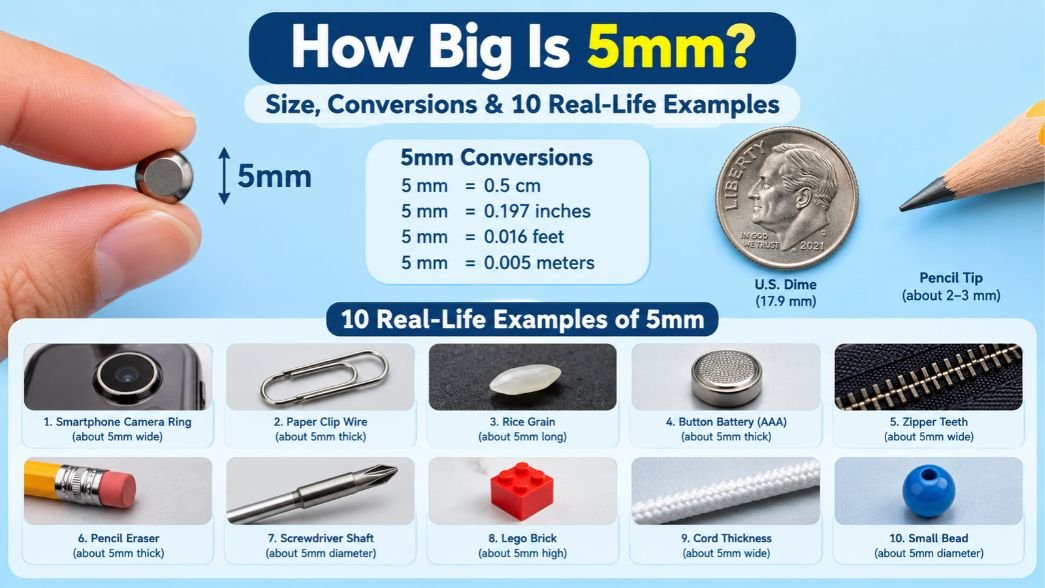
5 millimeters (5mm) equals 0.5 centimeters, approximately 0.197 inches, or just under 1/5 of an inch. It is a small measurement, roughly the width of a small bead or a peppercorn. Although 5mm can be difficult to judge by sight alone, understanding its conversions and comparing it with familiar objects makes the size easier to visualize.
A millimeter is one-thousandth of a meter and one-tenth of a centimeter. Millimeters are commonly used when measuring small objects, jewelry components, craft supplies, electronic parts, and material thicknesses.
5mm Conversion Table
Converting 5mm into other units helps when following craft instructions, checking product dimensions, working with small components, or comparing metric measurements with imperial measurements.
The exact metric conversion is straightforward: 10 millimeters equal 1 centimeter, so 5mm equals 0.5cm. To convert millimeters into inches, divide the millimeter value by 25.4 because one inch equals exactly 25.4mm.
| Unit | Conversion of 5mm |
| Millimeters (mm) | 5 mm |
| Centimeters (cm) | 0.5 cm |
| Meters (m) | 0.005 m |
| Inches (decimal) | 0.19685 inches |
| Inches (rounded) | 0.197 inches |
| Fractional inches (nearest common fraction) | 13/64 inch |
| Feet (ft) | 0.0164 ft |
| Micrometers (µm) | 5,000 µm |
How to Convert 5mm to Centimeters
To convert millimeters into centimeters, divide the measurement by 10.
Calculation:
5 ÷ 10 = 0.5 cm
Therefore, 5mm is exactly half a centimeter. This is one of the simplest ways to remember the measurement without needing a calculator.
How to Convert 5mm to Inches
To convert millimeters into inches, divide the millimeter value by 25.4.
Step-by-step calculation:
- Start with the measurement: 5mm.
- Divide 5 by 25.4.
- The result is approximately 0.19685 inches.
For most everyday purposes, you can round this to 0.197 inches, or approximately 0.2 inches.
What Fraction of an Inch Is 5mm?
Five millimeters is approximately 13/64 of an inch when rounded to the nearest common fraction with a denominator of 64. It is also close to one-fifth of an inch, which equals 0.2 inches.
These values are approximations when expressed as fractions. The exact inch equivalent is 5 ÷ 25.4, or approximately 0.19685 inches.
| Inch Measurement | Decimal Equivalent | Difference from 5mm |
| 3/16 inch | 0.1875 inches | Slightly smaller |
| 13/64 inch | 0.203125 inches | Slightly larger |
| 1/5 inch | 0.2 inches | Very close |
| 1/4 inch | 0.25 inches | Noticeably larger |
If you are measuring a component for a DIY project, use the decimal conversion or a metric measuring tool whenever precision matters. Fractional inch equivalents are helpful for visual comparison, but rounding can create small differences that matter when fitting tightly matched parts.
What Does 5mm Look Like?
5mm is a short distance equal to half a centimeter or approximately 0.2 inches. It is small enough to fit within the width of many small jewelry pieces, beads, and seeds. To visualize it, imagine a line spanning just under one-fifth of an inch on a ruler. Although the measurement is short, it is visible to the naked eye.
A useful way to picture 5mm is to compare it with familiar objects rather than trying to imagine the number alone. A small peppercorn, a tiny decorative bead, or a miniature stud earring can provide a rough reference. However, these objects come in different sizes, so they should not be treated as exact measuring tools.
Here are a few ways to understand the size of 5mm:
- Compared with a centimeter: 5mm is exactly half the length of a 1cm segment.
- Compared with an inch: It is slightly less than one-fifth of an inch.
- Compared with a fingernail: A 5mm line is generally much shorter than the width of an adult fingernail.
- Compared with a small bead: A bead measuring 5mm across has a diameter of half a centimeter.
- Compared with a standard ruler: The distance between five consecutive millimeter marks, starting at zero, measures 5mm.
The direction of a measurement also matters. A round bead can have a diameter of 5mm, while a flat object may be 5mm thick but much longer and wider. Always check whether a product’s listed measurement refers to its length, width, height, diameter, or thickness.
For a quick visual reference, draw a straight line between the zero mark and the 5mm mark on a metric ruler. This gives you a reliable representation of the length. If you only have an inch ruler, remember that 5mm is close to 0.2 inches, although a ruler with fine subdivisions will make the comparison easier.
10 Common Things That Are About 5mm
Several small everyday objects can help you picture a measurement of 5mm. Seeds, beads, jewelry pieces, and tiny electronic components are useful examples because they are small enough to make millimeter measurements meaningful.
The following objects can serve as approximate visual references. Their actual dimensions vary by variety, manufacturer, and design, so not every example will measure exactly 5mm.
Black Peppercorn

A black peppercorn is a small, round spice that can help you visualize a few millimeters. Many peppercorns measure several millimeters across, and some are close to 5mm in diameter.
Peppercorns vary depending on their variety, growing conditions, and processing. Some are smaller than 5mm, while others are larger. For a visual comparison, place a peppercorn beside the 5mm mark on a ruler and compare its widest point with the marked distance.
Its roughly spherical shape makes it a useful example for understanding diameter. However, a peppercorn is a natural object, not a precision measurement reference, so use a ruler or caliper if you need an exact 5mm dimension.
Coriander Seed

Coriander seeds are small, rounded seeds commonly used in cooking. Many whole coriander seeds are approximately 3–5mm across, making the larger examples useful for visualizing a measurement close to 5mm.
Their rounded shape makes it easy to compare their diameter with a short line on a metric ruler. Place the seed next to the ruler rather than estimating its size from memory.
Not all coriander seeds measure 5mm. Their dimensions depend on the variety and the individual seed, so this example is best used to develop a general sense of scale.
Ladybug
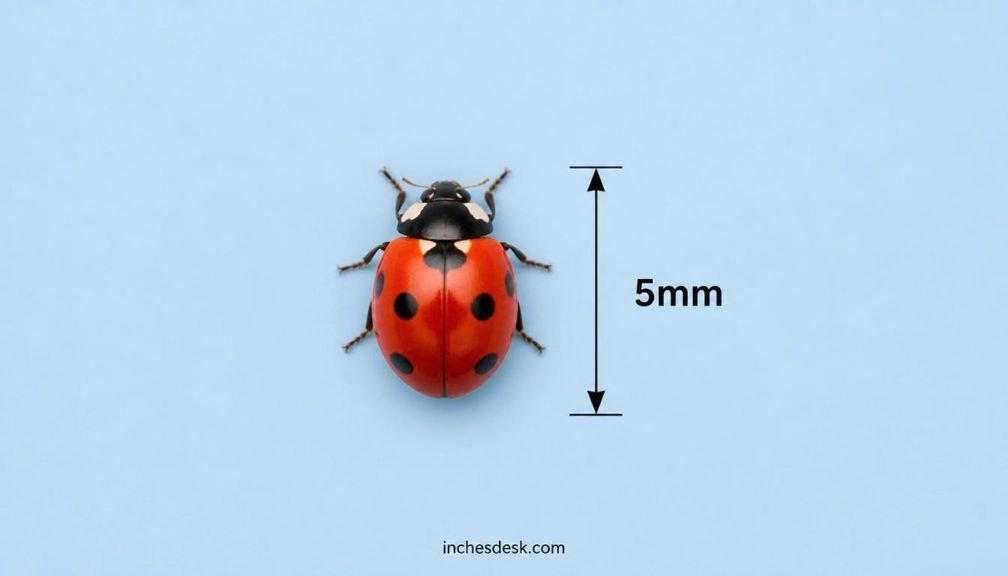
A small ladybug can help demonstrate how a measurement of 5mm looks on a living insect. Some small ladybug species or immature individuals can have body dimensions around this size, although many adult ladybugs are considerably larger.
A 5mm reference is especially useful when observing tiny insects on plants, leaves, or garden surfaces. It provides a sense of scale without requiring you to handle the insect.
Keep in mind that body length and body width are different measurements. A ladybug may be around 5mm long but narrower across its body. Species and life stage also affect size, so a ladybug should be considered an approximate comparison rather than an exact 5mm object.
Lentil
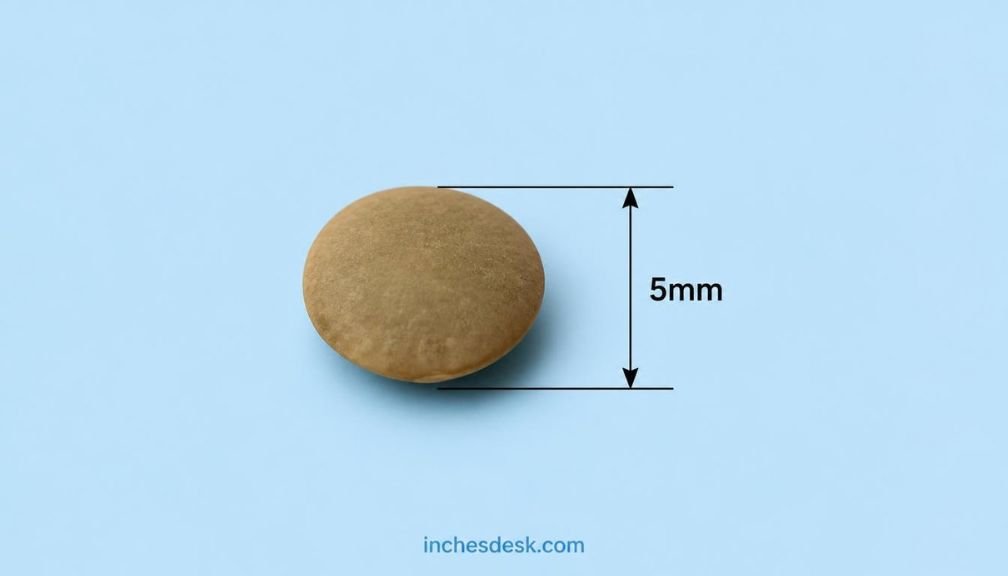
Lentils, including masoor and moong daal, are familiar kitchen ingredients that offer a practical way to understand small measurements. A lentil can be a few millimeters across, and some individual seeds approach 5mm in diameter or width.
Moong beans are often rounded or oval, while masoor lentils are commonly flatter and may be split into halves. These differences affect how their dimensions should be measured.
To compare a lentil with 5mm, place it beside a metric ruler and measure its widest point. A seed that appears 5mm long may have a smaller thickness, so consider the dimension you actually need.
Lentils are particularly useful for visualizing small sizes because they are easy to find at home. However, seed size varies by type and batch, so they should not replace a measuring tool when accuracy is necessary.
Grain of Rice
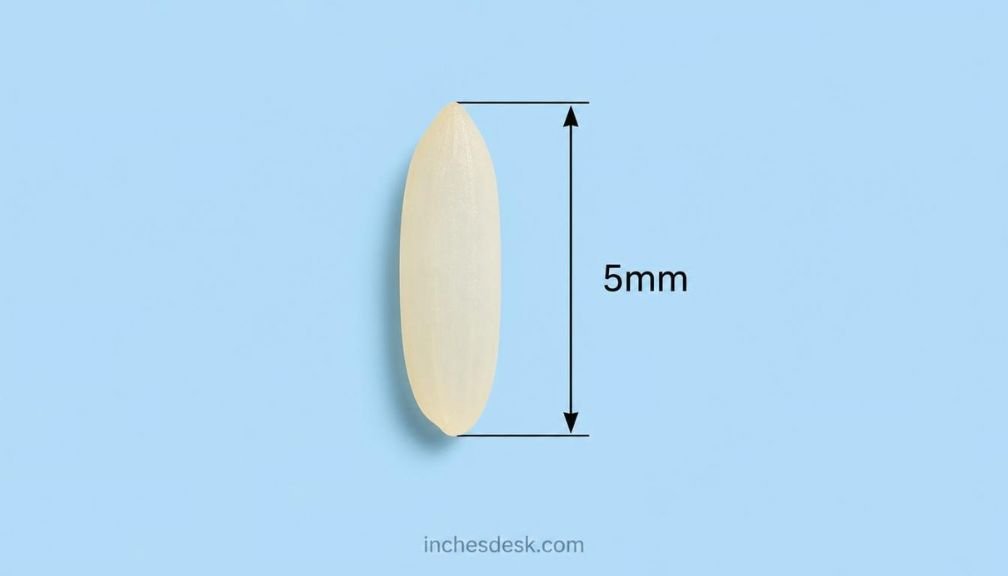
A grain of rice illustrates why it is important to distinguish between length and width. Many uncooked rice grains are several millimeters wide or thick, while their lengths are commonly much greater than 5mm.
For example, a short or broken grain may be close to 5mm long, but a typical intact grain of rice is generally longer. Its width is also usually smaller than its length.
If you want to use rice as a reference, measure the grain in the direction relevant to your comparison. A grain that is 5mm wide would be different from one that is 5mm long. This distinction matters when measuring small food ingredients, craft materials, or other narrow objects.
Stud Earring Top

A small stud earring top is a useful example of a manufactured item that may measure approximately 5mm across. Simple round studs, tiny gemstone settings, and decorative metal tops are commonly available in different diameters, including 5mm.
The measurement usually refers to the visible front of the earring, not the length of the post that passes through the ear. A 5mm stud therefore has a face approximately half a centimeter across.
When shopping for earrings, check whether the listed size refers to the stone, the decorative setting, or the complete earring face. These dimensions can differ, particularly when the setting has a raised edge or a decorative border.
Unlike seeds, a manufactured earring can be made to a specified size. If you need a reliable 5mm example, a product listing that explicitly states a 5mm diameter is more useful than estimating the size from a photograph.
Small Sequin

A small sequin is a thin, decorative disc used in clothing, embroidery, costumes, and craft projects. Sequins are manufactured in many sizes, and a 5mm sequin provides a direct example of a circular object measuring half a centimeter across.
Because sequins are flat, their diameter is usually more noticeable than their thickness. A 5mm sequin spans 5mm from one edge to the opposite edge through its center.
Small sequins are useful for visualizing millimeter measurements in sewing and crafting. They can also help when choosing decorative materials for patterns that require consistent spacing or a particular size.
Always check the listed diameter when buying sequins. A product described as small may be available in several sizes, and visual photographs can make the pieces look larger or smaller than they actually are.
Mini Pearl Bead

A mini pearl bead with a 5mm diameter is one of the clearest manufactured examples of this measurement. Small pearl beads are used in jewelry making, bracelets, necklaces, clothing embellishments, and decorative crafts.
A 5mm pearl bead measures half a centimeter across its widest point. When placed beside a metric ruler, it spans the distance from zero to the 5mm mark.
Pearl beads may be natural, cultured, glass, plastic, or imitation pearls. Their appearance and material can vary considerably, but a bead specified as 5mm in diameter provides the same basic size reference.
If you are purchasing beads for a bracelet or necklace, look for the bead diameter rather than relying on the term mini. Sellers may use that description for several different sizes. Also consider the drilled hole, because its diameter is separate from the overall bead size.
Pencil Lead Refill Stack
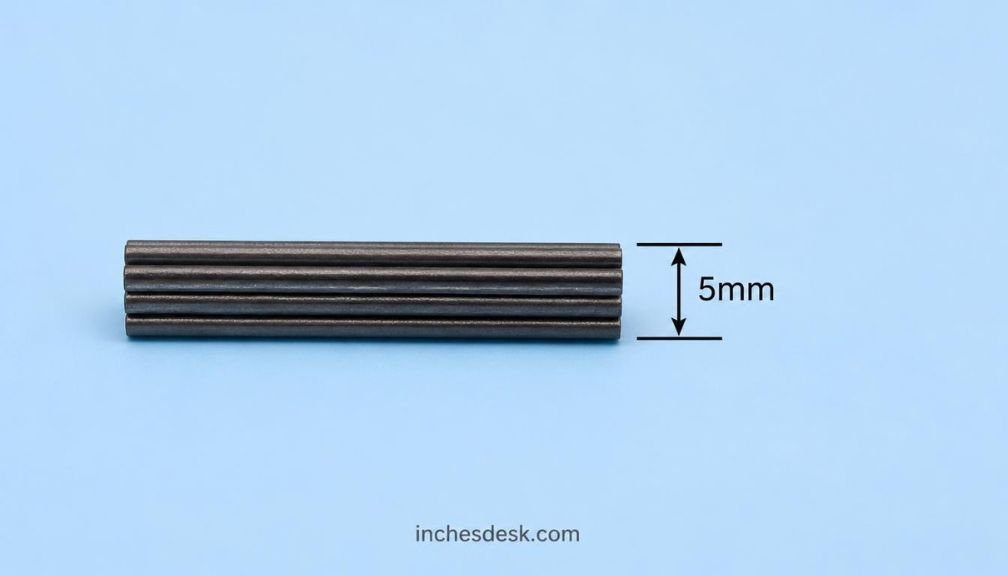
Mechanical pencil leads are extremely thin compared with a 5mm measurement. Common lead diameters include 0.5mm and 0.7mm, which means a 5mm distance is ten times the diameter of a 0.5mm lead and more than seven times the diameter of a 0.7mm lead.
This makes pencil lead a useful comparison for understanding how small millimeter measurements can be. A single 0.5mm lead is only one-tenth of 5mm across.
You can compare these dimensions mathematically:
- 0.5mm lead: Ten lead diameters equal 5mm.
- 0.7mm lead: Five lead diameters equal 3.5mm, while seven lead diameters equal 4.9mm.
- 5mm measurement: Equal to ten 0.5mm lead diameters placed side by side, assuming no gaps.
These calculations describe the total widths of the leads, not a practical recommendation to stack or align them for precise measuring. Small gaps, irregular alignment, and fragile graphite can affect the result. A caliper or metric ruler is more suitable for accurate work.
5mm LED Bulb
Some miniature LED components are available in packages or housings with a specified 5mm diameter. These small LEDs are widely associated with hobby electronics, indicator lights, educational circuits, and DIY projects.
A 5mm LED provides a helpful example because the size is often part of the component’s description. In a typical 5mm round LED, the main circular housing is approximately 5mm across, although the overall length, leads, and mounting requirements differ.
When selecting an LED, check the manufacturer’s dimensions. A 5mm package does not mean the complete component is only 5mm long. The clear or colored housing may extend several millimeters, and the metal leads add extra length.
For electronics projects, package diameter matters when fitting an LED into a panel hole or enclosure. A hole that is too small may not accept the component, while an oversized hole may leave it loose. Check both the LED’s dimensions and the recommended mounting-hole size before drilling.
How to Measure 5mm Without a Ruler
You can estimate 5mm without a ruler by using a metric reference, a digital measuring tool, or an object with a known dimension. Since 5mm equals exactly half a centimeter and approximately 0.197 inches, converting the measurement into a familiar unit is a useful starting point. However, everyday objects vary in size, so use a proper measuring tool when accuracy matters.
Here are several practical ways to visualize or estimate 5mm at home.
1. Use a ruler’s centimeter markings
If you have a ruler with centimeter markings, locate the space between two consecutive centimeter marks. Each space represents 10mm. Half of that distance equals 5mm.
For example:
- One centimeter = 10mm.
- Half a centimeter = 5mm.
- One-quarter of a centimeter = 2.5mm.
This method works well when your ruler does not have clearly printed millimeter subdivisions. For greater accuracy, use a ruler that displays individual millimeter marks.
2. Convert the measurement into inches
If you have an inch-based measuring tool, remember that 5mm is approximately 0.2 inches. This is slightly less than one-fifth of an inch, which equals 0.2 inches exactly.
The conversion formula is:
Inches = millimeters ÷ 25.4
For 5mm:
5 ÷ 25.4 = 0.19685 inches
An inch ruler with fine subdivisions can help you estimate this distance, but a standard ruler may not show the exact equivalent clearly.
3. Use a digital caliper
A digital caliper is one of the most reliable tools for checking a small measurement such as 5mm. Depending on its quality and specifications, it can measure external dimensions, internal openings, and depths.
To measure a small object, close the caliper gently around the relevant dimension and read the displayed value. If the display shows 5.00mm, the object measures 5mm to the displayed precision. Actual accuracy depends on the instrument’s specifications, calibration, and how it is used.
Avoid squeezing soft materials too tightly, as this can change the measurement.
4. Check the dimensions of a manufactured object
Some products, including jewelry beads, sequins, LED components, and small hardware parts, are sold with specified dimensions. A bead labeled as 5mm in diameter, for example, can serve as a reference for comparing other small objects.
However, do not assume that every small bead or electronic component measures 5mm. Check the packaging or manufacturer’s specifications before using it as a reference.
5. Use a phone’s measuring feature
Some smartphones support measuring applications that use the camera and device sensors to estimate dimensions. If your phone has this feature, you may be able to measure an object that appears to be 5mm long or wide.
Camera-based measurements can be less reliable for very small dimensions because of perspective, lighting, focus, and sensor limitations. For a measurement as small as 5mm, confirm the result with a ruler or caliper whenever possible.
6. Draw a reference line
If you have access to a ruler even briefly, draw a line exactly 5mm long on paper. Keep the line as a visual reference for later comparisons.
Remember that the paper line helps you estimate length, not thickness or diameter. It is also not a permanent precision reference if the paper becomes damaged, stretched, or folded.
For crafts, home repairs, and general visual comparisons, these methods are usually sufficient. If you are fitting a component into a tight opening, cutting a material, or checking a technical specification, use a suitable measuring instrument instead of relying on visual estimates.
5mm Compared to Other Sizes
5mm is larger than 1mm and 3mm but smaller than 8mm and 10mm. It equals half a centimeter, while 10mm equals one full centimeter. Comparing these measurements side by side makes it easier to understand small differences in length, thickness, and diameter.
The table below shows how each size converts into centimeters and inches.
| Measurement | Centimeters | Inches (approximately) | Comparison with 5mm |
| 1mm | 0.1cm | 0.0394 inches | One-fifth of 5mm |
| 3mm | 0.3cm | 0.1181 inches | 2mm smaller |
| 5mm | 0.5cm | 0.1969 inches | Reference size |
| 8mm | 0.8cm | 0.3150 inches | 3mm larger |
| 10mm | 1cm | 0.3937 inches | Twice as large |
5mm vs. 1mm
A 5mm measurement is five times as long as 1mm. The difference is 4mm, which is substantial when working with tiny components.
A 1mm gap may be difficult to judge without a suitable measuring tool, while 5mm is easier to see on a metric ruler. In practical applications, the difference matters when selecting thin materials, checking small clearances, or choosing electronic components.
For example, a 1mm-thick sheet is much thinner than a 5mm-thick sheet, even though the difference may appear small when expressed in centimeters.
5mm vs. 3mm
A 5mm measurement is 2mm greater than 3mm. In proportional terms, 5mm is approximately 1.67 times the length of 3mm.
This difference can be important when choosing small beads, drill bits, fasteners, and craft materials. A 3mm bead looks noticeably smaller than a 5mm bead when placed beside it, even though both are less than one centimeter across.
The conversion also helps clarify the difference: 3mm equals 0.3cm, while 5mm equals 0.5cm.
5mm vs. 8mm
An 8mm measurement is 3mm larger than 5mm. It measures 0.8cm, compared with 0.5cm for 5mm.
Although the difference is only 3mm, an 8mm circular bead has a substantially larger diameter than a 5mm bead. If both beads are spherical and similarly shaped, the 8mm bead will also have considerably more volume.
This comparison is useful when purchasing jewelry supplies or choosing small components where diameter affects appearance, fit, or function.
5mm vs. 10mm
A 10mm measurement is exactly twice the length of 5mm. Since 10mm equals 1cm, this is one of the easiest size comparisons to remember.
Imagine a centimeter divided into two equal sections. Each section measures 5mm, and the complete centimeter measures 10mm.
This relationship is useful for reading metric rulers, checking material thickness, and understanding product dimensions. A 5mm-thick panel, for example, is half as thick as a 10mm-thick panel, assuming both thicknesses are measured in the same way.
The key distinction is that these comparisons describe linear dimensions. Doubling a bead’s diameter does not simply double its volume, and doubling a material’s thickness does not necessarily double its overall size. The effect depends on the object’s shape and which dimensions change.
Where Is 5mm Commonly Used?
A measurement of 5mm is commonly used for small components, jewelry, craft materials, hardware, electronics, and material thicknesses. Because it equals half a centimeter, it is convenient for describing objects that require more detail than whole-centimeter measurements provide. You may encounter 5mm in product specifications, DIY instructions, school projects, and everyday shopping.
Here are several areas where this measurement is useful.
Jewelry and accessories
Jewelry makers frequently use millimeters to specify the diameter of beads, pearls, gemstones, and decorative settings. A 5mm pearl bead, for example, measures half a centimeter across. Stud earrings may also have a 5mm decorative face, depending on their design.
When purchasing jewelry supplies, check whether the listed measurement refers to the bead diameter, gemstone size, setting, or complete decorative piece. These dimensions are not always identical.
Crafts, sewing, and embroidery
Small decorative materials are often measured in millimeters. Sequins, buttons, beads, and embellishments may have dimensions around 5mm, making this unit useful when planning patterns or choosing materials.
For example, if a craft design requires evenly spaced 5mm decorative beads, the measurement helps you select components that match the intended appearance. You can also use millimeter measurements to compare the width of narrow ribbons, small openings, and other craft supplies.
Electronics and electrical components
Some miniature electronic components are described by their dimensions in millimeters. A common example is a round 5mm LED, which has a housing approximately 5mm in diameter.
The measurement can matter when fitting a component into an enclosure or selecting a matching mounting hole. However, the housing diameter is different from the component’s total length, including its electrical leads.
Always check the manufacturer’s drawing or specifications before cutting a hole or choosing a replacement component.
DIY projects and hardware
Millimeters are widely used to specify the dimensions of screws, washers, drill bits, fittings, and other hardware. A 5mm measurement may refer to a fastener’s diameter, a drill bit’s cutting diameter, or the thickness of a component.
These measurements must be interpreted carefully. For instance, a 5mm drill bit does not necessarily produce a finished hole of exactly 5mm in every material. Material properties, tool condition, and drilling technique can affect the result.
When fitting hardware, follow the manufacturer’s recommended dimensions instead of relying only on a visual estimate.
Material thickness and manufacturing
Small sheets, panels, plastic pieces, rubber components, and other materials may be specified as 5mm thick. This means the distance between the two opposite surfaces is 5mm.
Thickness can affect the strength, flexibility, weight, and fit of a material. A 5mm plastic panel, for example, will behave differently from a 5mm sheet of rubber because their material properties differ.
If you are purchasing materials for a project, confirm that the stated measurement refers to thickness rather than length or width.
School projects and educational activities
Five millimeters is a useful measurement for learning the metric system. Students can compare it with a centimeter, measure small objects, and practice converting millimeters into centimeters and inches.
The relationship is simple: 5mm = 0.5cm. This makes the measurement suitable for exercises involving decimals, unit conversions, and basic geometry.
Product dimensions and online shopping
Online listings frequently provide dimensions in millimeters when describing small products. Examples include watch components, decorative beads, replacement parts, and miniature accessories.
If a product specification lists a 5mm diameter, you know that the item measures half a centimeter across that dimension. Checking the actual specifications is more reliable than judging size from product photographs, where perspective can make an object look larger or smaller.
Why 5mm Matters in Everyday Measurements
Five millimeters may seem like a tiny distance, but it can make a meaningful difference when selecting materials, assembling components, or comparing product sizes. A difference of just a few millimeters can affect whether a part fits, how a small object looks, or whether a measurement matches a project’s requirements.
Understanding 5mm is useful for several practical reasons.
It improves size estimation. When you know that 5mm equals half a centimeter, you have a simple reference for visualizing small dimensions. This can help you make quicker comparisons while shopping for beads, hardware, accessories, and craft supplies.
It helps prevent fitting errors. In DIY work, a few millimeters can determine whether two components fit together properly. A hole that is too narrow may not accept a part, while an opening that is too wide may leave it loose. Checking the specified dimensions before cutting, drilling, or assembling can reduce these problems.
It makes metric conversions easier. Five millimeters is an especially convenient measurement because it sits halfway between zero and one centimeter. Once you remember that 10mm equals 1cm, converting 5mm becomes straightforward.
The conversion rules are:
- Millimeters to centimeters: Divide by 10.
- Millimeters to inches: Divide by 25.4.
- Centimeters to millimeters: Multiply by 10.
- Inches to millimeters: Multiply by 25.4.
For example, converting 5mm to centimeters requires just one calculation:
5 ÷ 10 = 0.5cm
To convert 5mm to inches:
5 ÷ 25.4 = 0.19685 inches
It supports more accurate shopping decisions. Product photographs can be misleading because the camera angle, image cropping, and surrounding objects affect how large an item appears. Reading a specification such as a 5mm bead diameter gives you a more dependable basis for comparison.
It helps distinguish dimensions. A measurement can refer to length, width, height, diameter, or thickness. A 5mm-wide bead and a 5mm-thick sheet share the same numerical measurement, but they describe different physical properties. Understanding this distinction helps prevent mistakes when reading product descriptions.
It encourages appropriate precision. Not every task requires an exact measurement. Estimating 5mm may be sufficient for choosing a decorative item, while fitting a machine component may require a calibrated measuring tool. Knowing when an estimate is acceptable and when precision matters is an important practical skill.
For everyday tasks, a metric ruler is often enough. For small components that must fit precisely, a digital caliper or another suitable measuring instrument provides a more dependable result. Natural objects such as seeds and peppercorns can help you visualize 5mm, but their sizes vary and should not be treated as exact standards.
Ultimately, understanding 5mm gives you a useful reference for working with small dimensions. Whether you are choosing craft supplies, comparing jewelry, completing a school assignment, or measuring a DIY component, knowing how this distance relates to centimeters and inches makes the task easier.
FAQs About 5mm
How big is 5mm in inches?
5mm is approximately 0.197 inches, or just under one-fifth of an inch. To convert millimeters to inches, divide the measurement by 25.4. Therefore, 5 ÷ 25.4 = 0.19685 inches. For everyday comparisons, you can round this value to 0.2 inches.
Is 5mm the same as half a centimeter?
Yes, 5mm is exactly half a centimeter (0.5cm) because one centimeter contains 10 millimeters. To convert millimeters into centimeters, divide by 10. This makes 5mm an easy measurement to remember when reading metric rulers or comparing the dimensions of small objects.
Is 5mm bigger than a grain of rice?
A 5mm measurement is longer than the width of many rice grains, but it may be shorter than the length of a typical intact grain of rice. Rice grains vary in size depending on the variety. For an accurate comparison, measure the grain’s length and width separately rather than treating the entire grain as a fixed size.
What does a 5mm measurement look like on skin?
A 5mm measurement on skin is approximately half a centimeter, similar to the diameter of a small round bead. You can visualize it by imagining a line measuring 5mm across the skin’s surface. The appearance depends on the location and the size of the feature being compared. If you need to assess a skin mark or change, visual size comparisons alone cannot determine its medical significance.
What does a 5mm bead or pearl look like?
A 5mm bead or pearl measures half a centimeter across its widest point. It is a small decorative piece commonly used in necklaces, bracelets, earrings, and craft projects. If you place it beside a metric ruler, its diameter should span approximately the distance from the zero mark to the 5mm mark. Beads labeled as 5mm may have slight manufacturing variations.
How can I measure exactly 5mm at home?
The simplest way to measure 5mm accurately at home is to use a metric ruler with millimeter markings. Align one end of the object with the zero mark and check where the other end falls. For greater precision, particularly when measuring small components or openings, use a suitable digital caliper. You can also remember that 5mm equals 0.5cm or approximately 0.197 inches, but visual estimates are less reliable than direct measurement.
Final Thoughts on 5mm
Five millimeters is a small but useful measurement that appears in jewelry, crafts, electronics, hardware, and many everyday products. It equals 0.5 centimeters, approximately 0.197 inches, and one-half of a centimeter. These simple conversions make it easier to understand the size without having to perform complicated calculations.
To visualize 5mm, compare it with a small bead, a peppercorn, or another object with a known dimension. Keep in mind that natural objects vary in size, so these examples are only visual guides. For tasks that require accuracy, a metric ruler or digital caliper is a better choice.
The most useful facts to remember are straightforward: 10mm equals 1cm, 5mm equals half of that distance, and 5mm is five times as large as 1mm. Whether you are checking a product specification, selecting craft materials, or completing a DIY project, understanding this measurement can help you compare sizes and make better-fitting choices.
