
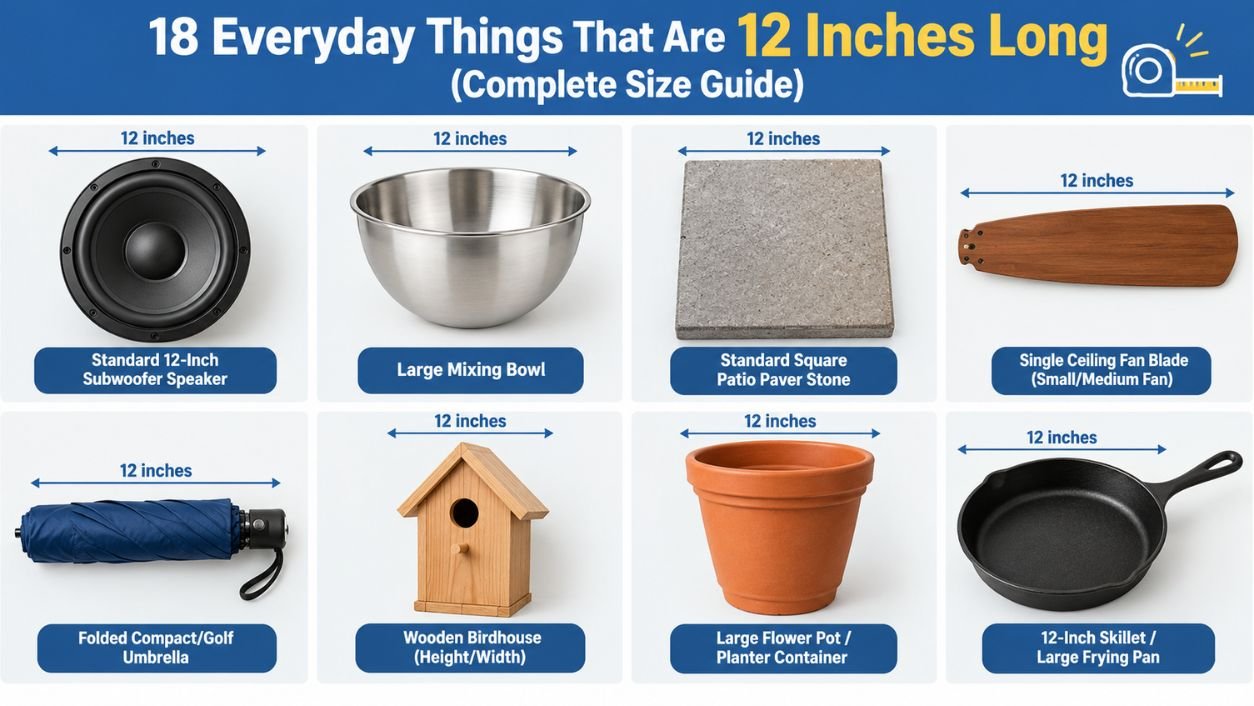
When you need to picture 12 inches, the easiest reference is 1 foot. Twelve inches equals exactly one foot, making it a familiar length for measuring furniture, tools, household items, crafts, and many other objects. This guide explains the size of 12 inches and provides practical everyday examples you can use to estimate this length.
What Is 12 Inches?
12 inches is exactly 1 foot, which equals 30.48 centimeters or 304.8 millimeters. An inch is a standard unit of length used widely in the United States and a few other countries, while centimeters and millimeters are common metric units.
The simplest way to visualize 12 inches is to think of a one-foot length. For example, a standard foot-long ruler measures 12 inches from end to end. However, you can also estimate this distance using familiar objects when a ruler is not available.
12 Inches Quick Conversion Table (Feet, CM, MM)
The table below gives the most useful conversions for 12 inches at a glance.
| Measurement | Equivalent |
|---|---|
| 12 inches | 1 foot |
| 12 inches | 30.48 centimeters |
| 12 inches | 304.8 millimeters |
| 12 inches | 0.3333 yards |
| 12 inches | 1,000 mils |
For everyday measuring, 12 inches = 1 foot is usually the easiest relationship to remember. If you work with metric measurements, 30.48 cm is the exact equivalent, while 30.5 cm is a convenient rounded value for quick estimates.
Why Visualizing 12 Inches Is Useful in Daily Life
Visualizing 12 inches gives you a practical sense of length when you do not have a ruler or measuring tape nearby. Since 12 inches is exactly 1 foot, it is one of the easiest standard lengths to estimate using familiar objects, hand spans, tools, and household items.
For students, a mental picture of 12 inches can make unit conversions easier. Instead of thinking only about numbers, you can connect 1 foot with a physical length. This is especially helpful when learning the relationship between inches, feet, centimeters, and millimeters.
For DIYers and tradespeople, estimating 12 inches can help with quick layout decisions. You might need to judge whether a piece of material is approximately one foot long, estimate spacing between components, or check whether an object will fit into a particular area before getting an exact measurement.
Shoppers can also benefit from visual references. Product dimensions are often listed in inches, and knowing what 12 inches looks like makes it easier to judge the approximate size of items such as storage containers, cookware, trays, mirrors, tools, and home accessories.
A useful mental reference is to picture 30.48 cm, because that is the exact metric equivalent of one foot. You can also think of a standard 12-inch ruler as a direct visual model. Once you become familiar with this length, comparing objects that are close to one foot becomes much easier.
Keep in mind that an object’s advertised size does not always mean its overall length. A 12-inch skillet, for example, usually refers to its cooking surface or pan diameter rather than the distance from the end of one handle to the other. Similarly, a 12-inch speaker refers to a particular speaker dimension rather than necessarily measuring 12 inches across every part of the finished enclosure.
18 Everyday Objects That Are 12 Inches Long
The following objects provide useful real-world references for understanding 12 inches, but their exact dimensions can vary by model, design, and manufacturer. Some examples are designed around a 12-inch specification, while others commonly have one dimension close to 12 inches. Always check the stated measurement when exact size matters.
Standard 12-Inch Subwoofer Speaker

A 12-inch subwoofer is a useful reference for this length because its speaker driver is commonly specified as 12 inches. The measurement generally refers to the nominal diameter of the woofer, not the complete outside dimensions of the speaker enclosure.
A 12-inch driver has a nominal diameter of 12 inches, or about 30.48 cm. The actual visible cone and the surrounding frame can have different measurements depending on the design.
Large Mixing Bowl
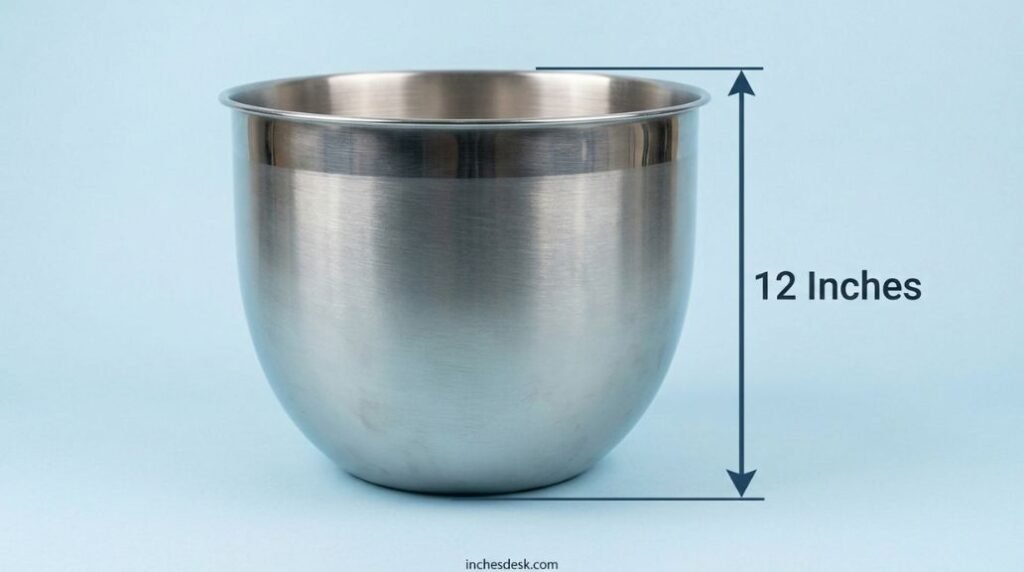
A large kitchen mixing bowl can have a diameter of approximately 12 inches, making it a familiar household reference for one foot. This size is common for bowls designed to hold larger quantities of ingredients for baking, cooking, or food preparation.
Because bowls are usually wider than they are tall, the 12-inch measurement normally refers to the diameter, not the bowl’s height. Different bowl shapes can therefore have noticeably different capacities even when their diameter is similar.
Standard Square Patio Paver Stone

A square patio paver measuring 12 × 12 inches provides one of the clearest physical examples of a 12-inch measurement. Its sides are each exactly 1 foot long, giving you a convenient reference for visualizing the distance.
A 12-inch square has an area of 144 square inches, or 1 square foot. This makes a one-foot paver particularly useful when estimating outdoor layouts, garden paths, and small patio sections.
Single Ceiling Fan Blade (Small/Medium Fan)

A single blade on a small or medium ceiling fan can measure around 12 inches from the blade’s inner mounting area toward its outer end. However, fan blade dimensions vary substantially between models.
It is important not to confuse the length of one blade with the fan’s total diameter. A fan’s advertised size usually describes the overall sweep or diameter of the rotating blades, which is much larger than the length of an individual blade.
Folded Compact/Golf Umbrella

Some compact or golf-style umbrellas can have a folded length close to 12 inches, particularly models designed for convenient storage. This makes a folded umbrella a useful everyday comparison for approximately one foot.
The exact closed length depends on the umbrella’s shaft, folding mechanism, canopy size, and construction. A compact umbrella may therefore be shorter or longer than 12 inches.
Wooden Birdhouse (Height/Width)

A small wooden birdhouse can have a height or width of approximately 12 inches. This makes it a practical visual reference because its box-like construction gives you a clear sense of a one-foot dimension.
However, birdhouses come in many shapes and sizes. A 12-inch measurement might describe the overall height, width, or another part of the structure, so the specific dimension should always be identified.
Large Flower Pot / Planter Container
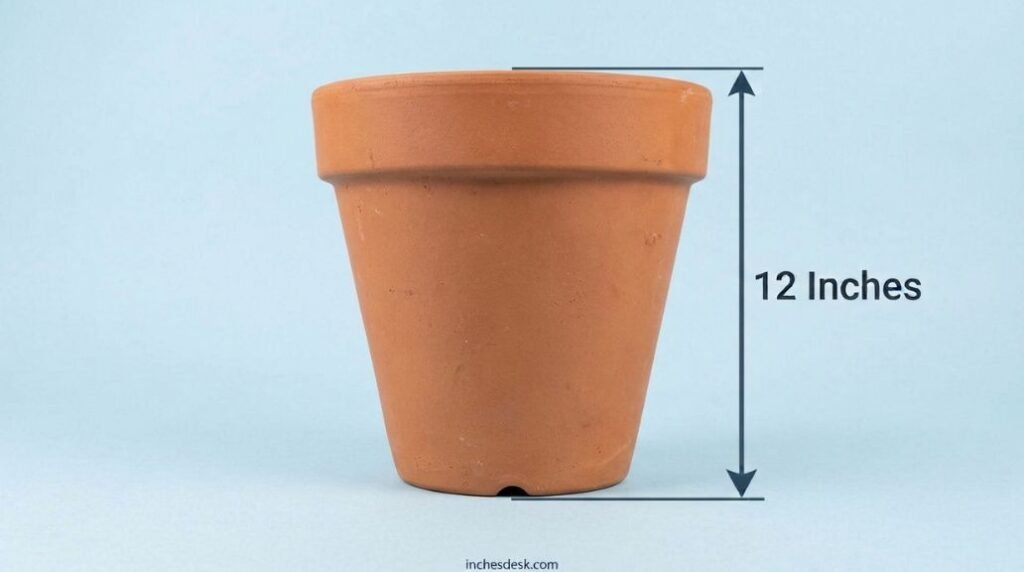
A large flower pot or planter may measure around 12 inches across its top opening. This size is common enough to serve as a useful reference when imagining one foot.
Planters are often wider at the top than at the bottom, so a pot described as 12 inches may have a smaller base diameter. Its height can also be significantly different from 12 inches.
12-Inch Skillet / Large Frying Pan
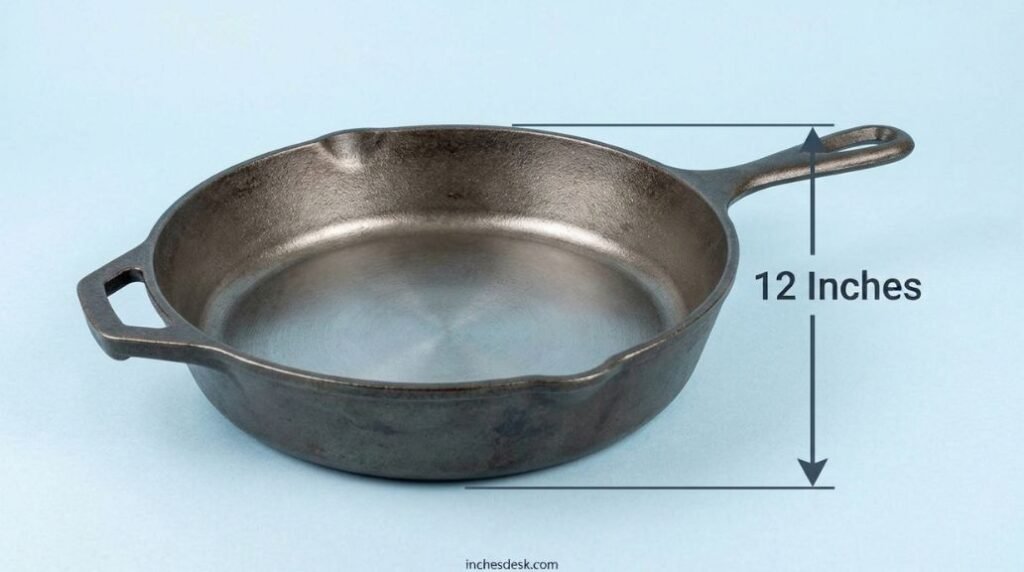
A 12-inch skillet is a familiar kitchen example of a 12-inch measurement. In most cases, the 12-inch specification refers to the approximate diameter across the top of the cooking vessel rather than its height or total length including the handle.
That means a 12-inch skillet can help you visualize a one-foot distance when viewed across its cooking surface. The overall pan length becomes considerably greater once the handle is included.
Medium Round Wall Mirror

A medium round wall mirror can have a diameter of approximately 12 inches, giving you another simple circular reference for one foot. Imagine a straight line running from one edge of the mirror through its center to the opposite edge: that line would be about 12 inches.
Mirror sizes vary widely, so a 12-inch mirror is best treated as an example rather than a universal standard.
Adult Tennis Racket Head Length

The head of an adult tennis racket can approach 12 inches in length, depending on the racket’s design and head shape. This can provide a useful sports-related reference for estimating a one-foot distance.
The complete racket is much longer than 12 inches because the handle and throat extend below the racket head. Therefore, the 12-inch comparison applies only to a particular part of the racket.
Medium Table Lamp Base
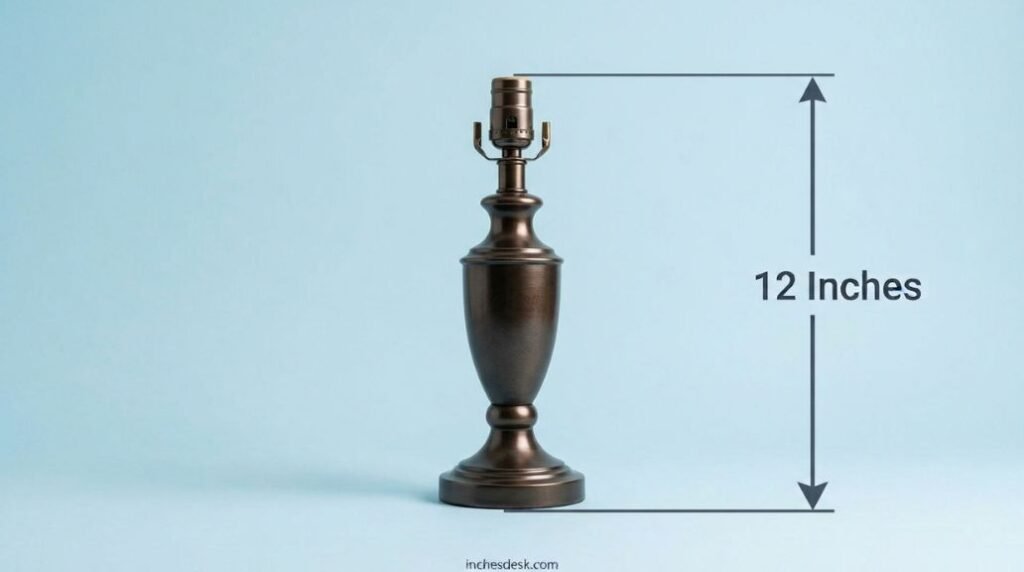
A medium table lamp can have a base measuring approximately 12 inches across. A broad circular or square base of this size gives you a practical way to picture one foot on a desk, table, or nightstand.
The lamp’s overall height will normally be much greater than 12 inches. When using it as a size reference, focus specifically on the base dimension rather than the complete lamp.
Long Chef’s Knife (Total Length with Handle)
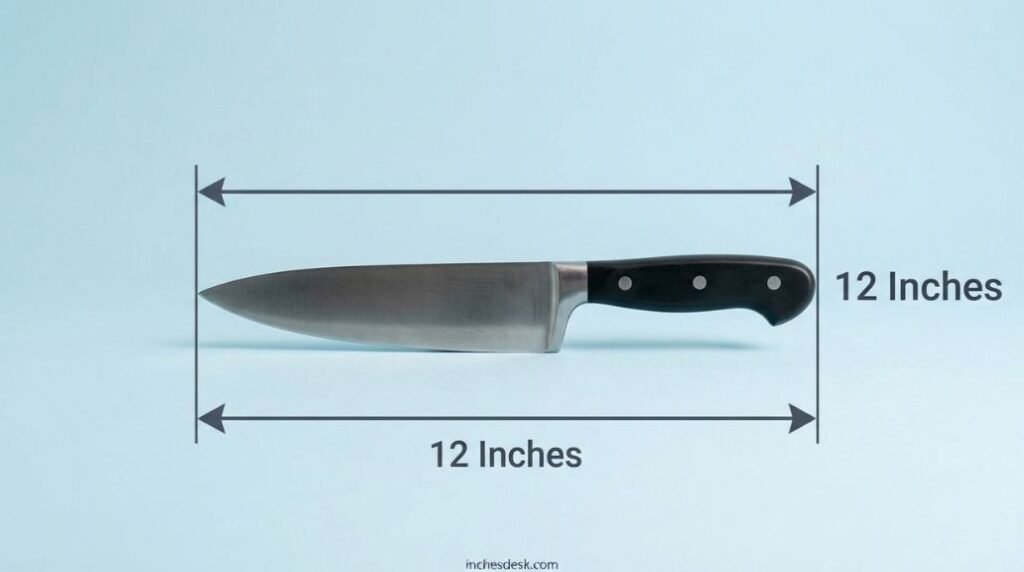
A long chef’s knife can have a total length close to 12 inches, measured from the tip of the blade to the end of the handle. This makes a large kitchen knife a convenient object for visualizing approximately one foot.
The blade itself is usually shorter than the complete knife. When comparing it with 12 inches, make sure you are considering the entire knife length, including both blade and handle.
Small Practice Guitar Amplifier

A compact practice guitar amplifier can have one dimension close to 12 inches, particularly its width or front-to-back measurement. Small amplifiers are designed to fit easily into bedrooms, practice spaces, or other compact areas.
The exact dimensions depend heavily on the amplifier model. A 12-inch width does not mean that every side of the amplifier measures one foot.
Rectangular Serving Tray
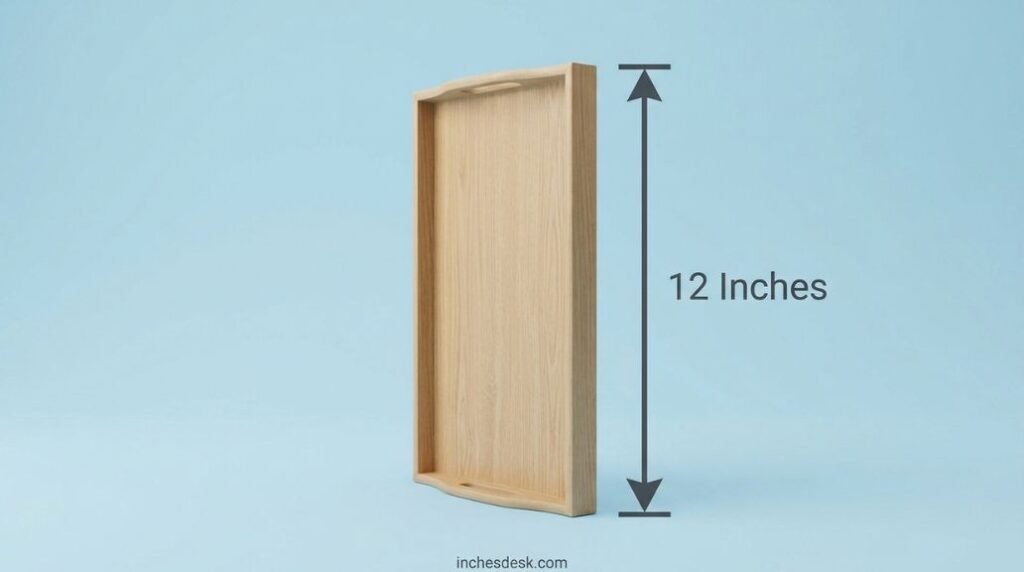
A rectangular serving tray may have a length of around 12 inches, providing a straightforward household example of a one-foot dimension. This size is practical for carrying drinks, snacks, small meals, or tableware.
Because trays come in many proportions, the 12-inch measurement usually describes the longer side. The shorter side can be considerably less than one foot.
Long Loaf / Cake Baking Pan

A long loaf or cake baking pan can have a length close to 12 inches, although common baking pans are available in several different sizes. A 12-inch pan therefore provides a useful kitchen reference for approximately one foot.
When checking a pan’s dimensions, distinguish between its outside dimensions and its internal baking area. Thick walls, handles, and angled sides can make these measurements different.
Adjustable Dumbbell Handle / Bar

Some adjustable dumbbell handles or short exercise bars can measure approximately 12 inches long. Their compact size makes them easy to compare with a one-foot length.
The exact handle length depends on the equipment design and how much space is provided for weight plates. A 12-inch handle should therefore be considered a size example rather than a universal dumbbell standard.
Senior Hockey Stick Blade
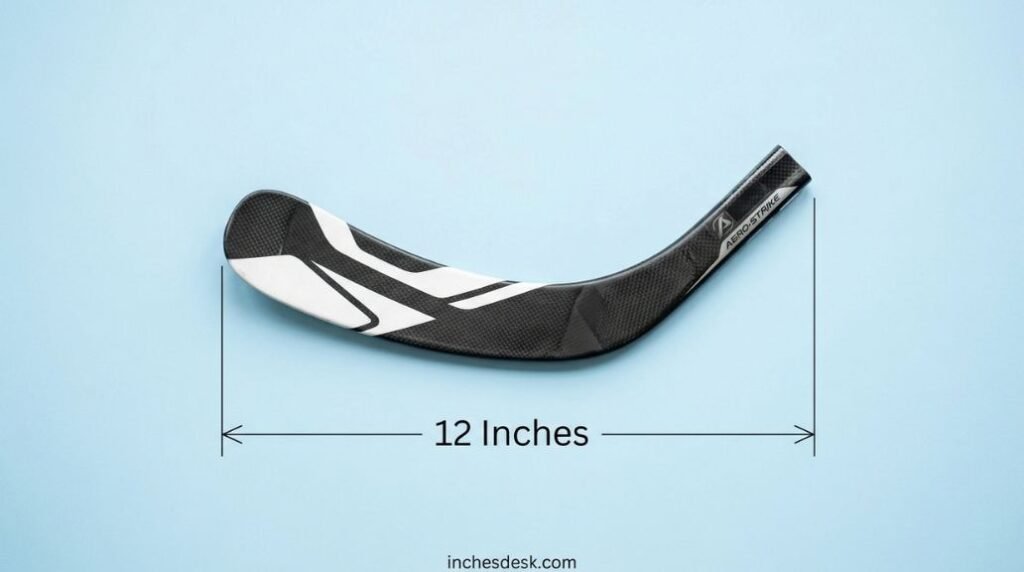
A hockey stick blade can have a length close to 12 inches, depending on the stick’s design and the specific measurement being used. This makes it a useful sports reference when visualizing a one-foot distance.
The blade’s curved shape can make visual estimation slightly harder than with a straight object. For a precise comparison, measure along the manufacturer’s specified dimension rather than following the curve.
Small Craft Cutting Mat / Quilting Ruler
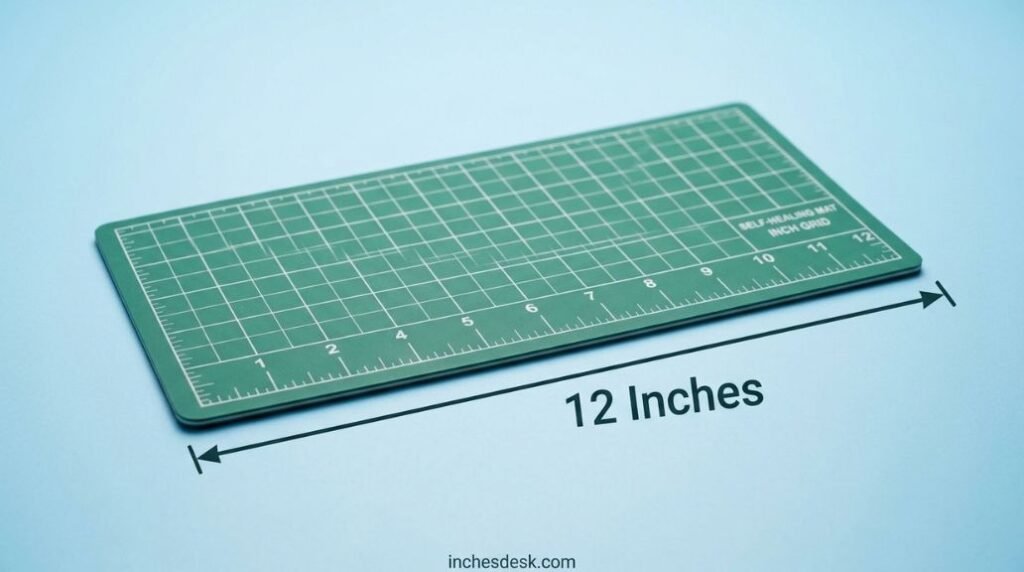
A small craft cutting mat or quilting ruler can be designed with a 12-inch dimension, making it one of the most direct references on this list. A 12-inch side or edge provides exactly one foot of length.
For crafters, this is particularly useful because 12 inches is also 30.48 cm. A 12-inch crafting surface can therefore serve as a convenient bridge between imperial and metric measurements when working on patterns, fabric, paper, or other materials.
How to Measure 12 Inches Without a Ruler (Handy Tricks)
You can estimate 12 inches without a ruler by using familiar one-foot objects, repeated hand measurements, or standard items with known dimensions. These methods are useful for quick checks, DIY projects, shopping decisions, and everyday situations, but they should not replace a precise measuring tool when accuracy matters.
Use a Standard Sheet of Paper as a Reference
A US Letter sheet measures 11 inches on its longer side, so it is almost exactly 12 inches. Place the paper lengthwise and mentally add about 1 inch to its longer edge. This gives you a quick approximation of one foot.
Remember that Letter paper is 8.5 × 11 inches, while A4 paper is approximately 8.27 × 11.69 inches, so the paper size matters.
Use Your Hand Span
For a rough estimate, measure the distance from the tip of your thumb to the tip of your little finger when your hand is fully stretched. Many adults have a hand span somewhere around several inches, but hand sizes vary considerably.
If your hand span is close to 6 inches, placing two spans end-to-end gives approximately 12 inches. Because everyone’s hands are different, this method is best for quick estimation rather than exact work.
Use a One-Foot Object You Already Know
The easiest method is to find an object specifically designed around a 12-inch measurement. A 12-inch ruler, one-foot measuring stick, or another clearly labeled 12-inch item provides a direct reference.
Once you have compared that object with other household items, you can build a mental picture of what one foot looks like.
Estimate Using Repeated Short Lengths
If you know the approximate length of another object, you can use it repeatedly. For example, if you have an object that is approximately 4 inches long, placing that length three times end-to-end gives:
4 inches × 3 = 12 inches
This technique works well for rough estimates, provided the reference object’s size is known reasonably well.
Use a 12-Inch Square as a Visual Reference
A 12 × 12-inch square has sides that are each exactly one foot long. You can visualize this as a one-foot-by-one-foot area on a tabletop, floor, piece of cardboard, or other flat surface.
This is particularly useful for DIY work because it gives you both a length and an area reference: 12 inches on each side equals 1 square foot.
For cutting, construction, furniture placement, or other tasks where a small error matters, confirm your estimate with a measuring tape or ruler before making the final cut.
12 Inches vs. Other Common Measurements (1 Foot, 30 CM, 15 Inches)
12 inches equals exactly 1 foot and 30.48 centimeters, while 30 centimeters is slightly shorter at about 11.81 inches. Compared with 15 inches, 12 inches is 3 inches shorter, or 80% of the 15-inch length.
| Measurement | Equivalent to 12 Inches | Difference |
|---|---|---|
| 12 inches | 12 inches | Exact reference |
| 1 foot | 12 inches | Exact |
| 30 cm | 11.81 inches | 0.19 inch shorter |
| 30.48 cm | 12 inches | Exact |
| 304.8 mm | 12 inches | Exact |
| 15 inches | 15 inches | 3 inches longer |
12 Inches vs. 1 Foot
There is no size difference between 12 inches and 1 foot. They are two names for exactly the same length.
The relationship is:
1 foot = 12 inches
This is the simplest conversion to remember when working with imperial measurements. If something is 12 inches long, it is exactly one foot long.
12 Inches vs. 30 CM
Thirty centimeters and 12 inches are very close, but they are not exactly equal.
The exact relationship is:
12 inches = 30.48 cm
Therefore:
30 cm = 11.81 inches
The difference is 0.48 cm, or about 4.8 millimeters. For casual visual estimates, 30 cm can feel almost identical to one foot, but the distinction matters when precise measurements are required.
12 Inches vs. 15 Inches
A 15-inch length is 3 inches longer than 12 inches. In relative terms, 12 inches represents 80% of 15 inches.
You can calculate the difference simply:
15 inches − 12 inches = 3 inches
So if you are comparing two objects, one measuring 12 inches and another measuring 15 inches, the 15-inch object extends an additional quarter of a foot beyond the 12-inch object.
Common Mistakes When Estimating 12-Inch Objects
Estimating 12 inches can be surprisingly easy to get wrong because an object’s advertised size does not always describe its total length. Understanding what the measurement actually refers to helps prevent mistakes when comparing everyday objects.
One common mistake is confusing diameter with length. A 12-inch skillet, for example, generally refers to the pan’s diameter across the top, not the total distance from the end of its handle to the opposite edge. The same principle applies to round mirrors, bowls, planters, and other circular objects.
Another mistake is assuming that every object with a “12-inch” label measures 12 inches from end to end. A 12-inch subwoofer, for instance, uses a nominal driver-size measurement. The complete speaker cabinet can have different dimensions.
Paper size can also cause confusion. A US Letter sheet is 11 inches long, not 12 inches, while A4 paper is approximately 11.69 inches long. These can look close to one foot, but neither is exactly 12 inches.
Hand-based estimates are another source of error. Your thumb-to-little-finger span, palm width, or hand length may be useful for a rough comparison, but these measurements vary from person to person. A method that works reasonably well for one person may produce a noticeably different estimate for someone else.
It is also easy to confuse 30 cm with 12 inches. They are close, but not identical. Twelve inches equals 30.48 cm, so 30 cm is approximately 0.48 cm shorter.
FAQs
How long is 12 inches exactly?
12 inches is exactly 1 foot, 30.48 centimeters, or 304.8 millimeters. It is a standard imperial measurement commonly used for household items, tools, materials, and dimensions.
Is 12 inches the same as 1 foot?
Yes. 12 inches equals exactly 1 foot. The conversion is fixed, so an object measuring 12 inches in length is precisely one foot long.
Is 12 inches the same as 30 cm?
No. 12 inches equals 30.48 cm, while 30 cm equals approximately 11.81 inches. The two measurements are close enough for rough visualization but should not be treated as identical for precise work.
What does 12 inches look like?
Twelve inches looks like a one-foot length. A standard 12-inch ruler is a direct reference, while a 12-inch square provides a useful one-foot visual reference on each side. Several everyday objects can also have one dimension close to 12 inches.
Is 15 inches much longer than 12 inches?
15 inches is 3 inches longer than 12 inches. Since 12 inches equals one foot, 15 inches is one foot plus another 3 inches.
Can I measure 12 inches without a ruler?
Yes, you can make a rough estimate using familiar objects, hand spans, or a known one-foot reference. For example, three lengths of approximately 4 inches equal 12 inches. However, use a proper measuring tool when an accurate measurement is required.
Final Thoughts
12 inches is exactly 1 foot, 30.48 centimeters, and 304.8 millimeters, making it a particularly easy length to understand and visualize. From a 12-inch skillet or square paver to a long chef’s knife or craft mat, familiar objects can provide useful real-world references for estimating one foot.
The most important point is to identify which dimension an object’s stated size represents. A 12-inch skillet usually refers to its diameter, while a 12-inch knife refers to its total length in the example above. Object dimensions can also vary by manufacturer, design, and intended use.
For quick everyday estimates, comparing an object with a one-foot reference can be helpful. For DIY projects, cutting materials, installation work, or any task where a small difference matters, confirm the measurement with a ruler or measuring tape.
