
How Long Is 36 Inches?
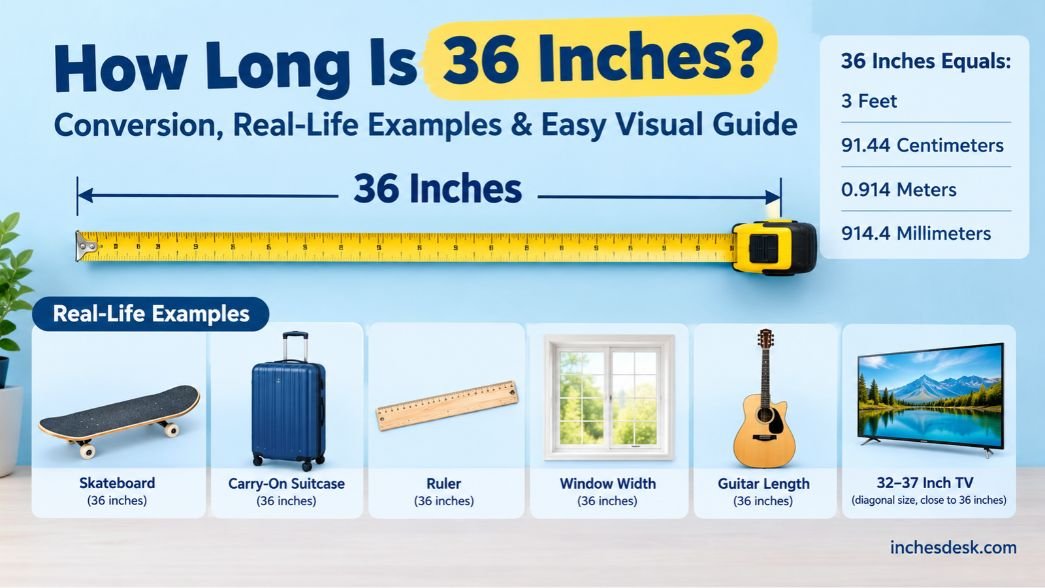
36 inches equals exactly 3 feet or 1 yard. In the metric system, the same length is 91.44 centimeters or 914.4 millimeters. These conversions make it easy to understand 36 inches when working with products, construction materials, or measurements listed in different units.
The inch is part of the customary measurement system used in the United States, while centimeters and meters are widely used internationally. Knowing how to convert between these units helps when comparing product dimensions, reading technical specifications, and planning DIY projects.
36 Inches Conversion Table
| Measurement Unit | Equivalent to 36 Inches |
| Inches | 36 inches |
| Feet | 3 feet (3 ft) |
| Yards | 1 yard (1 yd) |
| Centimeters | 91.44 cm |
| Millimeters | 914.4 mm |
| Meters | 0.9144 m |
| Kilometers | 0.0009144 km |
| Miles | 0.000568 miles |
How to Convert 36 Inches Into Other Units
You can convert 36 inches into other units by multiplying or dividing by the appropriate conversion factor.
- Inches to feet: Divide the number of inches by 12.
- Inches to yards: Divide the number of inches by 36.
- Inches to centimeters: Multiply the number of inches by 2.54.
- Inches to millimeters: Multiply the number of inches by 25.4.
- Inches to meters: Multiply the number of inches by 0.0254.
Here are the calculations for 36 inches:
1. Inches to feet
36 ÷ 12 = 3 feet
2. Inches to yards
36 ÷ 36 = 1 yard
3. Inches to centimeters
36 × 2.54 = 91.44 centimeters
4. Inches to millimeters
36 × 25.4 = 914.4 millimeters
5. Inches to meters
36 × 0.0254 = 0.9144 meters
Is 36 Inches the Same as 3 Feet?
Yes, 36 inches is exactly equal to 3 feet because every foot contains 12 inches. Multiplying 12 inches by 3 gives 36 inches.
This is also the same as one yard, since a yard contains 3 feet. For example, a piece of material measuring 36 inches long can also be described as 3 feet or 1 yard without changing its actual length.
What Does 36 Inches Look Like?
36 inches is about 91.4 centimeters, making it just over 3 feet long. One easy way to picture this length is to imagine three standard 12-inch rulers placed end to end. You can also use familiar objects, body-based estimates, or a straight measuring reference to approximate the distance when a tape measure is unavailable.
Use Three 12-Inch Rulers
A standard 12-inch ruler is one foot long. Placing three rulers in a straight line, with each ruler starting where the previous one ends, creates a total length of 36 inches.
The calculation is simple:
- First ruler: 12 inches
- Second ruler: 12 inches
- Third ruler: 12 inches
- Total: 12 + 12 + 12 = 36 inches
This is a useful method for students checking measurements, DIYers estimating material lengths, and shoppers comparing the dimensions of a product. Make sure the rulers touch end to end without overlapping or leaving gaps, or the estimate will be inaccurate.
Estimate the Length Using a Yardstick
A standard yardstick measures exactly 36 inches, or 1 yard. If you have one available, it provides a direct reference for checking whether an object is approximately 3 feet long.
For example, you can place a yardstick beside a shelf, wooden board, or workbench to estimate its length. If the object extends beyond the yardstick, the extra portion can be measured separately or estimated using another known reference.
Use a Familiar Three-Foot Reference
You can also visualize 36 inches by thinking of an object or space that measures approximately 3 feet. A small work surface, a section of building material, or the height of a suitable household item may provide a helpful mental reference.
However, familiar objects are not always manufactured to exact dimensions. A table described as three feet long may have slightly different actual measurements, and the visible length of a product may differ from its advertised nominal size.
Measure With a String or Cord
If you do not have a ruler or tape measure, a piece of string can help you transfer a known length. First, mark a 36-inch length using a reliable reference, such as three 12-inch rulers. Then use the string to compare that distance with an object that needs measuring.
If you have no reference at all, a string can still help compare two objects with each other, but it cannot establish an exact 36-inch measurement on its own.
12 Things That Are 36 Inches Long
1. Tennis Net at the Center

A tennis net measures 36 inches high at the posts, but its height at the center is lower. According to standard tennis rules, the net is 36 inches high at each end and 3 feet (36 inches) at the posts, while the center is held at 36 inches? More precisely, the regulation net height is 3 feet at the center and 3 feet 6 inches at the posts?
For a reliable comparison, the key measurement is the standard tennis net’s 36-inch height at the center. This makes it a useful example of a three-foot measurement in sports. The net stretches across the court, dividing it into two playing areas, and its height is controlled to keep play consistent.
2. Pickleball Net at the Sidelines

A regulation pickleball net is 36 inches high at the sidelines and 34 inches high at the center. The two-inch difference creates a slight dip in the middle, allowing the net to follow the standard dimensions used for competitive play.
This is a practical example of a measurement that changes slightly depending on where it is taken. If you are setting up a pickleball court, measure the net at both the center and the sides rather than assuming the height is uniform throughout.
3. Wooden Dowel Rod

A 36-inch wooden dowel rod is a long, round piece of wood commonly used for crafts, furniture repairs, model building, and DIY projects. It is exactly 3 feet long and can be cut into smaller sections to suit different designs.
Dowel rods are available in different diameters, so length alone does not tell you how thick or strong a rod will be. Before purchasing one, check both its length and diameter. For furniture joints or load-bearing applications, choose a dowel material and size appropriate for the forces it must handle.
4. Threaded Steel Rod

A 36-inch threaded steel rod is a metal fastener with threads running along all or most of its length. It is commonly used in construction, machinery, mounting systems, and repair projects where components need to be secured with nuts and washers.
Because 36 inches equals 3 feet, this rod length is convenient for installations requiring a longer fastening point than a standard bolt provides. Threaded rods come in different diameters, thread pitches, and materials, so confirm those specifications before buying one. A rod’s overall length does not determine its load capacity by itself.
5. Aluminum Angle Bar

A 36-inch aluminum angle bar is an L-shaped metal section with two sides meeting at a right angle. It is used for framing, shelving, edge protection, light fabrication, and reinforcing corners in suitable projects.
At 3 feet long, it can span a useful distance while remaining relatively easy to handle. Aluminum angle bars are sold in various leg widths and thicknesses. These dimensions affect stiffness and strength, so select a profile based on the intended use rather than length alone.
6. 36-Inch Bolt Cutters

36-inch bolt cutters are heavy-duty hand tools designed to cut suitable metal items, such as chains, wire, and certain bolts. Their long handles provide leverage, helping the jaws apply substantial cutting force.
A tool measuring 36 inches from end to end is about as long as a yardstick. This extended length can be useful for demanding cutting jobs, but it also makes the tool heavier and less convenient in confined spaces. Always check the manufacturer’s rated cutting capacity and use appropriate eye and hand protection.
7. 36-Inch Pipe Wrench

A 36-inch pipe wrench is a long-handled plumbing tool used to grip and turn suitable threaded pipes and fittings. Its adjustable toothed jaw helps hold round metal surfaces while the handle provides leverage.
The long body makes it useful for certain large-pipe applications, but it is not intended for every plumbing job. A 36-inch wrench may be difficult to maneuver in tight spaces, and using it on an unsuitable fitting can damage the surface. Choose the wrench size according to the pipe and the manufacturer’s guidance.
8. 36-Inch Pry Bar (Wrecking Bar)

A 36-inch pry bar, also called a wrecking bar, is a long steel tool used for levering, separating materials, and removing certain nails or components. Its length gives the user more leverage than a short pry bar when working on appropriate tasks.
This tool is commonly associated with renovation, demolition, and construction. The curved end or claw may help lift boards or pull nails, depending on the design. At three feet long, it is easy to compare with a standard yardstick, but its actual working reach depends on the shape of its ends.
9. 36-Inch Traffic Cone
A 36-inch traffic cone stands 3 feet tall and is commonly used for roadwork, parking control, construction zones, and temporary hazard marking. Its bright color and reflective bands, when fitted, help improve visibility.
Compared with a small indoor marker cone, a three-foot cone is more noticeable from a distance and can be easier for drivers and pedestrians to see. Actual cone dimensions vary by model, so check the product specifications if a particular height is required for a worksite or safety plan.
10. 36-Inch Piano Hinge
A 36-inch piano hinge is a long, continuous hinge designed to support a lid, panel, door, or other hinged component along much of its edge. It is made from interlocking knuckles connected by a central pin, allowing the attached parts to pivot.
This hinge length is useful for projects such as storage boxes, cabinets, access panels, and work surfaces. Its continuous design distributes the attachment points along the hinge, but the suitable load depends on the hinge material, thickness, mounting method, and the object being supported.
11. 36-Inch Drawer Slide
A 36-inch drawer slide is a long metal rail system used to support and guide a compatible drawer as it opens and closes. Slides of this length may be used in deep storage units, workshop cabinets, and specialized furniture.
The stated length generally refers to the slide’s nominal size, not necessarily the distance the drawer travels when opened. Before purchasing, confirm the cabinet depth, mounting style, required clearance, and load rating. A slide that is too long for the cabinet may not fit correctly, even if its length matches the drawer.
12. 36-Inch Steel Straightedge
A 36-inch steel straightedge is a rigid, straight metal bar used to check alignment, guide marking, and assess straightness across longer surfaces. At 3 feet long, it can span areas that would be difficult to check with a short ruler.
Straightedges are useful in workshops, woodworking, fabrication, and layout tasks. However, a straightedge is not automatically a precision measuring instrument. If you need to determine an exact dimension, use a calibrated measuring tool; if you need to check flatness or alignment, choose a straightedge with an appropriate accuracy specification.
How Does 36 Inches Compare To Other Measurements?
36 inches equals 3 feet or 1 yard, and it is 8.56 centimeters shorter than 1 meter. These comparisons make it easier to visualize the length and switch between customary and metric measurements when working with tools, materials, or everyday objects.
| Measurement | Equivalent Length | Difference Compared With 36 Inches |
| 12 inches | 1 foot | 24 inches shorter |
| 18 inches | 1.5 feet | 18 inches shorter |
| 24 inches | 2 feet | 12 inches shorter |
| 36 inches | 3 feet / 1 yard | Reference length |
| 48 inches | 4 feet | 12 inches longer |
| 60 inches | 5 feet | 24 inches longer |
| 72 inches | 6 feet | 36 inches longer |
| 1 meter | 39.37 inches | About 3.37 inches longer |
36 Inches Compared With 1 Meter
One meter is approximately 39.37 inches, while 36 inches equals 91.44 centimeters. Therefore, 36 inches is slightly shorter than one meter by approximately 8.56 centimeters, or 3.37 inches.
This difference matters when converting dimensions for furniture, building materials, and imported products. A 36-inch component should not be treated as a one-meter component when the fit needs to be exact.
36 Inches Compared With 2 Feet and 4 Feet
A 36-inch length sits directly between 2 feet and 4 feet.
- 2 feet = 24 inches, which is 12 inches shorter than 36 inches.
- 3 feet = 36 inches, the exact reference length.
- 4 feet = 48 inches, which is 12 inches longer than 36 inches.
This comparison is helpful when estimating boards, shelves, rails, and other materials. Each foot represents another 12 inches, so adding or subtracting one foot makes the comparison straightforward.
36 Inches in Everyday Use
In practical settings, 36 inches is a convenient reference because it equals one yard. A yardstick, three one-foot rulers, or a correctly measured piece of material can help you visualize this distance.
For shopping and DIY projects, distinguish between a product’s stated length and its other dimensions. A 36-inch drawer slide, for example, has a specified rail length, while a 36-inch traffic cone refers to its height. The same number can describe different dimensions depending on the object.
Why Is 36 Inches Such A Common Measurement?
36 inches is a common measurement because it equals exactly 3 feet or 1 yard, two convenient units for describing everyday lengths. This makes it useful across construction, manufacturing, sports, woodworking, and household projects. Manufacturers can produce items in standard lengths, while buyers and workers can estimate, compare, and communicate dimensions without complicated conversions.
1. It Simplifies Construction and DIY Projects
Three feet is a practical length for many building and repair tasks. Workers can use it as a reference when cutting materials, planning layouts, or checking the dimensions of components. Since 36 inches equals one yard, the measurement is also easy to transfer between imperial units.
For example, a DIYer planning a small shelving project might need a 36-inch wooden board. Instead of converting the length into a more complicated number, they can work directly with a three-foot measurement.
2. It Works Well for Standardized Tools and Hardware
Many tools and hardware products are available in 36-inch versions because a three-foot length can provide useful reach and leverage. Examples include long pry bars, pipe wrenches, steel straightedges, and certain continuous hinges.
A longer tool can help users reach farther or apply more leverage, depending on its design. Likewise, a 36-inch straightedge can span a larger surface than a short ruler, making it useful for layout and alignment work.
3. It Makes Length Calculations Easier
The relationship between inches, feet, and yards makes 36 inches especially easy to calculate with.
- 12 inches = 1 foot
- 36 inches = 3 feet
- 36 inches = 1 yard
- 72 inches = 2 yards
These straightforward relationships are useful in school mathematics, material estimation, and workshop planning. For example, if a project requires three separate pieces that are each 36 inches long, the total required length is 108 inches, or 9 feet, before allowing for cutting waste.
4. It Provides a Useful Reference for Sports and Recreation
Sports equipment often follows standardized dimensions so that courts, playing areas, and equipment remain consistent. Tennis and pickleball provide useful examples of three-foot measurements, although the exact measurement depends on the equipment and where it is taken.
For instance, a regulation pickleball net measures 36 inches at the sidelines and 34 inches at the center. Knowing these dimensions helps players and court installers check whether a net has been set up correctly.
5. It Bridges Imperial and Metric Measurements
Although 36 inches is a whole number in the imperial system, its metric equivalent is 91.44 centimeters. This conversion is useful when working with international product listings, technical drawings, or specifications that use centimeters and millimeters.
For example, someone buying a 36-inch component from a supplier that lists metric dimensions can look for a product measuring 914.4 millimeters long. If the supplier offers only rounded metric sizes, the buyer should check the tolerance to ensure the component will fit.
FAQs
Is 36 Inches Exactly 3 Feet?
Yes, 36 inches is exactly 3 feet. One foot contains 12 inches, so multiplying 12 by 3 gives 36 inches. This conversion is exact and does not require rounding.
Is 36 Inches the Same as 1 Yard?
Yes, 36 inches equals exactly 1 yard. A yard contains 3 feet, and each foot contains 12 inches. Therefore, 3 × 12 = 36 inches.
How Many Centimeters Are in 36 Inches?
There are exactly 91.44 centimeters in 36 inches. To calculate the conversion, multiply 36 by 2.54, because one inch equals exactly 2.54 centimeters.
Is 36 Inches Almost 1 Meter?
Yes, 36 inches is close to 1 meter, but it is shorter. A meter equals approximately 39.37 inches, so 36 inches is about 3.37 inches shorter, or 8.56 centimeters less than 1 meter.
How Can I Measure 36 Inches Without a Tape Measure?
You can estimate 36 inches using three standard 12-inch rulers placed end to end or a standard 36-inch yardstick. If neither is available, a previously measured piece of string can serve as a reference. For precise construction, cutting, or installation work, verify the length with a suitable measuring tool.
What Common Objects Are 36 Inches Long?
Examples of products available in 36-inch lengths include wooden dowel rods, threaded steel rods, aluminum angle bars, pry bars, pipe wrenches, piano hinges, drawer slides, and steel straightedges. A standard yardstick also measures 36 inches. Check individual product specifications because not every version of these items is manufactured in this length.
Is 36 Inches a Good Length for a DIY Project?
It can be, depending on the project. A 36-inch board, rail, or metal bar may suit shelving, furniture repairs, and workshop layouts. Before buying materials, confirm the required length, width, thickness, and other relevant dimensions. For projects involving cuts, allow extra material for trimming and potential errors.
Conclusion
36 inches equals 3 feet, 1 yard, 91.44 centimeters, or 914.4 millimeters. Its convenient relationship to feet and yards makes it a familiar measurement for construction materials, workshop tools, sports equipment, and everyday household projects.
You can visualize this length by placing three 12-inch rulers end to end or using a standard yardstick. Real-world examples, such as 36-inch dowel rods, pry bars, and straightedges, provide additional ways to recognize the measurement.
